Museum
CastleGroß Pankow-Wolfshagen
Wolfshagen Castle
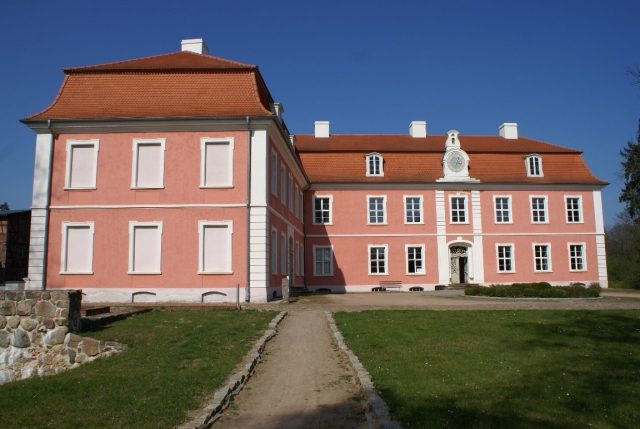
Wolfshagen Castle is located in the eponymous district of the municipality of Groß Pankow, about eight kilometers west of Pritzwalk in northwestern Brandenburg. The castle is situated on the Stepenitz river, about four kilometers off the B 189. Today, it serves as a museum and is used for cultural events such as concerts, art exhibitions, lectures, conferences, and readings.
In 1147, the Gans Edlen Herren zu Putlitz, originally from the Altmark region, brought the Stepenitz river area under their rule. They erected a moated castle, remnants of whose vaults are still preserved in the west wing of the current castle. Around 1590, the castle was expanded into a four-winged Renaissance castle with ramparts, which, however, fell into disrepair after the Thirty Years' War.
Between 1771 and 1787, Albrecht Gottlob Gans Edler Herr zu Putlitz had a late Baroque two-wing complex built on the existing foundations. In addition to painted canvas wallpapers in some rooms, fixed, partly illusionistic wall and ceiling paintings were created. In the so-called Second Prince's Room, grisaille paintings with scenes based on popular copper engravings by Daniel Chodowiecki were created in the supraporte fields above the doors and wall cabinets, which is likely unique in the art history of the Mark Brandenburg. Other motifs, and especially the decoration of the garden hall with allegorical and figurative motifs depicting Frederick the Great as a military commander, elevate Wolfshagen to the rank of one of Prussia's earliest monuments to Frederick. However, most of these paintings were destroyed in 1952.
In the 1850s, Peter Joseph Lenné created a landscape park on both sides of the Stepenitz, and Hans Albrecht zu Putlitz had the castle's facade redesigned in the Neo-Baroque style in 1911, and a balcony supported by Doric columns added in front of the castle portal.
After the Gans zu Putlitz family was forced to leave the castle in October 1945, it was plundered by the Red Army. In 1952, the castle was converted into a school, during which the Baroque canvas wallpapers, the two internal staircases, and the still-preserved manorial and family archive were destroyed. In the 1960s, the 18th and 19th-century ovens and fireplaces were removed, and in 1969, the balcony was demolished.
Although the small 16th-century castle chapel was listed as a historical monument in 1975, it was demolished in 1982.
Even before the school use was abandoned in 1998, the Förderverein Schlossmuseum Wolfshagen e.V. (Friends of Wolfshagen Castle Museum) was founded in 1995, which today operates the museum housed in the castle. This museum was able to open after several years of renovation, partly with the help of the German Foundation for Monument Protection. Since 2005, the "Stiftung Schlossmuseum Wolfshagen" (Wolfshagen Castle Museum Foundation), established by Bernhard von Barsewisch, has contributed to the preservation of the castle.
Castle Museum+
On the ground floor, furnishings and everyday objects, as well as hunting trophies and ancestral portraits – especially of the families von Winterfeld, von Saldern, von Platen, and von Königsmarck – and Hohenzollern portraits are displayed. Some of these come from Wolfshagen Castle itself, and others from further manor houses of the Gans zu Putlitz family or other Märkisch noble residences. In the chapel room, which was redesigned and consecrated in 2002, essential parts of the original furnishings saved after the demolition of the old castle church – including the pew ends from 1572, coats of arms, ceremonial helmets, and the baptismal font – were integrated. The upper floor of the building houses Bernhard von Barsewisch's porcelain collection. It is Europe's most significant collection of utilitarian tableware and Central European blue painting from over 50 European manufactories, comprising pieces from four centuries. In the cellar rooms, an GDR classroom has been set up to commemorate the building's long-standing use as a school. A permanent exhibition illustrates the history of the almost 3000-year-old so-called King's Grave of Seddin, located near Seddin. Copies of the grave goods discovered in 1899 are on display, the originals of which are in the Märkisches Museum in Berlin.
Take Mobile History with you
You are reading this text for free. Premium adds what matters on the road: descriptions read aloud, sites found through your camera, whole regions taken offline.
- Every description, including the ~17,700 Premium sites
- Audio guide: have descriptions read to you on location
- AR finder: see sites through your camera, with distance and bearing
- Unlimited saved sites
14 days free, then from €2.99 a month. Cancel anytime.
Source: Wikipedia · Licence: CC BY-SA 4.0 · Image: Roland Neubert, Halle (Saale)
This description draws on the facts documented in the linked Wikipedia article; Wikipedia content is licensed under CC BY-SA 4.0. Wording and editing: Mobile History.
Location: 53.1490, 12.0093