Cultural Events
CastleWolfsegg am Hausruck
Wolfsegg Castle
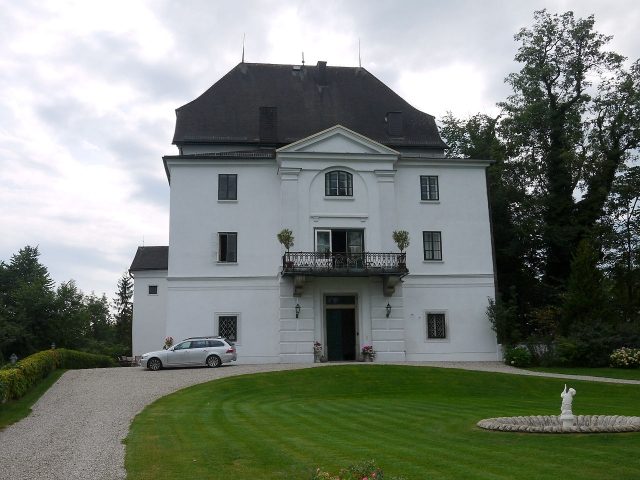
Wolfsegg Castle is located in the Hausruck region in the municipality of Wolfsegg in the Vöcklabruck district.
Wolfsegg was formerly known as "Hauruck" after the Hausrucker family. In 1120, Hadmar I von Hausruck is mentioned in a document. His son Heinrich de Husrucke is named in a document from 1135. The Wolfsecker family succeeded them. The first of these was Aribo, followed by Chunradus de Wolvesekke, mentioned in a document in 1191, who was a ministerialis of the Margraves of Steyr. Other Wolfseckers were Helwiga (1185), Adelhaid (1185), Hadmar II (1220), Christina (1260), Otto (1277), Ortlof (1277), and Christian. The last male descendant of this family and feudal lord of the Archbishops of Salzburg, Christian von Wolfsegg, died in 1321. He had sold his share of the property to Duke Albrecht I of Austria in 1291. The ownership rights were already divided at that time: one half belonged to his sister, who brought it into her marriage with Albero von Pollheim as a dowry. This share was given as a fief to the Weißbergers; the other half fell to the Archbishopric of Salzburg, which enfeoffed the Schaunbergers with it in 1321. In 1326, Dietrich von Weißenberg sold his share to Duke Friedrich the Fair, although he had "sent it up" to the Archbishop of Salzburg in 1321 and received it back as a Schaunberger fief. This feudal dispute was settled by an arbitration court in 1328. In 1369, Wolfsegg finally came under the rule of the Habsburgs, who had it administered by caretakers, unless it was pledged. From 1405–1410, Wolfsegg was pledged to Reinprecht von Wallsee.
In 1455, King Ladislaus enfeoffed Jörg Perkheimer with the Wolfsegg property. This enfeoffment was converted by Duke Albrecht VI into a Perkheimer pledge. In 1488, Kaspar Perkheim was commissioned by Emperor Friedrich III to suppress the rampant salt smuggling. However, as he did not adequately comply with this order, his pledge was dissolved by the Emperor. Hilprand Jörger followed as caretaker. Emperor Maximilian I pledged Wolfsegg in 1500 to Caspar von Retschan († 1545), who was later succeeded by Johann von Senftenau. Cosmas Gienger von und zu von Grienpichel came into the pledged possession of the castle in 1566, which later became his property. After the death of Hans Adam Gienger († 1621), his daughter Ursula inherited Wolfsegg.
Wolfsegg was also affected by wartime events. On November 19, 1626, the castle, occupied by peasants, was stormed by General von Pappenheim. In 1632, the castle was stormed and severely damaged during the Upper Austrian Peasant Uprisings. Christoph von Khevenhüller drove the peasants out again.
The castle had already been converted into a palace during the time of the Giengers. She brought the property as a dowry into her marriage with Josef Pfliegl (Pflügl) von und zu Goldenstein, Bavarian chamberlain and vicedominus. Through the marriage of Johann Baptist Pfliegl's daughter, Eleonore Isabella Anna, Wolfsegg came to Mathias Castner von Sigmundslust. After his death, his widow married Count Karl von Tige in 1721 in her second marriage. He managed the property so poorly that after his death, bankruptcy proceedings had to be initiated. State Minister Thaddäus Adam von Reischach acquired the lordship of Wolfsegg in 1797. In 1818, Ehrenreich Ritter von Schinnern was the owner, and in 1819, it passed to the eleven Querer siblings. This division did not benefit the castle and the property, so Wolfsegg had to be placed under forced administration.
In 1835, Franz von Saint Julien bought the lordship, and the Saint Julien-Wallsee family has owned the property to this day.
Wolfsegg Castle Today+
The castle is situated on a hill above the market town of Wolfsegg. It is a successor building from the 16th/17th century to an earlier existing castle, the remains of which are still recognizable. Two deep moats separated the castle from the foreland. Of these, only wide depressions remain. Above the castle entrance, the year MDXCIX is inscribed, which presumably marks the conversion of the castle into a palace. In the three-story main wing, an irregular quadrilateral building, remains of the old castle wall are still present. In the knight's hall, a magnificent, six-columned doorframe from the end of the 17th century can be seen. Two two-story corridor wings lead from the main wing to the rear and connect to the three-story parallel wing of the main wing. All these building parts enclose an inner courtyard. Opposite the castle stands a horseshoe-shaped farmstead.
The castle chapel from 1746 is equipped with barrel vaults and stucco. It is dedicated to Saint Anne. The altarpiece from 1746 is by Bartolomeo Altomonte.
The castle is surrounded by a park with a glasshouse (palm house) from the early 19th century and a simple wall. The park was laid out or described in 1721.
Wolfsegg Castle is the setting for the 1986 novel "Extinction. A Decomposition" by the Austrian writer Thomas Bernhard (1931–1989). In addition, the novel "The Italian" has also been adapted into a film here.
Take Mobile History with you
You are reading this text for free. Premium adds what matters on the road: descriptions read aloud, sites found through your camera, whole regions taken offline.
- Every description, including the ~17,700 Premium sites
- Audio guide: have descriptions read to you on location
- AR finder: see sites through your camera, with distance and bearing
- Unlimited saved sites
14 days free, then from €2.99 a month. Cancel anytime.
Source: Wikipedia · Licence: CC BY-SA 4.0 · Image: http://commons.wikimedia.org/wiki/File:Wolfsegg_Schloss_1.JPG?uselang=de
This description draws on the facts documented in the linked Wikipedia article; Wikipedia content is licensed under CC BY-SA 4.0. Wording and editing: Mobile History.
Location: 48.1087, 13.6741