Cultural Events
CastleWolfpassing
Wolfpassing Castle
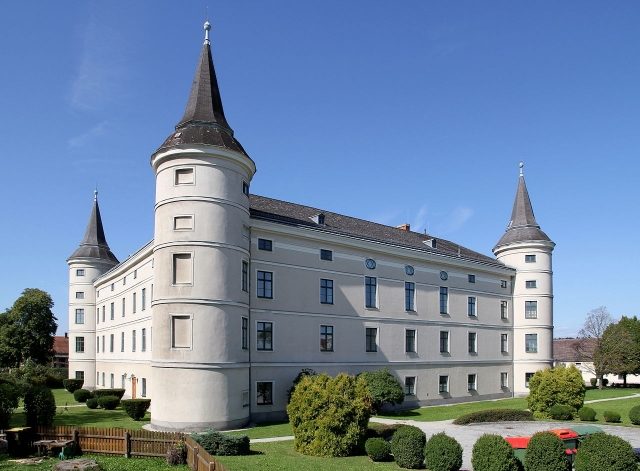
There is little reliable information about the early history of the dominion. In the 12th century, a ministerial family, who named themselves after Wolfpassing, presumably resided here. However, they could also have been settled in Wolfpassing near Tulln. The first documented mention of Wolfpassing is found in the provincial lord's urbarium from the second half of the 13th century, where a farmstead in Wolfpazingen is listed as being in the possession of the provincial lord.
In the 15th century, the Lords of Wolfstein served as burgraves. Later, they likely held the dominion as a fief. Margarethe von Wolfstein married Volkhard I von Auersperg, through which Wolfpassing first came into his family's possession in 1508. In 1609, however, the dominion was owned by the Hofkirchen family.
As Baron Wilhelm von Hofkirchen was proven to have connections to the rebellious Protestants in Bohemia, his property was confiscated in 1620. His children, however, were Catholic, which allowed them to reclaim it in 1621. Wenzel Wilhelm von Hofkirchen chose a clerical profession and sold Wolfpassing to Sigmund Abensperg-Traun in 1635. Around 1690, the castle, which had already been modernized in the 16th century, was finally converted into a palace. Through inheritance, it passed to the Barons von Geymann, who owned it until 1723, when Leopold Karl Graf Zinzendorf acquired it. His sons sold the palace in 1747 to their relative Ernst Ferdinand Graf Auersperg. Shortly thereafter, the building received its current appearance.
When Emperor Franz I purchased several Auersperg castles for the Imperial and Royal Patrimonial Fund in 1834, Wolfpassing was among them. In 1910, Crown Prince Archduke Franz Ferdinand transferred the estate to the Ministry of Defense in exchange for the Blühnbach estate. A cavalry barracks was established on the palace grounds. During the First World War, the palace served as a convalescent home for wounded officers. In 1918, Wolfpassing was taken over by the Austrian Ministry of Agriculture, which made it available to the Lipizzaner stud farm, relocated from Slovenia, until 1924.
In 1929, a dairy technical school and a federal research institute for dairy farming were established in the palace. Later, a food technology center, and until 2007, it was used as a boarding school and as teaching premises. Today, the palace, owned by the Bundesimmobiliengesellschaft, is available for exhibitions, events, weddings, and receptions.
Take Mobile History with you
You are reading this text for free. Premium adds what matters on the road: descriptions read aloud, sites found through your camera, whole regions taken offline.
- Every description, including the ~17,700 Premium sites
- Audio guide: have descriptions read to you on location
- AR finder: see sites through your camera, with distance and bearing
- Unlimited saved sites
14 days free, then from €2.99 a month. Cancel anytime.
Source: Wikipedia · Licence: CC BY-SA 4.0 · Image: http://commons.wikimedia.org/wiki/File:Wolfpassing_-_Schloss.JPG
This description draws on the facts documented in the linked Wikipedia article; Wikipedia content is licensed under CC BY-SA 4.0. Wording and editing: Mobile History.
Location: 48.0774, 15.0650