To be privately owned
CastleWolfersdorf
Wolfersdorf Castle
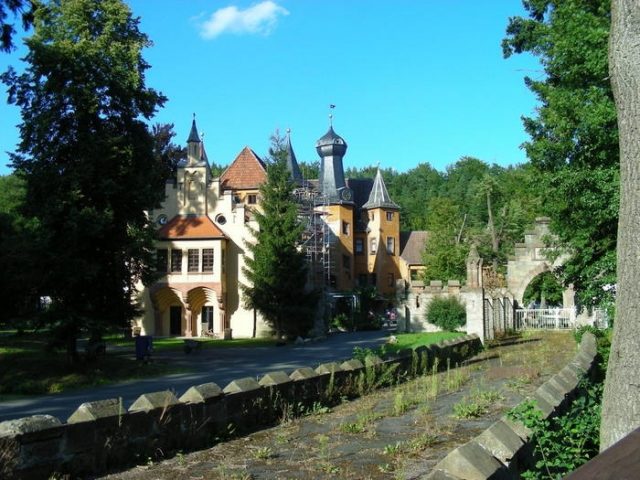
Wolfersdorf Hunting Lodge near Stadtroda in Thuringia is a former hunting lodge built between 1548 and 1550 by Nikolaus Gromann on behalf of Elector Johann Friedrich the Magnanimous. It stands on an island in a small lake in the middle of the village.
Already at the beginning of the 16th century, a princely hunting lodge existed at the same location. It was destroyed in 1547 during the Schmalkaldic War. Thereupon, Elector Johann Friedrich I commissioned the architect Nikolaus Gromann in 1547 with the new construction of a hunting lodge. It was completed within three years (1548–1550) as an L-shaped, two-story half-timbered building on a stone plinth with eight heated rooms and eleven chambers. A wooden stair tower provided access to the upper floors. This building is still largely preserved today. The core building was surrounded by outbuildings, which were largely renewed and altered in the 19th century. In 1552, the Elector was released from captivity, met his family in Wolfersdorf, and therefore named the new castle "Fröhliche Wiederkunft" (Joyful Return).
In the 16th and 17th centuries, it was actively used as a hunting lodge by his successors. From around 1650, hunting parties shifted to Hummelshain Castle. The Fröhliche Wiederkunft was used by the princely hunting administration and began to fall into disrepair.
From 1858 to 1865, the castle was restored and converted and extended in Neo-Gothic style on behalf of Duke Joseph of Saxe-Altenburg, who had abdicated in 1848. Four large-format painted panels with scenes from the life of Elector Johann Friedrich I were brought into the castle.
In 1918, Duke Ernst II of Saxe-Altenburg abdicated and moved from Altenburg Castle to Wolfersdorf Castle in 1922. Among other things, he had a modern observatory installed, with the support of Kurd Kisshauer.
In 1945/46, the castle was expropriated as part of the land reform. However, Ernst II received lifelong residency rights in the castle from the Soviet occupation forces, lived there until 1955, and died as a GDR citizen.
In 1955, the castle was transferred to public ownership. The inventory was relocated, among other places, to Leuchtenburg Castle. The four painted panels went to the Berlin Zeughaus, today's German Historical Museum. The castle was subsequently used as a youth workhouse and from 1990 as a "youth learning center". The building fabric suffered considerably.
In 1997, the pond was extensively desilted and ammunition was recovered from its bottom.
In 2007, the castle was sold to a native of Jena, and an extensive restoration of the partially dilapidated parts of the building began. The goal of the owner and a founded "Schloss Wolfersdorf Verwaltungsgesellschaft mbH" is to make the castle accessible to the public again as a cultural and historical asset. The project, with the support of the Free State of Thuringia and the German Foundation for Monument Protection, shows significant progress (2013). Among other things, a cafe on the ground floor with outdoor seating could be opened. In 2012, the castle was visited by 35,000 guests.
Take Mobile History with you
You are reading this text for free. Premium adds what matters on the road: descriptions read aloud, sites found through your camera, whole regions taken offline.
- Every description, including the ~17,700 Premium sites
- Audio guide: have descriptions read to you on location
- AR finder: see sites through your camera, with distance and bearing
- Unlimited saved sites
14 days free, then from €2.99 a month. Cancel anytime.
Source: Wikipedia · Licence: CC BY-SA 4.0 · Image: http://www.wehrbauten.de/thread.php?threadid=599
This description draws on the facts documented in the linked Wikipedia article; Wikipedia content is licensed under CC BY-SA 4.0. Wording and editing: Mobile History.
Location: 50.7878, 11.7102