Museum
Youth hostel
CastleWittenberg
Wittenberg Castle
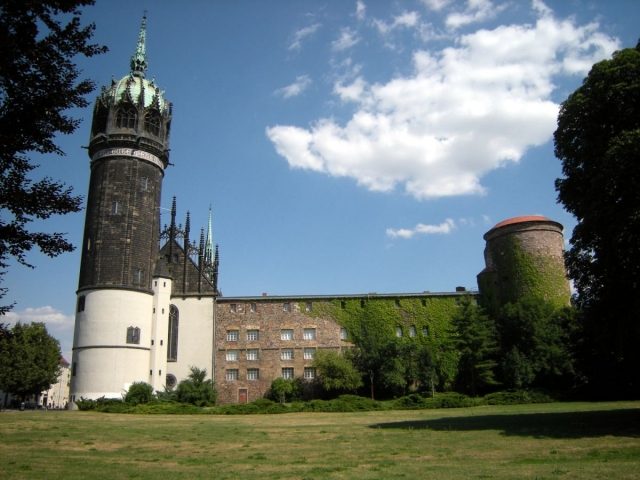
Wittenberg Castle and the associated All Saints' Church are UNESCO World Heritage Sites in Lutherstadt Wittenberg.
The slender, 88-meter-high castle church tower rises visibly from the silhouette of Lutherstadt Wittenberg, marking the western end of the old town. Approaching this castle church tower, one recognizes a filigree-like neo-Gothic spire, beneath which is a mosaic-decorated banner with the words of Martin Luther's hymn "A Mighty Fortress Is Our God, a good defense and weapon" in meter-high letters. Rather inconspicuous next to the castle church tower stands the actual castle, on whose southern wing there is also another tower structure. The world-famous castle church is part of the UNESCO World Heritage and closes off the entire complex from the north side. It gained fame when, on October 31, 1517, the hitherto almost unknown Wittenberg Augustinian monk and theology professor Martin Luther disseminated his 95 Latin disputation theses, which are considered the trigger of the Reformation.
The mention of a castle can already be found in a document from around 1187. In 1338, Wittenberg Castle last appears in documents, as a new Ascanian castle was built on the present site around 1340 under the Ascanian Duke and later first Elector of Saxony, Rudolf I. From this time on, the castle served as an official residence for servants and was demolished as part of the castle's reconstruction under Elector Frederick the Wise to make way for new official residences. On May 6, 1346, the "All Saints" foundation was established, which was located in the newly built Ascanian castle. The "All Saints" chapel, founded by the Ascanian Duke Rudolf I, was placed under the direct jurisdiction of the Roman See. On February 24, 1361, Duke Rudolf II endowed the "All Saints" chapel with income, gave it statutes, and regulated its divine service order. Subsequent rulers continued these revenues. In 1400, by order of Pope Boniface IX, the city church of St. Mary and the Mary Chapel on Apollensberg were subordinated to the castle church. In 1415, under Rudolf III, the chapel was moved to the attic of the present castle church to relocate it to a brighter place and to accommodate a larger number of visitors.
According to plans by Konrad Pflüger, a new residential castle was built under the direction of Frederick the Wise, which was also intended to serve as a fortification for the southwest corner of the city. For this purpose, the existing Ascanian castle was demolished in 1489, and a new foundation for the castle was built on its foundations from 1490 to 1496. From 1493 to 1496, master builder Hans von Torgau directed the construction. This was followed by the interior development. Through its architectural involvement as the third wing of the castle in 1496, the castle church is also closely linked to the further history of the castle. The original form of the castle church must have been in such an inadequate state in 1496 that after its demolition, a new church building was erected, which was only completed in 1506 (see the adjacent woodcut by Lucas Cranach the Elder from 1508 from the "Wittenberg Heiltumsbuch").
After the founding of the University of Wittenberg Leucorea in 1502, the castle church was assigned to it as a university church in 1507, and the church thus developed into an academic place of consecration. Here, students received their doctorates, Philipp Melanchthon delivered his famous inaugural address here, devotions were held in the church, and the academic dignitaries of the university were buried here. Some of these dignitaries can still be seen today on the walls in their epitaphs, and the famous reformers Martin Luther and Philipp Melanchthon found their final resting place in the castle church itself. Many important masters of that time, such as Lucas Cranach the Elder, Albrecht Dürer, Jacopo de'Barbari, Tilman Riemenschneider, etc., participated in the construction of the castle and later the castle church. In 1524, Protestant worship was introduced in the castle church.
Wittenberg, too, has not been spared from wars throughout its history. Already in 1547, during the Schmalkaldic War, the helmets of the two round towers were removed so that cannons could be stationed on the towers. The castle increasingly lost its importance and almost collapsed before, in the Seven Years' War in 1760, the castle and the castle church fell victim to bombardments and subsequently burned down to their foundations. Most of the church's interior, with its valuable artworks and relics, was lost. Only the metal art monuments have been preserved, in particular the tomb of Frederick the Wise, which the renowned bronze caster Peter Vischer created in Nuremberg in 1527.
Ten years later, the church was rebuilt. However, it again fell victim to the flames during the storming of Wittenberg in 1814 during the Wars of Liberation. After Wittenberg's annexation to Prussia in 1815, which had conquered the city from the castle in 1814, the castle was converted into barracks. In the process, the remaining artistic insignia were completely removed. Thus, the once magnificent castle became a simple citadel. After Wittenberg University was moved to Halle (Saale) in 1817, the castle and university church were handed over to the newly founded Protestant Preacher Seminary for use. In memory of Martin Luther's great deed, King Frederick William IV of Prussia donated the bronze-cast Thesis Door on Martin Luther's 375th birthday on November 10, 1858, with an inauguration ceremony.
The castle church owes its current appearance to a renovation in the Neo-Gothic style between 1883 and 1892 by Friedrich Adler. Its inner core was completely redesigned according to historical records, and the spire of the castle church tower was rebuilt. On October 31, 1892, the redesigned church was reconsecrated.
The Castle Church Parish was founded in 1949 to assign the church its own congregation in addition to the preacher seminary.
On the occasion of the 500th anniversary of Martin Luther's birth in 1983, twelve stained-glass windows with portraits of Luther's thirteen most important Reformation students were inaugurated in the castle church. The Lutheran World Federation commissioned the artist Renate Brömme, who implemented the stained-glass paintings in an adaptively timeless style.
Recent History
From 1978–1992, preacher Friedrich Schorlemmer worked at this church, who, among other things, became internationally known at the 1983 Kirchentag in the presence of then Federal President Richard von Weizsäcker with the symbolic act of beating a sword into a plowshare – a sign of hope for the GDR peace movement. The GDR authorities had previously declared the public use of the "Swords to Plowshares" symbol illegal.
Today+
The castle ensemble is to be fundamentally redesigned by the Reformation Jubilee in 2017. The castle will be renovated, and the south wing of the castle, destroyed in 1760, will be rebuilt in the form of a new building.
Due to construction work, the interior of the castle church can currently only be entered as part of daily construction site tours.
Organ+
The organ of the castle church was built in 1863 by the organ builder Friedrich Ladegast (Weißenfels) in the casing of the baroque predecessor organ by J. E. Hübner from 1771, which, however, was replaced in 1893 by a neo-Gothic oak casing. The instrument initially had 39 stops on three manuals and pedal. In 1935, the organ building company Wilhelm Sauer (Frankfurt/O.) expanded the disposition to 50 stops and equipped the instrument with electro-pneumatic actions. Between 1985 and 1994, the instrument was reconstructed by the organ building company Hermann Eule (Bautzen) and expanded by another division. The instrument now has 57 stops (approx. 3500 pipes) on four manuals and pedal. The playing actions are mechanical.
Thesis Door+
The old door of the Wittenberg Castle Church, to which, according to the - albeit controversial - tradition, Martin Luther is said to have nailed his 95 Theses in 1517, was destroyed by fire in the 18th century. The so-called Thesis Door, which King Frederick William IV of Prussia presented to the city of Wittenberg in 1858, commemorates the presumed event. It contains the text of Luther's 95 Theses and is adorned with musical boys on the door jambs, based on drawings by Ferdinand von Quast and models by Friedrich Drake, cast by the bronze founder Friebel from Berlin.
The strongly profiled jamb of the church door is still original; on both sides of the keystone, one can see the year 1499. In 1845, figures of Elector Frederick the Wise and Duke John the Steadfast by Friedrich Wilhelm Holbein were placed above the portal on high, coat-of-arms-decorated pedestals. The designs for these came from Friedrich Drake. In the arch field, there is a crucifix in lava painting by August von Kloeber from 1851. The wooden door wings, which are said to have carried the thesis paper, burned in 1760 and were renewed in 1768 according to designs by Fr. W. Exner. The spandrels of the rectangular frame contain a barely legible inscription in capitals, commemorating the fire of 1760 and the subsequent restoration.
Take Mobile History with you
You are reading this text for free. Premium adds what matters on the road: descriptions read aloud, sites found through your camera, whole regions taken offline.
- Every description, including the ~17,700 Premium sites
- Audio guide: have descriptions read to you on location
- AR finder: see sites through your camera, with distance and bearing
- Unlimited saved sites
14 days free, then from €2.99 a month. Cancel anytime.
Source: Wikipedia · Licence: CC BY-SA 4.0 · Image: http://schloesserrundschau.de/anhalt/schloesser/wittenberg001.html
This description draws on the facts documented in the linked Wikipedia article; Wikipedia content is licensed under CC BY-SA 4.0. Wording and editing: Mobile History.
Location: 51.8660, 12.6376