Youth hostel
CastleWindischleuba
Windischleuba Castle
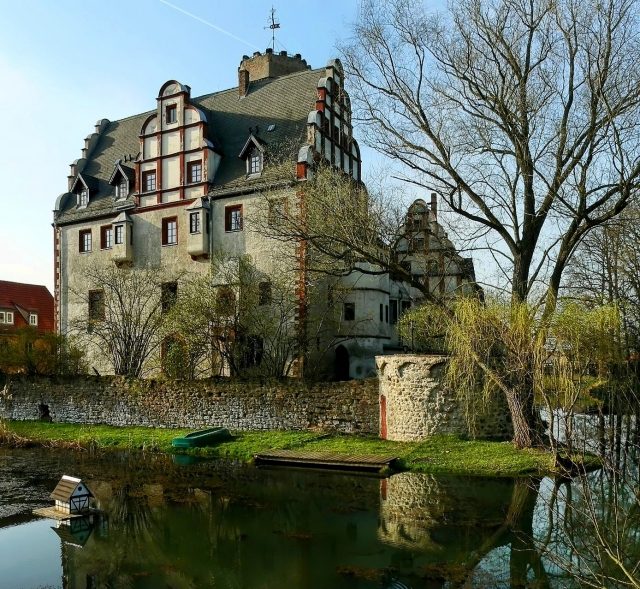
Around 925, Windischleuba Castle was founded, serving as a border fortress to protect Altenburg. By 1244, Heinrich von Kohren and Hugo zu Stolberg were the owners of the castle. Later, shortly after 1300, the feudal lordship over Windischleuba passed from the Burgraves of Meissen to the Burgraves of Leisnig. After several owners, Windischleuba remained in the possession of the von der Gabelentz family until 1650. In 1632, during the Thirty Years' War, Windischleuba Castle burned down. In 1678, Georg Ernst von Zehmen bought it. In 1739, Sophie Elisabeth von Lindenau, née von Zehmen, acquired it. In 1880, Börries Freiherr von Münchhausen (* 1845 † 1931), a landowner in Moringen, Lower Saxony, who had married Clementine von der Gabelentz from the neighboring Poschwitz Castle in 1873, bought it. Windischleuba Castle was dilapidated and considered almost beyond repair. However, the Münchhausens completely rebuilt it by 1886, having the old forms reconstructed. The castle has been preserved in this state to this day. In 1920, they retired to Apelern and handed over the castle to their son of the same name, the völkisch ballad poet Börries von Münchhausen (* 1874 † 1945), who lived there with his family. His only son Börries died in an accident in 1934 at the age of 29, and the poet's wife died in January 1945. In March of the same year, one month before the invasion of US troops, Börries von Münchhausen, who was prominently listed in the category of writers on the 36-page Gottbegnadeten-Liste (God-gifted list) compiled in 1944 by the Reich Ministry for Public Enlightenment and Propaganda, Joseph Goebbels, and Adolf Hitler, committed suicide. In 1945, the family was dispossessed, and part of the Gothic inventory was moved to Altenburg.
Windischleuba Country Boarding School
In the course of the land reform, on October 1, 1945, 250 hectares of "Junkerland" belonging to the von Münchhausen family were distributed among 20 new farmers, two small farmers, and one gardener. At the suggestion of the Altenburg school councilor, Erich Knippel (KPD), the decision was made to establish a twelve-grade central school in Windischleuba and to set up the castle as the associated school boarding house. Where until 1945 a noble family of three people and seven employees had lived, 120 children of workers and farmers were to live in the future.
On November 7, 1946, the first 26 boys and girls moved into the castle, followed by another 32 boys and girls on September 1, 1947. With a father's net monthly salary of up to 250 RM, each child was granted free accommodation and board. The management of the school and the home was transferred to Ehrenfried Winkler (later Distinguished Teacher of the People of the GDR) on May 1, 1947, and his wife was given the economic management. Brunhilde Weide took over responsibility for economic management and home education on March 1, 1948.
The establishment, development, and maintenance of the "Landschulheim" (country boarding school), as it was officially called, took place under the difficulties of the post-war period, concerning, for example, catering, heating, furnishing of sleeping and working rooms, and the provision of teaching materials. Here, the community spirit and cohesion of all residents, educators, and teachers proved their worth. On May 1, 1950, the foundation stone for a new school building was laid. Students and teachers contributed thousands of voluntary working hours, and local farmers provided teams of horses for transport work for hundreds of hours. In 1952, the new school was occupied. At this time, 126 students lived as boarders in the castle, while others came daily as "commuter students" by bicycle from the surrounding villages to the secondary school. In 1951, the first graduates took their Abitur examination. Ehrenfried Winkler was director of the secondary school until 1954, after which Hans-Erich Günther took over this function. The head of the boarding school was one of the school's first graduates, Manfred Hainich.
Parallel to academic work, cultural activities played a major role in boarding school life. There was a school choir, a folk dance group, and a political-satirical cabaret. The boarding school students held a theater subscription at the Landestheater Altenburg and participated in the cultural life of the community and the district town with various activities.
A highlight was the "small Peace Race," which was held annually on Teacher's Day. The boarding school and the Extended Secondary School closed in 1975; from then on, the students attended the "Karl Marx" Extended Secondary School in Altenburg.
Today, the castle serves as a youth hostel. The CdE has been holding its Winter Academy there since 2008. The youth hostel opened in 1977 and was considered one of the most beautiful in the GDR. It was affected by the two floods in 2002 and 2013.
Take Mobile History with you
You are reading this text for free. Premium adds what matters on the road: descriptions read aloud, sites found through your camera, whole regions taken offline.
- Every description, including the ~17,700 Premium sites
- Audio guide: have descriptions read to you on location
- AR finder: see sites through your camera, with distance and bearing
- Unlimited saved sites
14 days free, then from €2.99 a month. Cancel anytime.
Source: Wikipedia · Licence: CC BY-SA 4.0 · Image: Thomas Eichler
This description draws on the facts documented in the linked Wikipedia article; Wikipedia content is licensed under CC BY-SA 4.0. Wording and editing: Mobile History.
Location: 51.0162, 12.4725