Museum
CastleHanau
Wilhelmsbad Castle (Hanau)
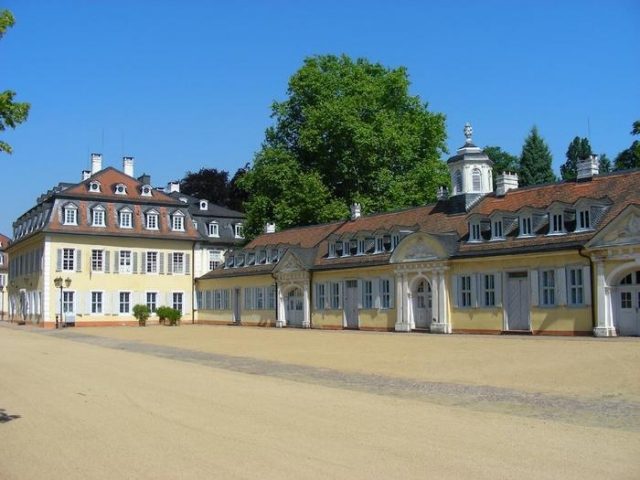
Wilhelmsbad is a former spa complex in Hanau, today located in the Kesselstadt district and a state park managed by the State Palaces and Gardens of Hesse.
According to the founding legend, two herbalists found a spring in the forest in 1709, which was attributed healing properties due to its rich mineralization.
The bathing and park complex was built starting in 1777 at the behest of Hereditary Prince and reigning Count of Hanau, Wilhelm IX/I of Hesse-Kassel (1743–1821), who resided in Hanau from 1764 to 1785. The architect was Franz Ludwig Cancrin, who also supervised the construction of the carousel (see below). After only one and a half years of construction, the grand opening took place on June 3, 1779. The construction of Wilhelmsbad with its extensive park was financed by leasing Hessian and Hanau soldiers to the British King, the Hereditary Prince's uncle.
When the spring dried up around 1860, healing water for drinking and bathing was brought from Bad Nauheim, a process that soon proved uneconomical. Today, no more cures take place in Wilhelmsbad. The well house in contemporary, classical style is located directly opposite the spa buildings.
Park Grounds+
The park of the Wilhelmsbad spa complex is designed as an English landscape park and equipped with numerous "sensations": carousel, ruin, Comoedienhaus, rock passages, hermitage, Devil's Bridge, pyramid, snail hill, and play equipment.
Modern amenities at Wilhelmsbad include an adjacent golf course in the pheasantry, a mini-golf course, several restaurants and cafés.
Carousel
One of the biggest attractions is the huge carousel. It was built in 1780 on an artificial hill and was in operation from 1780–1830 and, after a renovation, from 1868–1920. The constructor was Franz Ludwig Cancrin (* 1738; † 1816). It was initially driven underground by people, later by oxen and horses. In the spring of 1898, for a cost of 20,000 Marks, it was motorized and renovated with newly acquired carriages and horses by the Gotha company Fritz Bothmann u. Glück, Maschinen- und Carousselfabrik. The number of carriages was increased to 4, and the number of horses to a total of 16. They are preserved to this day. However, the system is no longer functional, as the structure has subsided, and now a part of the floor, which is suspended from the roof, blocks the drive. After years of efforts by the owner and the Friends' Association for the Carousel in the State Park Hanau-Wilhelmsbad to restore the carousel, work began on February 14, 2007. Funds come from donations, sponsorships for individual carousel horses, grants from public authorities, and the German Foundation for Monument Protection.
"Castle Ruin"
Hidden in the tower of the artificial ruin is a pleasure palace with an elegant living apartment and a magnificent domed hall. These private living quarters of the Hereditary Prince are today restored to their historical condition.
Pyramid
The four-sided pyramid stands on an island in the park's pond. A grated gate opens on each side. In the center of the pyramid stands a marble urn. The pyramid was erected in memory of Prince Friedrich (1772–1784), the eldest son of Landgrave Wilhelm IX, who died at the age of just under 12. He is buried in the Marienkirche in Hanau. When his coffin was opened in 1879, a heart-shaped box was found inside, which likely contained the prince's heart. The legend that the heart is buried in the urn in the pyramid is therefore probably incorrect.
Train Station
In the 19th century, the complex – already a popular excursion destination, also from neighboring Frankfurt am Main – received its own train station, today: Hanau-Wilhelmsbad, on the Frankfurt-Hanau railway.
Doll Museum
Since 1983, the Hessian Doll Museum has been displaying its collection in rooms of the spa building.
Historical Events in Wilhelmsbad+
In the summer of 1782, Wilhelmsbad was the scene of the Masonic Convention of the Strict Observance.
On June 22, 1832, following the Hambach Festival, a political folk festival with 8,000 to 10,000 participants took place in Wilhelmsbad. The main speaker was the Heidelberg student and fraternity member Karl Heinrich Brüggemann, who was sentenced to death in Prussia in 1834, but later pardoned to fortress imprisonment and amnestied in 1840. Other speakers included the Darmstadt democrats Theodor Reh and Friedrich Wilhelm Schulz, as well as Georg Fein, pre-March politician and editor of the liberal-democratic newspaper Deutsche Tribüne.
Under pressure from the opposition, which had built up in the state capital Kassel against the reactionary policies of Elector Friedrich Wilhelm I and his leading minister Ludwig Hassenpflug, the sovereign and government moved to Wilhelmsbad in 1850 and declared it the capital of the Electorate. This lasted until early 1851.
Take Mobile History with you
You are reading this text for free. Premium adds what matters on the road: descriptions read aloud, sites found through your camera, whole regions taken offline.
- Every description, including the ~17,700 Premium sites
- Audio guide: have descriptions read to you on location
- AR finder: see sites through your camera, with distance and bearing
- Unlimited saved sites
14 days free, then from €2.99 a month. Cancel anytime.
Source: Wikipedia · Licence: CC BY-SA 4.0
This description draws on the facts documented in the linked Wikipedia article; Wikipedia content is licensed under CC BY-SA 4.0. Wording and editing: Mobile History.
Location: 50.1488, 8.8827