Local government
CastleZernez
Wildenberg Castle (Zernez)
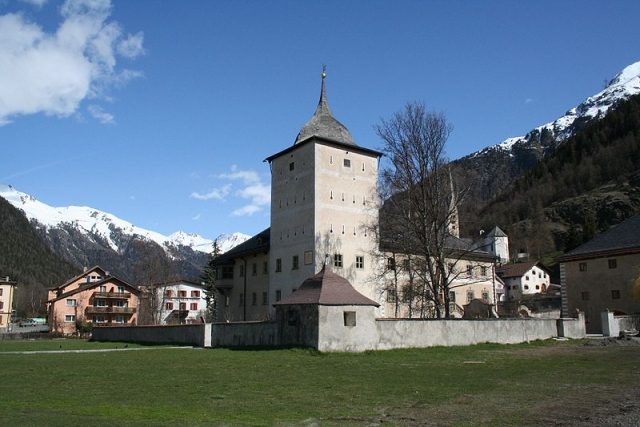
Wildenberg Castle, converted into a baroque palace in the post-medieval period, forms the most striking building in the old village center of Zernez. It was the seat of the Zernez family Planta.
The castle complex is located on the eastern edge of the old village part of Runatsch, which, along with the Protestant parish church and the Catholic chapel of St. Sebastian, was spared from the great village fire of 1872, unlike the rest of the village.
The oldest part of the complex is the square tower, which was probably built in the 13th century. The wide window openings in the lower floors were broken through later. The keyhole embrasures in the upper floors date from around 1630, the curved spire from the 18th century, and the interior and roof from the 17th century. The two baroque wings of the castle adjoin it at an angle. They have no defensive character and date back to a new building from 1622. Alterations were made in 1649 and in the second half of the 18th century. The castle is surrounded by a courtyard and two gardens.
The complex is not documented as a medieval castle; however, numerous possessions of the Lords of Tarasp and Lords of Frickingen are documented for the 12th century in Zernez, and numerous farms of the Lords of Sagogn-Wildenberg in Falera in the Surselva for the 13th century, which were transferred to the Diocese of Chur and later to the Zuoz family Planta. From one of these farms, transferred to the bishop before 1298 and to Conrad Planta in 1302, Wildenberg-Planta Castle emerged. In 1377, a farm located in Sarnetz called Wildenberg is mentioned. Subsequently, a branch of the Planta family called themselves "von Planta-Wildenberg". The Zernez Plantas also operated the iron ore mines on the nearby Ofenpass.
During the Bündner Wirren, a large part of the castle, then the residence of Rudolf von Planta, was stormed and destroyed by the Engadine population in 1618 by undermining the walls, as the Habsburg-loyal Rudolf was said to have received Archduke Leopold of Austria at his castle. As commander of Austrian troops, Rudolf von Planta forced the Engadine people to rebuild it with a new residential wing in 1622. With Rudolf's death, the castle passed to the Planta-Steinsberg family.
Johann von Planta played a significant role in the redemption of the Lower Engadine villages from Habsburg rule, which was completed in 1652. He had the castle further renovated and inhabited it from 1645; the entrance portal still shows his coat of arms today. In the mid and late 18th century, Johann Heinrich von Planta and Peter von Planta had numerous alterations and extensions carried out, which characterize the current appearance of Wildenberg-Planta Castle. Peter Conradin von Planta sold the castle after 1850 to the Bezzola family. Since 1956, it has belonged to the municipality of Zernez, which had it rebuilt until 1957 and housed its municipal office there.
Take Mobile History with you
You are reading this text for free. Premium adds what matters on the road: descriptions read aloud, sites found through your camera, whole regions taken offline.
- Every description, including the ~17,700 Premium sites
- Audio guide: have descriptions read to you on location
- AR finder: see sites through your camera, with distance and bearing
- Unlimited saved sites
14 days free, then from €2.99 a month. Cancel anytime.
Source: Wikipedia · Licence: CC BY-SA 4.0
This description draws on the facts documented in the linked Wikipedia article; Wikipedia content is licensed under CC BY-SA 4.0. Wording and editing: Mobile History.
Location: 46.6997, 10.0962