To be privately owned
CastleIrnfritz-Messern
Wildberg Castle
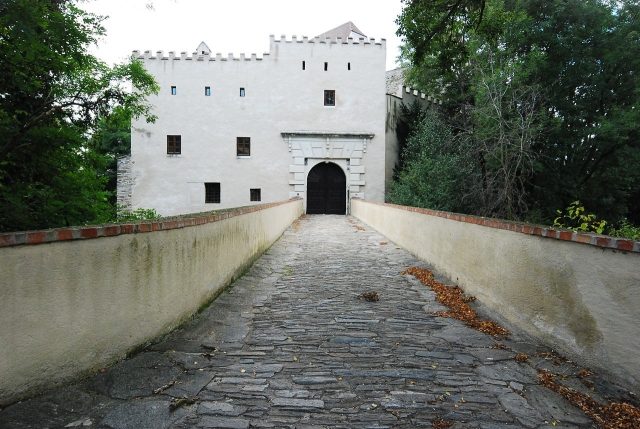
Wildberg Castle, formerly also Wildberg Fortress, is a castle high above the Taffatal valley in the Lower Austrian municipality of Irnfritz-Messern, northwest of Horn.
The first documented mention of Wiltperch Castle dates back to the 12th century. The castle belonged to the Lords of Wildperch, presumably a branch line of the Counts of Poigen.
After the male line of Hohenburg-Wildberg died out, the castle came into the possession of the Counts of Vohburg, partisans of the Staufer, as a princely fief at the beginning of the 13th century. It then passed to the Lords of Maissau. The Lords of Puchheim, who owned Wildberg Castle from 1432, expanded it into a fortified castle, which also served as a refuge during the turmoil of the 17th century. At the end of the 16th century, they established a printing press for Protestant writings here and converted the castle complex into a Renaissance castle. The printing press, in connection with the Horner Bund, made Wildberg a center of Lower Austrian Protestantism. Among the numerous treatises printed at the castle, the writing of the castle preacher Johann Tettelbach von Karlstein: "Christian Confession Unanimous Consensus, Considerations and Advice" was also published in 1586.
Numerous alterations and extensions during the 16th and 17th centuries have left only the foundations of the medieval complex. Worth seeing are the palas, the smoke kitchen, and the forge.
At the beginning of the Counter-Reformation in Lower Austria, after 1620, Wildberg Castle was expropriated from the Lords of Puchheim and came into the possession of the Catholic Barons of Traun; from the 18th to the 20th century, it belonged to the lordship of Altenburg Abbey. In the 20th century, it was partially restored with the support of the Federal Monuments Office by the Wildberg-Kaja Castle and Palace Preservation Association. It was planned to host exhibitions in the partly still dilapidated extensive building complex. Today, Wildberg Castle is privately owned and not accessible to the public.
Coat of Arms Castle+
Wildberg Castle is occasionally also referred to as "Coat of Arms Castle" because the Counts of Hohenburg-Wildberg bore a red-white-red bindenschild (shield with a band) as their coat of arms. Some historians believe that the red-white-red bindenschild used by the Babenbergs from the 13th century, which was later adopted by the Habsburgs and is the origin of Austria's current national colors, goes back to this.
Take Mobile History with you
You are reading this text for free. Premium adds what matters on the road: descriptions read aloud, sites found through your camera, whole regions taken offline.
- Every description, including the ~17,700 Premium sites
- Audio guide: have descriptions read to you on location
- AR finder: see sites through your camera, with distance and bearing
- Unlimited saved sites
14 days free, then from €2.99 a month. Cancel anytime.
Source: Wikipedia · Licence: CC BY-SA 4.0 · Image: http://commons.wikimedia.org/wiki/File:GuentherZ_2012-09-16_0103_Messern_Schloss_Wildberg.jpg
This description draws on the facts documented in the linked Wikipedia article; Wikipedia content is licensed under CC BY-SA 4.0. Wording and editing: Mobile History.
Location: 48.7162, 15.5282