To be privately owned
CastleBad St. Leonhard im Lavanttal-Wiesenau
Wiesenau Castle
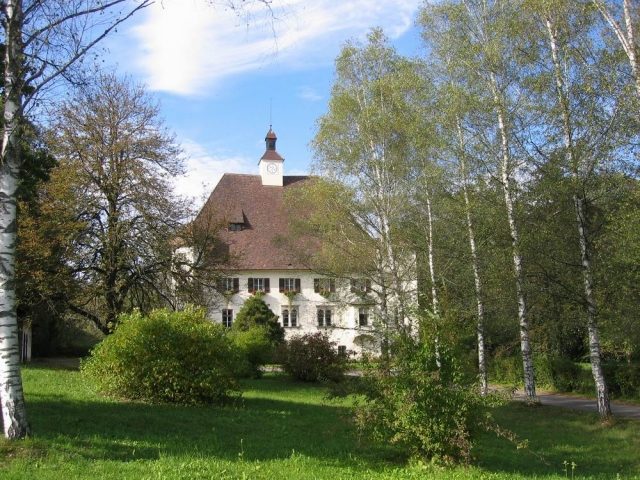
Wiesenau Castle is located in the town of Wiesenau, on the right bank of the Lavant river in the municipality of Bad St. Leonhard in Carinthia.
The Renaissance building was constructed in 1579 by the industrialist Siegmund Pain. With his son, the family died out impoverished in 1652. From 1648 to 1778, the estate was owned by the Barons of Siegersdorf-Kirchheimegg.
In 1814, Johann Soellner, director of the Wolfsberg white lead factory, bought the castle at auction and made it the meeting place of the "Wiesenau Circle," which was connected with Immanuel Kant, Friedrich Schiller, and other great minds of the time. The members of this circle discussed current topics of the time and corresponded with famous scientists, poets, and philosophers. A particularly frequent guest at Wiesenau Castle was the imperial court astronomer Tobias Bürg (1766–1834), who was an internationally recognized authority. When the Paris Institut National announced a prize in 1799 for the most accurate calculation of the moon's orbit, Bürg, alongside the Frenchman Alexis Bouvard, won. Bürg had evaluated data from around 3,000 astronomical observations and developed a complex theory of motion. Bürg retired completely to Wiesenau in his last years of life.
In 1847, the castle passed to the Counts Henckel von Donnersmarck, and in 1923 to the Hespa-Domäne. Since 2007, it has been owned by the company RZ Holzindustrie GmbH.
Description+
The courtyard-less, three-story complex is built on an approximately square floor plan. The castle is crowned by a high hip roof with a roof turret. Of its four corner towers, three are set diagonally. On the south facade, a round-arched, chamfered stone portal, offset from the central axis, and three coupled Renaissance windows (biforium windows), the eastern one a copy, can be seen. On the southwest tower, a tile with the coat of arms of Sigmund Pain from 1579 is immured.
In the hallway, there is a small collection of Roman-era grave monuments that were uncovered not far from the castle. They originate from a settlement that was likely connected with gold mining in nearby Kliening, which was also practiced during the Roman era.
Take Mobile History with you
You are reading this text for free. Premium adds what matters on the road: descriptions read aloud, sites found through your camera, whole regions taken offline.
- Every description, including the ~17,700 Premium sites
- Audio guide: have descriptions read to you on location
- AR finder: see sites through your camera, with distance and bearing
- Unlimited saved sites
14 days free, then from €2.99 a month. Cancel anytime.
Source: Wikipedia · Licence: CC BY-SA 4.0 · Image: http://commons.wikimedia.org/wiki/File:Schloss-Wiesenau.jpg
This description draws on the facts documented in the linked Wikipedia article; Wikipedia content is licensed under CC BY-SA 4.0. Wording and editing: Mobile History.
Location: 46.9459, 14.8126