Restaurant
Cultural Events
Stud farm
CastleMönchengladbach
Wickrath Castle (Mönchengladbach)
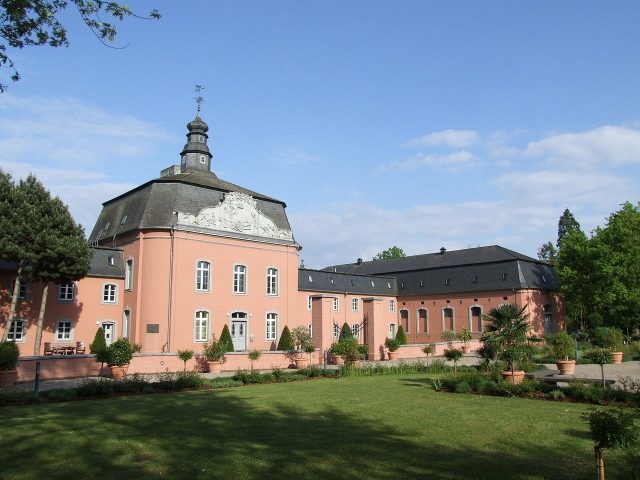
Wickrath Castle is a moated castle complex on the Niers with a publicly accessible park in Mönchengladbach-Wickrath.
Preserved are the baroque outer bailey wings, which have been used as horse stables since the baroque complex was built, as well as the so-called Landstallmeisterhaus (State Stud Master's House), a castle-like residential building for the then stud manager, built in 1875 on the site of the former main building. It is now an inn.
History and Building History+
In 1075, the Lordship of Wickrath was mentioned for the first time. The village of Wickrath was first mentioned in 971.
Also in 1075, a Count Gerlach is named as the owner of Wickrath Castle and as Vogt of Siegburg Abbey. Around 1080, Wickrath Castle was part of the possessions of Count Gerhard I from the noble family of Hochstaden, who had their ancestral seat near Frimmersdorf.
According to the four coats of arms on the fountain in the middle of the outer bailey square, Wickrath Castle remained in the possession of a line of the von Hochstaden family until 1335, while the predominant part of the possessions on the Ahr and the ancestral seat in Frimmersdorf came to Kurköln through the Hochstaden donation in 1246. In 1310, the previously imperial immediacy of the Lordship of Wickrath became a fief of the County of Geldern. The exclave of Schwanenberg (on the western side of Erkelenz, which belonged to the Duchy of Geldern until 1714 and then to the Duchy of Jülich), first mentioned in 1312, also belonged to the Lordship of Wickrath. Until 1454, the von Broichhausen family owned the castle and sub-lordship of Wickrath.
In 1486, Archduke and later Emperor Maximilian I conquered the Guelders fief of Wickrath, as the Duke of Guelders supported the uprisings in the Burgundian Netherlands (1482-1493/99). Maximilian I made Wickrath an imperial lordship again and enfeoffed his councilor Heinrich von Hompesch with it. After Heinrich's death in 1502, his stepsons von Quadt, the founders of the Quadt-Wykradt family, inherited the imperial lordship of Wickrath. The von Quadts completely rebuilt their residence in Dutch-Baroque style between 1746 and 1772 with the help of the Dutch master builders François and Matthieu Soiron and laid out the baroque park. Matthieu's son Mathias Soiron, also a master builder and architect and probably involved in his father's work, made the drawings of the castle construction. In 1752, the Quadts bought the count's title for 20,000 guilders.
The castle complex housed a stable with a central stable aisle and side stalls for the horses.
In 1794, Wickrath, like the entire Rhineland left of the Rhine, was occupied by France. As compensation, Count Otto Wilhelm von Quadt-Wykradt received the Imperial Abbey of Isny and the Imperial City of Isny in Allgäu during the secularization of 1803, both of which, however, fell to the Kingdom of Württemberg during the mediatization of 1806.
During the French rule, the stables of Wickrath Castle served as a state stallion depot.
The Prussians used the castle complex as barracks for two squadrons of hussars.
From 1839/40, it became the Rhenish State Stud.
The main building was completely demolished in 1859 due to dilapidation, and the stones were largely sold. In its place, the Landstallmeisterhaus was built in 1875 for the director of the then stud.
From 1876, Rhenish-German Coldblood breeding was carried out in Wickrath.
In 1957, the State Stud was moved to Warendorf and merged with the Westphalian State Stud to form the North Rhine-Westphalian State Stud.
In 1985, the castle was placed under monument protection.
In 2002, the castle and park were renovated as part of the decentralized State Garden Show "EUROGA 2002 plus" and in 2004/2005 became part of the Road of Garden Art between Rhine and Meuse.
Current Use+
* In 2002, the Wickrath Castle Equestrian Center was established when the headquarters of the Rhenish Horse Stud Book was moved from Bonn to Wickrath Castle. Since then, the east wing has been used again as a horse stable. Opposite the castle complex are a tournament ground, a riding stable, and a new event hall. A large foal show also takes place once a year.
* The Nassau Stable serves as an event hall and exhibition space.
* The former Landstallmeisterhaus is used as an inn.
* A small building houses an Ornithological Museum, maintained by the Naturschutzbund Deutschland (NABU) Mönchengladbach city association.
Portrait+
The portrait of Matthieu Soiron reproduced from an overall picture, which Josef Mataré created before 1933, as well as the original painting of Wilhelm Otto Friedrich von Quadt zu Wickrath as the builder of Wickrath Castle with the master builder by Johann Heinrich Fischer, illustrate Wickrath Castle in the background. The overall picture is located in the Municipal Museum Schloss Rheydt.
Take Mobile History with you
You are reading this text for free. Premium adds what matters on the road: descriptions read aloud, sites found through your camera, whole regions taken offline.
- Every description, including the ~17,700 Premium sites
- Audio guide: have descriptions read to you on location
- AR finder: see sites through your camera, with distance and bearing
- Unlimited saved sites
14 days free, then from €2.99 a month. Cancel anytime.
Source: Wikipedia · Licence: CC BY-SA 4.0
This description draws on the facts documented in the linked Wikipedia article; Wikipedia content is licensed under CC BY-SA 4.0. Wording and editing: Mobile History.
Location: 51.1283, 6.4163