To be privately owned
CastleKematen an der Krems
Weyer Castle
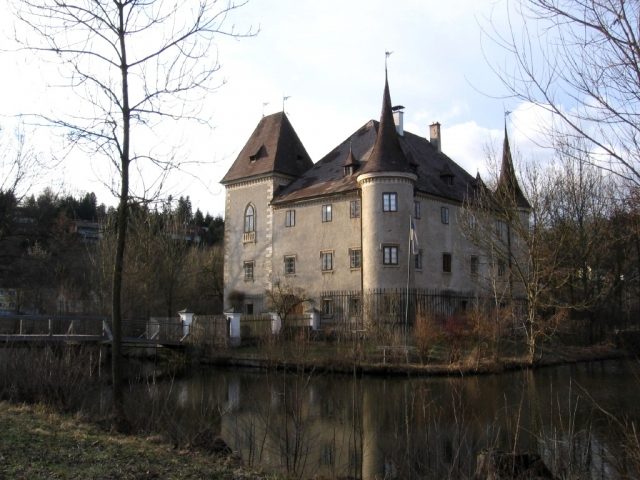
Weyer Castle is a moated castle in the municipality of Kematen an der Krems in the district of Linz-Land.
The first mentions of the castle probably date back to Charlemagne, who in 791 and 802 confirmed a donation made by Duke Tassilo III in 777 to Kremsmünster Abbey: the area of luibilinpach, a fortress (probably Leombach Castle), and the seat of Weyer are mentioned. The castle was originally a monastic estate (tithe farm) of Kremsmünster Abbey, first documented in the monastery's urbarium in 1299. In 1319, the abbey granted the farm as a fief to Heinrich Raidt. In 1500, Hans Raidt was the owner of the moated castle, which probably already existed then; he was succeeded by his son Otto. His grandson Ulrich Raidt sold Weyer, along with Au an der Traun Castle near Roitham, to Balthasar Wiellinger in 1557. Christoph Wiellinger von Au und Hinterndobl sold Weyer to the Steyr citizen Georg Fenzl (†1593). His nephew Hans Fenzl became the owner of Piberbach Castle through his marriage to Potentia Händl von Ramersdorf. Both properties were united into a fideicommissum, so that both estates temporarily shared their history. The united lordship came as a dowry to Count Siegmund Ka(t)zianer. Maria Beate Countess Kazianer married Siegmund Hager von Allentsteig und St. Veit in 1707, who thus took over both properties. After his death in 1768, Piberbach with Weyer was sold to Leopold Freiherr von Eiselsberg (Eyselsberg). Already in 1769, Kremsmünster Abbey bought back the lordship of Weyer, but it had to be ceded to the sovereign in 1811.
In 1812, the Linz merchant and banker Franz Planck von Planckburg (*1722, †1844), ennobled in 1844, acquired Weyer Castle from the so-called Religious Fund estates. The banking house "Scheibenpogen's Eidam", inherited from his father-in-law, merged in 1869 into the newly founded Oberbank AG (today: Bank für Oberösterreich und Salzburg). After his death, the property passed to his son Karl (*1802, †1868) and then to his daughter Henriette (*1847, †1922), who bequeathed the castle to her nephew Karl Planck (*1869, †1945). After his death, his nephews Robert (*1907) and Kurt (*1911) followed as half-owners each. Weyer thus remained in the possession of the Planck von Planckburg family for a long time. The last owners from the Planck family were Alexander and Marion Planck, who used the castle as their residence, the seat of their forestry business, and as an architecture and spatial planning office.
In 2010, the castle was bought by Franz Ömer, the founder and head of the bet-at-home.com AG group. Since 2012, the complex has been undergoing a costly total renovation. For this purpose, the pond has also been largely drained, and a concrete structure with an underground car park has been built into the pond. The facade has been completely renewed. The grounds are now surrounded by a high, bare concrete wall, so that views are only limited.
Description+
Until recently, the castle was located on an island reinforced by piles in a tree-shaded pond, fed by a side arm of the Krems. The castle building is three-story and has four towers. Three of them are round towers projecting from the masonry with pointed spires. On the entrance side, to the left, there is a fourth, square tower projecting from the masonry with a steep roof. Underneath its plaster, sgraffito ashlar work can be seen. Previously, a wooden bridge led to the castle. Behind it, a vaulted central corridor serves as an entrance hall. To its right is a single-column room with a cross-ribbed vault and a stone central column. Two rooms on the first floor still have the original beamed ceilings. In 1871, a neo-Gothic redesign of the facade took place with uniform pebble dash (roughcast with coarse, round grain). The second upper floor was also renovated in the 19th century.
Take Mobile History with you
You are reading this text for free. Premium adds what matters on the road: descriptions read aloud, sites found through your camera, whole regions taken offline.
- Every description, including the ~17,700 Premium sites
- Audio guide: have descriptions read to you on location
- AR finder: see sites through your camera, with distance and bearing
- Unlimited saved sites
14 days free, then from €2.99 a month. Cancel anytime.
Source: Wikipedia · Licence: CC BY-SA 4.0 · Image: http://commons.wikimedia.org/wiki/File:Wasserschloss_Weyer.jpg
This description draws on the facts documented in the linked Wikipedia article; Wikipedia content is licensed under CC BY-SA 4.0. Wording and editing: Mobile History.
Location: 48.1124, 14.1942