Cultural Events
Restaurant
Museum
CastleHagen-Vorhalle
Werdringen Castle
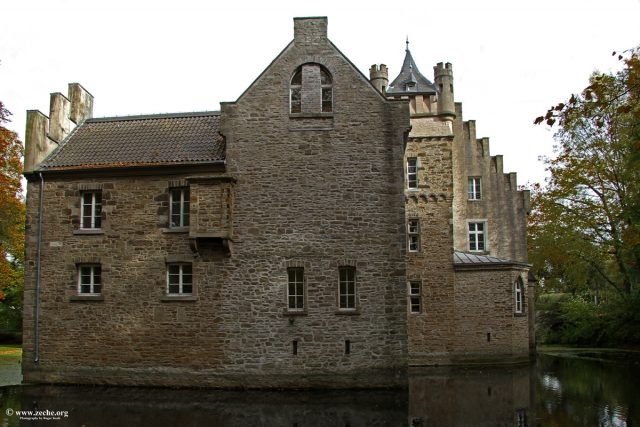
Wasserschloss Werdringen is a moated castle in Hagen-Vorhalle near the Ruhr river on Lake Harkortsee below the Kaisberg. It houses a supra-regional museum for prehistory and early history.
Landscape+
The complex, originally built as a moated castle, is located in a nature and landscape conservation area surrounded by old trees. Rare animal and plant species can be found in the moats and water ditches of the castle complex. The landscape around the moated castle is known for a diverse amphibian fauna and numerous protected dragonfly species, including the largest dragonflies found in Central Europe. It is fascinating to view the fossils of the ancestors of these amphibians and dragonflies in the Museum of Prehistory and Early History, which is located in the former castle complex.
The immediate vicinity of the moated castle is a historical landscape and has been one of the most important discovery sites for fossils and archaeological finds for over 200 years. Not far from the castle is the former Hagen-Vorhalle quarry. The world's oldest known flying insects in Earth's history were discovered there. They lived around 316 million years ago in the Carboniferous period.
At the foot of the Kaisberg, three longswords from the Late Bronze Age were found in 1876, which are among the archaeological treasures in North Rhine-Westphalia. But also the oldest modern humans in Westphalia and the Ruhr area were found near the moated castle near Hohenlimburg. The Museum of Prehistory and Early History in Wasserschloss Werdringen exhibits numerous geological and archaeological finds from 450 million years of history of the southern Ruhr area and Sauerland.
The numerous natural and archaeological monuments, the picturesque view of the Ruhr valley with the neighboring ruins of Volmarstein Castle and Wetter Castle, as well as the Wetter Harkort Tower and Freiherr-vom-Stein Tower, make Werdringen a place that is among the most scenically attractive in North Rhine-Westphalia. Directly opposite Werdringen on the far bank of the Ruhr lies the historic half-timbered old town of Wetter.
Wasserschloss was originally a fief of the Lords of Volmestein and is first mentioned in documents in the mid-13th century. At that time, it belonged to the Archbishops of Cologne. The territory of the Volmestein family also included the court and church in Hagen. They were the nucleus of the later large city of Hagen.
From the 13th to the 15th century, Werdringen was owned by the knightly Lords Dobbe (the particle "von" was not used by nobles of the region), who were also among the city nobility in Dortmund and were connected to the Counts of Mark and related to the Lords of der Recke. At that time, the noble seat consisted of several fortified buildings, which are to be described as "fortified houses" or "tower houses" in terms of architectural history. Whether the remains of a motte, which have been preserved near Werdringen, were a predecessor building of the later moated castle in the 12th or 13th century is unclear due to the lack of archaeological investigations so far.
After the conquest of Volmarstein Castle in 1324 by the Counts of Mark, Werdringen became part of the County of Mark. In the Late Middle Ages and early modern period, the owners changed several times. The minor noble families Dobbe, Düdinck, Capelle, von Berchem, and von Grüter are documented. In 1617, the Barons von der Recke-Volmestein were enfeoffed with the entire property as heirs of the extinct Dobbe family.
During the Soest Feud in 1449, the noble seat was shelled, partially destroyed, and plundered. The reconstruction in the 15th century led to the construction of a moated castle. By the end of the 18th century, the complex was already heavily damaged and ruinous. In addition to the demolition of the wooden drawbridge, which was replaced in 1800 by a stone bridge still existing today, the ring walls, which were over 2 meters high until then and are now only half of their original height, and parts of the medieval buildings were also demolished.
Around 1830, a line of the noble family von der Recke von Volmerstein, elevated to the Prussian countship in 1817, took up residence at Wasserschloss Werdringen. In 1856/57, Count Ottomar von der Recke-Volmerstein had parts of the medieval/early modern buildings renovated and expanded into a moated castle in the Neo-Gothic (historicist) style.
The "manor house" dating from the 13th/14th century with its stepped gable, as well as the building originally serving as a dwelling in the Late Middle Ages, but then as a coach house, remained largely unchanged. Particularly characteristic of the Neo-Gothic construction phase of the moated castle are the "chapel" and the "tower". In the forests of the neighboring Kaisberg, Count Ottomar built a mausoleum, which was used as a burial site until around 1880.
Around 1870, the counts' residence was moved to Silesia. The moated castle then served as the residence of the supervisor and later as an agricultural enterprise. In the 20th century, it increasingly fell into disrepair. In the "Third Reich", it was transferred to the German Labor Front, which intended to establish a model settlement in the vicinity of Werdringen. Already in 1939, Werdringen was designated as an outpost of the "Sauerländisches Friedrich Harkort-Museum" in Hagen.
After the moated castle was almost ready for demolition, it was acquired by the city of Hagen in 1977. Since 1985, extensive renovation work has been carried out in cooperation with a citizens' association, which concluded with the establishment of the Museum of Prehistory and Early History. Today, the moated castle is a popular excursion destination in the Ruhr valley and in Southwestphalia.
Museum of Prehistory and Early History+
Collection
On November 7, 2004, the Museum of Prehistory and Early History, a permanent exhibition focusing on paleontological and archaeological collections, was opened in Wasserschloss Werdringen as a museum of the city of Hagen and an outpost of the Historisches Centrum Hagen. In a short time, the Museum of Prehistory and Early History developed into a major attraction in the region. Just a few months after its opening, the museum recorded over 30,000 visitors from near and far.
The history of the collection dates back over 200 years. The museum houses geological and archaeological finds that were discovered in the region as early as the 18th century. The collections of Friedrich Harkort and Karl Ernst Osthaus, which were created in the 19th and early 20th centuries, played a significant role. They came into the possession of the Sauerländisches Museum für Vor- und Frühgeschichte, which opened in Hagen in the 1930s and was destroyed between 1943 and 1945.
After the Second World War, the collections of the city of Hagen were consolidated from 1975 by the historian Dr. Wilhelm Bleicher in the Museum Hohenlimburg at Hohenlimburg Castle. In the spatially restricted municipal museum, which was dissolved in 2002, a presentation took place in three small and inadequate rooms as well as in a tiny corridor.
It was not until 2004, with the opening of the Museum of Prehistory and Early History in Wasserschloss Werdringen, that a scientifically sound exhibition of the rich and supra-regionally significant collection holdings took place. The Museum of Prehistory and Early History cooperates closely with the universities in Münster and Cologne as well as with numerous other institutes and the archaeological heritage conservation.
Exhibition
The museum shows the development of life and settlement history in Southwestphalia over 450 million years on three floors. In addition to fossils from the Ordovician, Carboniferous, Cretaceous, Tertiary, and Ice Age, the exhibition addresses the prehistoric and early historical settlement from the Paleolithic, including numerous finds from the Balver Cave and other sites in the region, to the Middle Ages. Of particular importance are the archaeological finds from Raffenburg, which document daily life in a regional castle in the 13th century.
The medieval building also displays internationally significant finds, such as the skeletal remains of people from the early Mesolithic, discovered and scientifically examined in the Blätterhöhle in Hagen, and the small bronze sculpture of a waterfowl from the Hallstatt period, which came to the Sauerland from the southern Alpine region.
In the entrance area, visitors are greeted by a lifelike dermoplasty of a 3.70 meter high and 6.50 meter long mammoth. In other museum departments, reconstructions and sculptures of high museum quality, made according to scientific findings, complement the original exhibits. Among others, dermoplasties of a woolly rhinoceros and a reindeer can be seen. At workstations, visitors can independently work with hand axes and other tools.
Events
The museum offers content-rich and diverse museum educational activities and accompanying programs for children, teenagers, and adults, as well as special programs for school classes.
There is a small castle restaurant, which is open parallel to the museum. It was reopened in December 2007.
Every year, the large museum festival "STEINlive" and a "Medieval Market" take place, each attended by more than 10,000 people.
Take Mobile History with you
You are reading this text for free. Premium adds what matters on the road: descriptions read aloud, sites found through your camera, whole regions taken offline.
- Every description, including the ~17,700 Premium sites
- Audio guide: have descriptions read to you on location
- AR finder: see sites through your camera, with distance and bearing
- Unlimited saved sites
14 days free, then from €2.99 a month. Cancel anytime.
Source: Wikipedia · Licence: CC BY-SA 4.0 · Image: http://www.zeche.org/
This description draws on the facts documented in the linked Wikipedia article; Wikipedia content is licensed under CC BY-SA 4.0. Wording and editing: Mobile History.
Location: 51.3878, 7.4149