To be privately owned
CastleWeißenbrunn
Weißenbrunn Castle
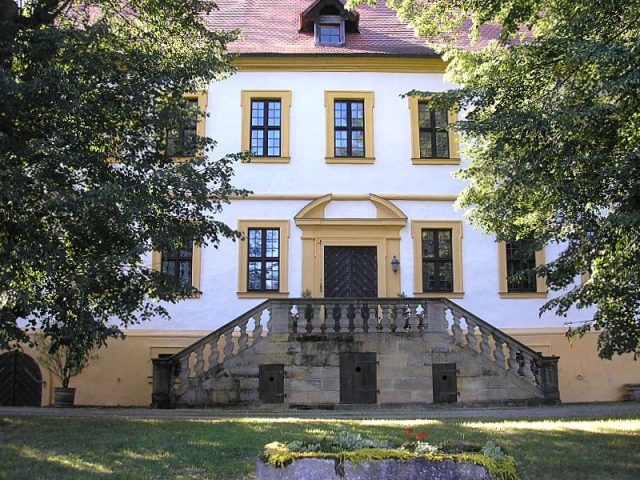
Weißenbrunn Castle is located on the edge of the Ebern district of Weißenbrunn in the Haßberge district (Lower Franconia). The small baroque country estate is privately owned. A gallery in the castle with exhibitions of contemporary art is open at times.
Weißenbrunn appears to have been the seat of a minor noble family as early as the Early and High Middle Ages. The first mentions, which are not considered secure due to missing source information or possibilities of confusion, date back to the years 804 and 1177 when a Herold von Wizenbrunn appears as a witness in a deed of gift from the Bamberg bishop Otto von Andechs in Weitramsdorf to Langheim Monastery. The first secure documentary evidence dates to 1232. In the parish division deed of the original parish of Pfarrweisach, "Wisenbrunnen" (in the possession of the Lords of Raueneck), like most of the surrounding villages, was then assigned to the newly founded parish of Ebern. Later, the lordship belonged to the Lords of Fuchs, and the Truchseß von Wetzhausen were also among the feudal lords in the village. Like most surrounding castles and palaces, the Weißenbrunn estate, along with the hamlet, was destroyed in the Peasants' War in 1525. According to tradition, this old estate was located on the opposite hill near the old quarry and was part of a chain of hilltop castles that had been newly founded along the Rennweg since the 11th century. They served to protect the prehistoric elevated path and later the new valley road that connected the royal courts in the Gäuland. However, no special terrain traces or other documents about the castle site have been preserved.
After the fortifications had increasingly lost their importance as protection along the elevated path, the Fuchs family, in accordance with the representative requirements of the time, now built a "small castle" near the village lake. The described location and the architectural prominence suggest that the former inn in the village center (house number 11) was this old Fuchs "small castle".
The economic hardship during and after the Thirty Years' War had not spared the lower nobility. Georg Adam Fuchs von Bimbach first mortgaged the feudal estate of Weißenbrunn to the Hanau councilor Johann Daniel Herpfer, the Meiningen councilor Philipp von Schönborn, and from him to the Prince-Bishopric of Würzburg. In 1695, Christoph Hanß Fuchs von Bimbach then requested the Würzburg bishop for the sale of the Weißenbrunn feudal estate to the Bamberg castellan of Zeil, Johann Rudolf Moser, who sold the knight's estate with the consent of Bishop Johann Gottfried von Guttenberg and the approval of the cathedral chapter on April 7, 1696, to the Colonel-Sergeant Georg Philipp von Boyneburg. Thus, the centuries-old rule of the Fuchs family in Weißenbrunn came to an end.
The Boineburgs were an old noble family originally from Hesse. Georg Philipp von Boineburg probably belonged to the Lengsfeld Conradinian main line, a Franconian branch that had its ancestral seat in the knightly canton of Rhön-Werra and already owned estates in Dörflis. Since 1704, he was the holder of the District Infantry Regiment No. 3, one of the three continuously existing infantry regiments of the Franconian Circle, and went through a considerable military career in the Franconian Circle troops, during which he was also appointed Lieutenant General Field Marshal.
In 1698, Georg Philipp von Boineburg requested the Bishop of Würzburg that the cent-freedom existing on the small castle in Weißenbrunn be transferred to another nearby place where he intended to build a castle. This was granted to him, and the new construction of the present castle is also attributed to him or his heirs. A roof tile of the castle is dated to 1723, and according to the stylistic forms, the building is likely to be from this period.
Georg Philipp von Boineburg must have soon found himself in financial difficulties. Already between 1711 and 1716, he asked the Würzburg bishop for feudal permission to sell the estate in Weißenbrunn to Ludwig A. von Vasolt, but the sale did not materialize. After the bishop had initially denied him the right to raise funds on the Weißenbrunn estate, he then approved the mortgage against a capital increase of 4000 thalers between 1719 and 1737, and finally the sale to Johann Christoph von Varell. The short-term owner Johann Christoph von Varell, however, had little interest in the manor and sold the castle and knight's estate in 1740 to the Princely Bamberg Privy Councilor Franz Ignaz von Hebendanz, who in turn sold it to his son-in-law Heinrich von Oberkamp in 1749.
The manor was now to remain in the possession of the Oberkamp family, a Catholic, originally Rhenish noble family, as a hereditary fief for four generations. After a request to the Episcopal Ordinariate in Würzburg, in 1752, a private right to hold holy masses in the castle chapel was granted only for the lordship and its employees. At the time of their father's death, the two sons Philipp Joseph and Carl Anton von Oberkamp were still minors. Like their father, they also underwent legal training and were also members of the Bamberg court. In 1791, they were admitted to the Franconian Imperial Knighthood in the canton of Baunach, and after both brothers died in 1806, the knight's estate passed into the possession of Franz von Oberkamp, the son of the elder Philipp Joseph von Oberkamp. He was in military service of the Duke of Nassau and lived in Wiesbaden; he was probably rarely present at the knight's estate.
After the dissolution of the Imperial Knighthood, the only remaining state-law prerogative for the nobles was the possibility of establishing so-called patrimonial courts. However, the lords of the manor only had limited police and judicial power over the tenants, which was restricted to contentious and voluntary jurisdiction. In the constant absence of the lord of the manor, Matthias Gottfried Reichenbach was appointed as patrimonial judge at the knight's estate in Weißenbrunn. However, by express order of the royal government of the Untermainkreis, for reasons of judicial credibility, legally trained personnel had to be consulted and paid in all patrimonial courts. For the small knight's estate and given the impoverishment of the subjects, this meant an almost unbearable financial burden. All the more, however, efforts seemed to be made to hold on to one of the last privileges from the Middle Ages and feudal times for as long as possible, and initially Johann Val. Jakob, who was already obliged to the patrimonial court of Baron v. Rotenhan zu Eyrichshof, was also called in for court hearings in Weißenbrunn. In the course of the progressive formation of municipalities in Bavaria, the village, together with Welkendorf and Gemünd, formed an independent political municipality since 1818, and a year later Franz von Oberkamp requested the allodification of his feudal estate. When he finally returned his patrimonial court in Weißenbrunn to the state on January 12, 1820, private jurisdiction in Weißenbrunn also came to an end.
At his death on February 3, 1832, his son Ludwig was still a minor, and therefore Hermann von Rotenhan was initially appointed as the legally obligated feudal guardian for Ludwig von Oberkamp. Since 1835, Johann Jordan was a tenant on the estate, and the then estate and forest administrator Heinrich Volkmar described the economic and social conditions, referring to the outstanding corvée payments and hereditary rents, visibly affected with the words that "the hardship here was so great that one cannot even describe it." Only timber harvesting from the forest seemed to provide tolerable income, and the comparatively high construction and improvement costs of 2057 guilders in 1844 suggest that more extensive renovation work was carried out again in that year.
Always absent anyway, Ludwig von Oberkamp finally sold the castle with all its associated property on December 27, 1850, for 48,000 guilders to Louis Ludloff, who was the tenant of the knight's estates of Obersiemau and Birkach in the Duchy of Saxe-Coburg. The previous tenant, named Roth, had to leave the estate upon its handover on February 26, 1851, and the district forester Georg Renner also had to vacate his official residence in the castle. Only two years later, in 1852, Louis Ludloff already sold the property again to the Chamber Councilor Adolf Huschke, as he had evidently overextended himself financially with the purchase of the former knight's estate. The estate was then one of the largest in the Ebern district and comprised 172 Tagwerk of fields, 42 Tagwerk of meadows, and 275 Tagwerk of forest.
Adolf Huschke, who came from a well-known Lutheran family from Breslau, was an eager promoter of the efforts of Protestants to separate from the Catholic parish association of Jesserndorf. As the Jesserndorf teacher Krimm reported in his chronicle, Adolf Huschke had agreed to provide some rooms in his castle for the vicar's residence and a worship room until the completion of the Protestant church and rectory in Jesserndorf. Rooms for the Protestant school were also planned in an outbuilding. On March 16, 1855, Johann Lorenz Keßler, a candidate for the preaching office appointed as the first vicar and teacher of the Protestant branch community of Jesserndorf, moved into Weißenbrunn, and on Palm Sunday, April 1, 1855, the first service took place. Weißenbrunn Castle was now the place of worship for the Protestant community for over 3 years until the inauguration of the Protestant church in Jesserndorf on October 24, 1858.
After Adolph Huschke died childless in Schweinfurt in 1864, his wife Emilie was initially the sole heir, and subsequently, the lords of the castle changed more and more frequently. Among the owners were, among others, a certain Gerold, the manufacturers Engelhardt from Sonneberg and Rätzer from Oberfrohna near Chemnitz, the Schmitt brothers, the economist Karl Gerber from Unterhohenried (a brother of the former ecclesiastical councilor Gerber in Ebern) and the freight forwarder Aßmann until the estate was finally taken over by the Schönlau family in 1907. In 1952 and 1958, the former knight's estate was hit by two major fires that severely damaged the farm buildings. The former tenant's house, as well as the manorial sheepfold and the bakehouse with its two ovens, fell victim to the flames.
After another change of ownership in 1980, the property was thoroughly renovated, and despite all modesty, today an extremely charming view of the ensemble of a hidden baroque small residence is once again offered from the opposite old quarry. It is precisely the secluded location that also reawakens something of the baroque way of life of Franconian knights, who probably shaped the cultural landscape of the Haßberge like no other social group. With their castles, they left behind a lasting cultural heritage that was a visible expression of their way of life in the 17th and 18th centuries and often stood in contrast to the everyday reality and living conditions of the majority of the population, especially in the countryside.
Description+
The two-story, rectangular manor house exhibits typical stylistic elements of the transition period from Renaissance to Baroque. The simple, single-wing building of 11 by 5 window axes rests on a color-contrasting basement and is topped by a hip roof. The floors are separated by a simple string course (round bar cornice), and the corners are enlivened by rusticated corner pilasters, both characteristic features of the Late Renaissance. The elevated main entrance on the south side is accessible via a double-flight open staircase with a balustrade railing and, like the simple, rectangular portal with a segmental pediment and the lugged windows, is typical for baroque castle buildings in the region.
The interior, with an original spacious wooden staircase, is also simply designed. Some rooms feature modest decorations of foliage and strapwork stucco.
Particularly charming are the small baroque garden to the east, which likely dates from the period of origin and whose strict "French" conception has been restored according to old plans, as well as the English park rising up the slope with its old trees. Such seemingly natural landscape gardens in the English style only emerged later in the second half of the 18th century, when, with the rise of naturalism, the artificial garden creations of the Baroque were increasingly perceived as a violation of nature.
Take Mobile History with you
You are reading this text for free. Premium adds what matters on the road: descriptions read aloud, sites found through your camera, whole regions taken offline.
- Every description, including the ~17,700 Premium sites
- Audio guide: have descriptions read to you on location
- AR finder: see sites through your camera, with distance and bearing
- Unlimited saved sites
14 days free, then from €2.99 a month. Cancel anytime.
Source: Wikipedia · Licence: CC BY-SA 4.0
This description draws on the facts documented in the linked Wikipedia article; Wikipedia content is licensed under CC BY-SA 4.0. Wording and editing: Mobile History.
Location: 50.0782, 10.6932