Restaurant
CastleMarbach SG
Weinstein Castle (Marbach)
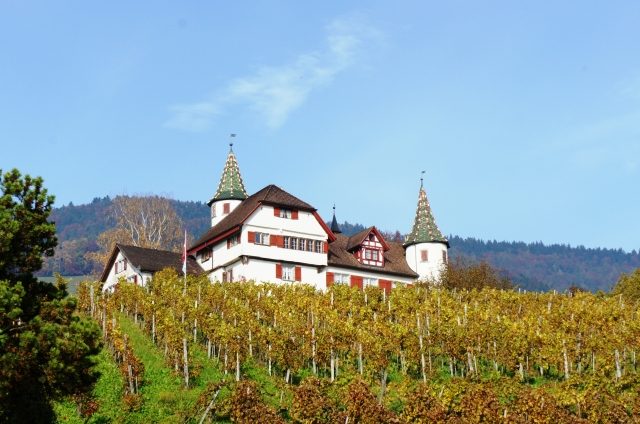
Weinstein Castle was an old noble seat of St. Gallen council families and was first mentioned in documents at the end of the 14th century. In the family chronicle of the Varnbühlers of St. Gallen, a Hans Varnbühler zu Weinstein is first mentioned in 1375. A descendant of the first Weinstein lords was Mayor Ulrich Varnbühler of St. Gallen, who made a name for himself as a field captain of the St. Gallen troops in the Burgundian Wars. It was he who built Weinstein Castle in place of the overly modest summer residence in Marbach. Varnbühler was an opponent of abbatial sovereignty and thus also an adversary of the power-hungry Abbot Ulrich Rösch. As one of the initiators of the Rorschach monastery breach (1489), he was defeated by the Confederates allied with Abbot Ulrich Rösch and banished from the country. On this occasion, the Rhine Valley came under the sovereignty of the eight old cantons. The Appenzellers were also on the side of the St. Galleners with Ulrich Varnbühler at their head. Ulrich Varnbühler fled to Germany. All his possessions, including Weinstein, were expropriated. After a lengthy process before the Imperial Chamber Court, Emperor Maximilian I ordered the return of the properties located outside the city of St. Gallen - including Weinstein Castle. Ulrich Varnbühler himself did not live to see this. Ownership of Weinstein passed to Ulrich's son Johannes (Mayor of Lindau). From him, the property passed to his son Nikolaus Varnbühler, Württemberg councilor, professor of law in Tübingen and multiple rector of the university. Nikolaus Varnbühler, the grandfather of Johann Conrad Varnbühler, who was enfeoffed with Hemmingen, sold Weinstein in 1559 to his brother-in-law Caspar Schlumpf, Mayor of St. Gallen. In 1590, Weinstein passed to the St. Gallen family of Schlapparitzi. These in turn expanded the castle in 1613 with the northeast wing, which now houses the Knights' Hall or Schlapparitzi Hall, and the mighty wine press.
From the Schlapparitzis, ownership passed by inheritance to Hans Heinrich Fels and the Högger family, later to Johann Heinrich Zollikofer of St. Gallen. In 1763, a Rheintaler, the Altstätten merchant Johann Jakob Custer, is first mentioned as owner. The construction of the west wing probably also falls into this period. In 1841, the bourgeois Johann Anton Kuster of Altstätten first bought Weinstein at auction. Weinstein was expanded with the addition of the farm building.
The documents do not specify how long the castle has operated as a restaurant - but it is likely to fall into this period.
In 1943, Johannes Herzog of Thal, the grandfather of the current owner family, bought the castle. From 1954 to 1984, Hans and Selma Herzog-Wälter successfully continued the business. In 1984, the children took over the castle on lease from their parents, until it was then acquired by Alfred and Käthy Herzog-Gfeller in 1986. In 1979, the entire castle wall was renovated. In 1981, both towers had to be re-roofed after a devastating storm. In 1984, the Schlapparitzi Hall was renovated and a central heating system was installed.
Take Mobile History with you
You are reading this text for free. Premium adds what matters on the road: descriptions read aloud, sites found through your camera, whole regions taken offline.
- Every description, including the ~17,700 Premium sites
- Audio guide: have descriptions read to you on location
- AR finder: see sites through your camera, with distance and bearing
- Unlimited saved sites
14 days free, then from €2.99 a month. Cancel anytime.
Source: Wikipedia · Licence: CC BY-SA 4.0
This description draws on the facts documented in the linked Wikipedia article; Wikipedia content is licensed under CC BY-SA 4.0. Wording and editing: Mobile History.
Location: 47.3970, 9.5711