Cultural center
CastleKefermarkt
Weinberg Castle
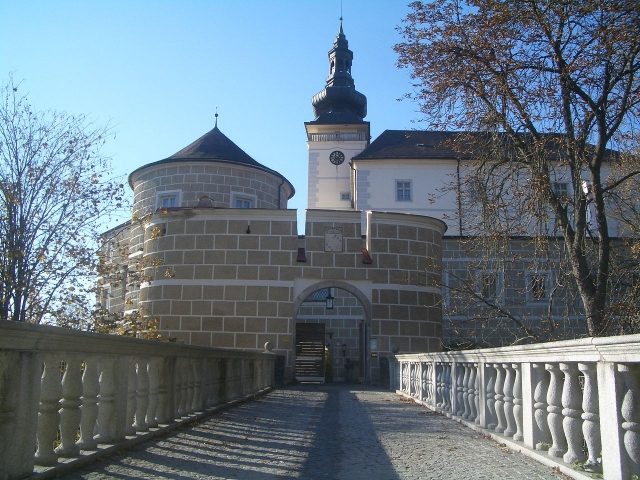
Schloss Weinberg is a castle complex in Upper Austria, located on the Weinberg hill above the village of Kefermarkt in the Mühlviertel region. The first castle on this site was built in the 13th century and significantly expanded under the Thürheim family from 1629. After it became almost uninhabitable in the early 1980s, the Province of Upper Austria leased the castle in 1986 for 99 years, renovated it, and hosted a provincial exhibition in its premises in 1988. Since 1989, the castle has served as a provincial education and music center.
Originally, the castle was part of the Freistadt dominion and was separated from it as a princely fief. The first documented mention occurred in 1305, when the Piber family of Weinperge were named as holders of the fief. The castle itself had existed for a longer time and was built after the clearing of the surrounding forest was completed. In 1378, the castle came into the possession of the Zelking family; they already owned half of the castle in 1359.
The brothers Ruger and Alber von Zelking were the first lords of the castle from this noble family. Particularly noteworthy is Christoph von Zelking († 1491), who significantly expanded the Weinberg dominion through acquisitions, thus rising to become an important landowner in the region. Additionally, he was also the administrator of Freistadt. Under Christoph, the parish church of Kefermarkt, including its late Gothic winged altar, was built in 1490, and the village was elevated to a market town on September 17, 1479. In 1510, Emperor Maximilian I abolished the princely feudal sovereignty, and the Weinberg dominion was henceforth a free allodial property. Under Hanns Wilhelm, alterations were made, and the castle served as a refuge for the population of Kefermarkt during the period of the Turkish threat (1594). For this reason, the castle had good military equipment. During the Upper Austrian Peasant War (1626), peasants captured the castle after prolonged fighting. As the Zelking family was Protestant, they were forced to leave the castle during the Counter-Reformation. Christoph Wilhelm von Zelking, Hanns Wilhelm's cousin, sold the castle on June 15, 1629, for 210,000 guilders and 1200 Reichstaler to Hans Christoph von Thürheim zu Bibrachzell, administrator of the Passau dominion of Ebelsberg.
The first Thürheim had the old castle converted into the present-day Schloss. The Thürheim family themselves climbed the career ladder and were appointed Imperial Counts in 1666. In the 18th century, they provided two provincial governors and held the hereditary office of Imperial Master Falconer. The castle was repeatedly slightly altered and rebuilt during this period.
In World War II, Soviet soldiers devastated the castle in 1945, rendering the main building uninhabitable. In May 1946, the occupying power returned the castle after all valuables had been removed. Between 1946 and 1954, the castle served as a training center for the construction and woodworkers' union. Briefly, it also served as a children's recreation home for the War Victims' Association.
They remained in possession of Schloss Weinberg until the family died out in 1961. Ownership then passed to Hans Ludwig von Gablenz-Thürheim and Christian von Zimmermann-Thürheim. In 1983, the "Schloss Weinberg" association was founded with the aim of saving the almost dilapidated castle. In 1986, the Province of Upper Austria leased the castle for 99 years and renovated it for approximately 6 million Euros. In 1988, the castle was reopened with a provincial exhibition on the theme "The Mühlviertel – Nature, Culture, Life." The exhibition attracted around 400,000 visitors. Since 1989, a provincial education and music center has been housed in the premises, and in the same year, a guesthouse brewery was established in the historic stables of the 400-year-old Meierhof. Every second Advent weekend since 1989, the Weinberger Advent Christmas market takes place in and in front of the castle. Handicraft products are exhibited in the castle. Concerts and other cultural events, such as an Easter market (since 1999) and a senior citizens' fair (since 2007), occasionally take place in the former state rooms.
Construction+
The imposing castle stands at around 600 m above sea level on a ridge of the Buchberg that slopes to the southwest. At its core, it is a Gothic castle that was converted into a Renaissance castle in the 16th century. The medieval castle with a rectangular, multi-story residential tower (26 x 27 meters) is recognizable in the northern part of the present-day castle. At the beginning of the 14th century, the castle was surrounded by a curtain wall with defensive towers. At the end of the 14th century, an 18-meter-high, 3-meter-thick, and 26-meter-long wall was added to the east to provide better protection against attacks. This wall was rebuilt in the 17th century and has since served as the exterior for living quarters.
Access to the castle is from the east through two gates. The outer gate was secured with a drawbridge, and a stone bridge is located in front of it. The inner gate sits on the former Zwinger wall, where the former battlements are still recognizable. In front of the curtain wall is the moat, where wolves were usually kept. The narrow outer courtyard of the castle surrounds the main building, the actual castle. This is a four-story building with a rectangular inner courtyard. A 45-meter-deep draw well from 1589 served for water supply in the Middle Ages.
A prominent, square tower dominates the castle. Its current appearance was given to it only after the fire of 1882. To the west, at the corners of the building, stand two round corner towers with conical roofs.
Description+
The former state rooms feature stuccoed ceilings and are equipped with lunette vaults. Some of the doors are fitted with massive, ornate portal frames. During the last renovation, the colorful wall frescoes were restored. In the former ancestral hall stands a beautiful Renaissance tiled stove with colorful figural tiles depicting ancient and mythological rulers. 16 painted coat-of-arms pyramids adorn the room. The Knights' Hall, which occupies the entire east front, is spanned by a barrel vault with frescoes by Johann Philipp Ruckerbauer. The Gothic castle chapel was renovated in 1635 after being destroyed by a fire in 1617. The altarpiece of the chapel is presumably by Bartolomeo Altomonte. In the castle garden stands an 18th-century falconer's house.
The rich interior furnishings of the 220 rooms, as well as the weapon collection and the family museum, were lost to looting in 1945. Only the Baroque castle pharmacy and the comprehensive castle archive could be saved. The former is located in the Linz Castle Museum, the latter in the Upper Austrian Provincial Archive.
Take Mobile History with you
You are reading this text for free. Premium adds what matters on the road: descriptions read aloud, sites found through your camera, whole regions taken offline.
- Every description, including the ~17,700 Premium sites
- Audio guide: have descriptions read to you on location
- AR finder: see sites through your camera, with distance and bearing
- Unlimited saved sites
14 days free, then from €2.99 a month. Cancel anytime.
Source: Wikipedia · Licence: CC BY-SA 4.0 · Image: http://commons.wikimedia.org/wiki/File:Schloss_Weinberg_1.JPG
This description draws on the facts documented in the linked Wikipedia article; Wikipedia content is licensed under CC BY-SA 4.0. Wording and editing: Mobile History.
Location: 48.4486, 14.5375