To be privately owned
CastleNürnberg-Schoppershof
Weigelshof Castle
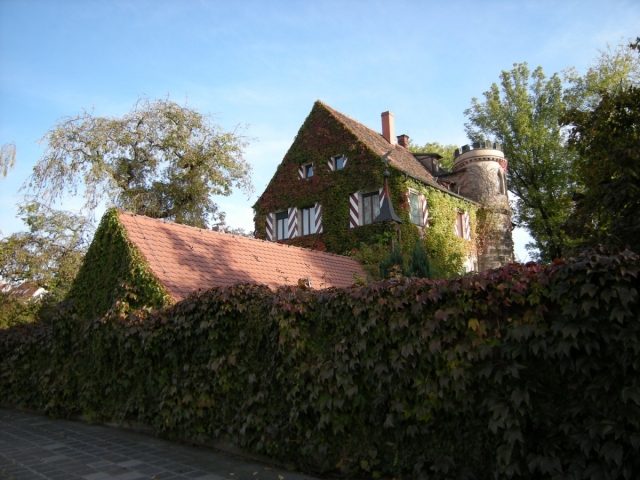
According to the annals of the Imperial City of Nuremberg from 1623, the Weigel von Neumarkt family is said to have coined the place name. Indeed, in 1388, Clara, the widow of Georg Ammann, sold half a farm near Schopper's farm, including 12 Tagwerk of meadows ("all of which once belonged to Weiglein"), to Contz Haug, who transferred them to the Carthusian monastery two years later. At the same time, Burgrave Friedrich V renounced his feudal lordship.
This now allodial farm must have later come into the possession of the Haller family, who built a residence there. It is not mentioned even in the report on the strategically important places in the region, which was ordered in 1504 before the outbreak of the Landshut War of Succession. Only on February 22, 1507, did Fabian Haller subsequently receive permission for his "Lusthaus" (a representative summer residence according to the language of the time) built near Weigelshof, but he had to commit to demolishing it at any time upon request by the Nuremberg Council.
By a hitherto unknown route, the residence came to Seifried Pfinzing (1486–1545), who mentioned it in his will; he also remembered his Voit zum Weigelshof in it. Together with Georg Dietherr, he owned two other farms there, which were margravial fiefs and must have originated from the other half of the half farm mentioned in 1388. They remained in the joint possession of the two families until the 18th century.
During the Second Margrave War, Weigelshof was burned down by the Nuremberg citizens themselves on May 17, 1552, to create a clear field of fire and deny shelter to enemy troops. The damage to the "Burgerßsytz" was estimated at 2,000 guilders.
Seifried's son Carl Pfinzing (1539–1570) had the residence rebuilt in 1568, one year after his marriage to Eleonora Geuder. His son Seifried Pfinzing had a new barn built in 1591. In the so-called Cnopf Sketchbook from 1612/14, the manor house is depicted in detail for the first time with its characteristic features that are still preserved today, e.g., the blind arcades on the hipped gable.
In 1617, the Weigelshof line died out with Seifried Pfinzing. He largely designated his enormous fortune for a charitable foundation, but bequeathed Weigelshof to his nephew Sebastian Scheurl von Defersdorf. The latter, in turn, gifted the property in 1649 to his grandson Carl Sebastian Pfinzing of the Gründlach line. After the death of his son Christoph Karl Pfinzing (1680–1739), Weigelshof fell as a legacy to his court clerk, the hospital master Johann Andreas Regulein.
Shortly thereafter, it came into the possession of the merchant family Günther. In 1770, Miss Sibylla Günther (1734–1797), daughter of market supervisor Johann Wolfgang Günther, owned the manor, in whose horse stable she had a room built for a stable boy. In 1777, she married Carl Friedrich Volckamer von Kirchensittenbach, who wanted to build a new annex in 1786 but died in the same year. In 1794, the widow married the Royal Prussian Chamberlain Friedrich Gottfried Ernst Freiherr von Egloffstein (1769–1848). The now widowed Baron had housed two workers in the manor house in 1798/99, who were to tinker there with the prototype of an "electric ignition machine." Only after lengthy negotiations was the Sebaldi Forest Office willing to cede two fire rights for 100 guilders so that the workspaces could be heated. The Baron did not remain in possession for long: by 1808, the community of heirs of the Nuremberg merchant Wilhelm Gottfried Kießling, who had acquired the estate shortly before his death, already disposed of the property.
The Kießling family sold it in 1815 to the merchant Karl Benedikt Schwarz (1771–1832), who at that time acquired a large number of stately properties, which helped him to be ennobled in 1816. Under his son Johann Christoph David von Schwarz (1802–1885), the manor house was probably redesigned in the Neo-Gothic style by Karl Alexander Heideloff in the 1830s [cf. Thumenberg]. On this occasion, the stair tower received its Gothic battlements. Furthermore, at this time, the Baroque garden was transformed into an English landscape garden, as the von Schwarz family had also done in Artelshofen and Henfenfeld. Nevertheless, Johann Christoph David von Schwarz sold the property as early as 1843 to the banker Georg Martin Kalb. From the subsequent owner Constantin Beck, it was acquired in 1879 by the hop merchant Johannes Barth, who had his coat of arms placed above the front door.
During the Second World War, the three-story manor house, built of sandstone blocks, was damaged and underwent a simplified restoration after 1945. Its appearance is still characterized by the hipped gable roof with dormer windows, the blind arcades in the north gable, and the battlemented tower. In the early 1950s, it was once noted that although the building had "outwardly" survived the World War, its "interior ... had suffered from various modernizations."
Take Mobile History with you
You are reading this text for free. Premium adds what matters on the road: descriptions read aloud, sites found through your camera, whole regions taken offline.
- Every description, including the ~17,700 Premium sites
- Audio guide: have descriptions read to you on location
- AR finder: see sites through your camera, with distance and bearing
- Unlimited saved sites
14 days free, then from €2.99 a month. Cancel anytime.
Source: Wikipedia · Licence: CC BY-SA 4.0 · Image: http://schloesserrundschau.de/bayern/schloesser01/nuernberg22.html
This description draws on the facts documented in the linked Wikipedia article; Wikipedia content is licensed under CC BY-SA 4.0. Wording and editing: Mobile History.
Location: 49.4663, 11.1094