Cultural Events
CastleOberneukirchen-Waxenberg
Waxenberg Castle
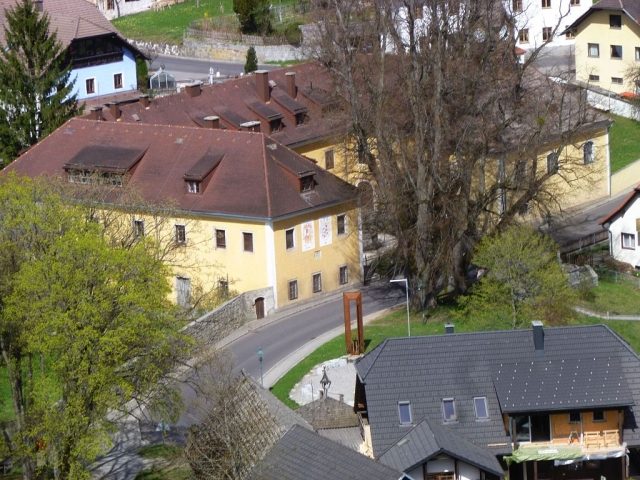
Waxenberg Castle is located in the town center of Waxenberg in the municipality of Oberneukirchen in Upper Austria's Mühlviertel region. The castle was built in the 17th century below Waxenberg Fortress and served as the seat of the Waxenberg dominion between 1756 and 1848. In 1910, the castle was expanded and is now used for events. It is owned by the Starhemberg family.
The castle was presumably built in the 17th century by the Lords of Gera. They also owned Waxenberg Fortress and built the castle about 200 meters away, below the fortress. When the fortress was destroyed by a lightning strike in 1756, the Starhemberg family, who had owned Waxenberg since 1640, moved into the castle and expanded it. The castle chapel has served as the local parish church since 1784. It is the last private patronage of the Starhemberg family. Between 1908 and 1910, a further expansion of the castle took place, with the new castle being built north of the old one.
In the interwar period (1918–1938), Prince Ernst Rüdiger von Starhemberg used the castle as a base for the Heimwehr, which he led. In 1938, the castle was expropriated by the National Socialists and made available to the Volksfürsorge (People's Welfare). After the Second World War, it was returned to the Starhembergs. Between 1948 and 1968, the building was used by the Association of War Blind, then renovated several times, and is now used for events.
Description+
The castle consists of the Old and New Castle. The older castle is a two-story, horseshoe-shaped building, open to the south. It was built in the 17th century. In the inner courtyard stands an octagonal fountain dating from the 17th century. The south side of the west wing is adorned with coats of arms of the Starhemberg, Jörger, Gera, and Turzo von Bethlen-Falva families. The richly decorated castle chapel inside is dedicated to Saint Joseph and is located at the southeast corner of the castle. Most of the furnishings date from the late 19th century, with the high altar by Ferdinand Stuflesser from 1892. The family crests of the Starhembergs and Jörgers are affixed to the outer wall. Currently, the Waxenberg Water Cooperative is housed in the castle.
The new castle is also a horseshoe-shaped building, open to the east. The two- to three-story building is located north of the old castle and was built around 1910. The Knights' Hall on the top floor has a carved beamed ceiling from the mid-16th century, which originates from Eschelberg Castle.
Take Mobile History with you
You are reading this text for free. Premium adds what matters on the road: descriptions read aloud, sites found through your camera, whole regions taken offline.
- Every description, including the ~17,700 Premium sites
- Audio guide: have descriptions read to you on location
- AR finder: see sites through your camera, with distance and bearing
- Unlimited saved sites
14 days free, then from €2.99 a month. Cancel anytime.
Source: Wikipedia · Licence: CC BY-SA 4.0 · Image: http://commons.wikimedia.org/wiki/File:Waxenberg_%28Schloss_Waxenberg-1%29.jpg
This description draws on the facts documented in the linked Wikipedia article; Wikipedia content is licensed under CC BY-SA 4.0. Wording and editing: Mobile History.
Location: 48.4772, 14.1908