To be privately owned
CastleEberndorf-Peratschitzen
Wasserhofen Castle
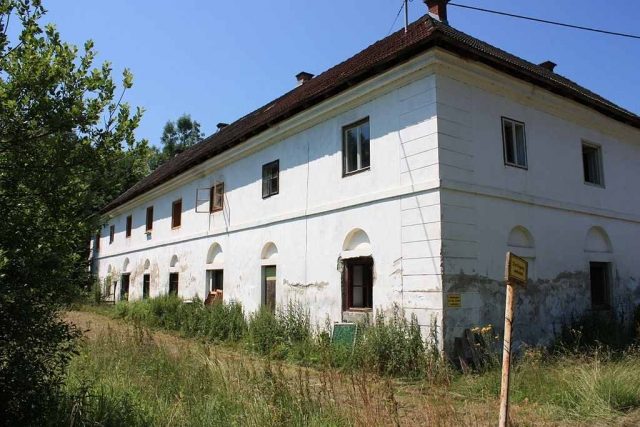
Schloss Eberndorf: A Historical Gem in Carinthia+
Schloss Eberndorf, a former Augustinian canonry, is a significant historical building located in the market town of Eberndorf in Carinthia, Austria. Its rich history dates back to the 11th century, and it has played a pivotal role in the region's cultural and religious development.
Early History and Foundation+
The origins of Schloss Eberndorf can be traced back to a Benedictine monastery founded around 1070 by the Archbishop of Salzburg, Gebhard. This monastery was later converted into an Augustinian canonry in 1100 by Bishop Ulrich I of Passau. The Augustinian canons were instrumental in the spiritual and economic development of the region, establishing schools, cultivating land, and providing pastoral care.
Architectural Evolution and Transformations+
Over the centuries, Schloss Eberndorf underwent numerous architectural transformations, reflecting the changing styles and needs of its inhabitants. The original Romanesque structures were gradually replaced or expanded with Gothic, Renaissance, and Baroque elements.
Romanesque and Gothic Periods
The earliest surviving parts of the castle date back to the Romanesque period, including remnants of the monastery church. During the Gothic era, significant additions were made, such as the impressive chapter house and parts of the cloister. These Gothic elements showcase the intricate craftsmanship and artistic sensibilities of the time.
Renaissance and Baroque Influences
In the 16th century, under the patronage of Provost Hieronymus Ungnad von Sonnegg, the castle was extensively renovated and expanded in the Renaissance style. This period saw the construction of new residential wings, arcaded courtyards, and decorative facades. Later, in the 17th and 18th centuries, Baroque elements were introduced, particularly in the interior decoration of the church and some of the ceremonial halls, adding a touch of grandeur and opulence.
Secularization and Later Ownership+
The Augustinian canonry of Eberndorf was dissolved in 1787 as part of Emperor Joseph II's secularization reforms. The property then passed into state ownership before being acquired by private individuals.
The castle was built by the Augustinian canonry of Eberndorf. Later, ownership transferred to Ungnad von Sonnegg and the Bishops of Bamberg.
Schloss Eberndorf Today+
Today, Schloss Eberndorf serves as a vibrant cultural and educational center. It houses a hotel, a restaurant, and various event spaces, making it a popular venue for weddings, conferences, and cultural events. The former monastery church, with its stunning Baroque interior, is still used for religious services and concerts. The castle also hosts a museum that showcases its rich history and archaeological findings from the region.
Schloss Eberndorf stands as a testament to centuries of history, faith, and architectural evolution. Its well-preserved structures and ongoing cultural activities ensure that this historical gem continues to thrive and captivate visitors from around the world.
Take Mobile History with you
You are reading this text for free. Premium adds what matters on the road: descriptions read aloud, sites found through your camera, whole regions taken offline.
- Every description, including the ~17,700 Premium sites
- Audio guide: have descriptions read to you on location
- AR finder: see sites through your camera, with distance and bearing
- Unlimited saved sites
14 days free, then from €2.99 a month. Cancel anytime.
Source: Wikipedia · Licence: CC BY-SA 4.0 · Image: http://commons.wikimedia.org/wiki/File:Schloss_Wasserhofen.JPG
This description draws on the facts documented in the linked Wikipedia article; Wikipedia content is licensed under CC BY-SA 4.0. Wording and editing: Mobile History.
Location: 46.6246, 14.6133