Foundation
CastleGaal
Wasserberg Castle
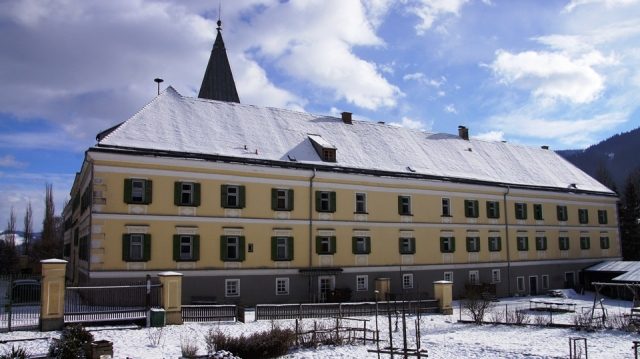
Wasserberg Castle is a castle in the municipality of Gaal near Knittelfeld, Styria, Austria.
In the angle formed by the Ingering and Gaal streams, on a small hill, lies the castle, which was once surrounded by a wide moat and swamps.
The upper Ingering Valley and the Gaal Valley came into the possession of the Archdiocese of Salzburg around 860. The archbishops may have had a fortified building erected on the site of the later castle as early as the 10th century and garrisoned it with Salzburg ministeriales.
In 1174, Margrave Ottokar confirmed the donation of a forest near wazerperc by Poppo von Tirnberch to Seckau Abbey. The margrave's representative, Reinbert von Mureck, indicated the boundaries of this forest to the abbey.
For the foundation of the Diocese of Seckau in 1218, the Archbishop of Salzburg donated the area around Wasserberg to the Bishop of Seckau. Around 1260, Bernhard von Seckau had a castle built on the donated property, which received the name of the region. In the 13th and 15th centuries, the castle was occasionally also named after its owners Seccoburg = Seccauburg, which, however, did not prevail.
In 1261, Otto von Wasserberg from the Galler (Geuler) family appears as the bishop's castellan. Dietmar aus der Geul, the father of the Styrian rhyming chronicler Ottokar aus der Gaal, conquered the castle in 1276 and drove out the Bohemians, after the castle had been handed over to the Bohemians by Bishop Wernhart von Seckau, who was on the side of King Ottokar. King Rudolf von Habsburg returned the castle to the Bishop of Seckau in the same year.
Bishop Rudmar von Hader (1337-1355) issued numerous documents in Wasserberg. In 1338, he received fishing rights on Lake Ingering from Duke Albrecht II and in 1358 the patronage rights over the parish church in Gaal.
In 1343, Otto der Geuler appears as castellan of the castle, in 1347 together with Niklas der Geuler, who held this office until 1367. Niklas Galler was succeeded as castellan and district judge by Nicla der Ennstaler, who still held this position in 1403.
In 1479, Bishop Christoph von Seckau handed Wasserberg over to the Hungarians. In 1480, the castle was recaptured by imperial troops under Field Captain Andreas Lueger.
Bishop Christoph's successor, Bishop Matthias Scheit, sided with Emperor Frederick III. However, Lueger did not want to hand over the castle and "caused the bishop's people many adversities," as a report from 1482 states. Following an order from Emperor Frederick III, Lueger finally returned the castle to the Bishop of Seckau.
Under Bishop Matthias Scheit (1482-1503/12), the castle was expanded into a palace. In the course of a long dispute with the Seckau cathedral provost, Bishop Matthias died excommunicated in Wasserberg in 1512. In 1482, Jörg Mertschtainer was the episcopal castellan of the castle, now again called Seccoburg.
In the 16th century, Andree Zach von Lobming (1521 - 1538) and Lienhardt Muerer (since 1540) served as administrators of the bishop at the castle. The high Turkish taxes forced Bishop Petrus in 1555 to pledge the castle and lordship of Wasserberg to Christoph Haymer for 10,000 fl, with the option of repurchase within 10 years.
After the repurchase, the lordship was leased for 10 years to Zacharias Gabelkhoven in 1565. In 1573, Gabelkhoven's widow took over the lease. In 1574, Paul Persicus, who was recommended by the Archbishop of Salzburg, and Adam von Gallenberg, who was recommended by Archduke Karl, applied for the vacant lease. "I will address the matter in over 14 days," the bishop wrote in a letter.
In 1590, the bishop again began to appoint administrators who had to render accounts:
- 1599-1603 Raimund Eberlein
- 1610-1630 Hans Jakob von Gabelkhoven
- 1640-1649 Hans Wilhelm Grießler
- 1649-1664 Martin von Ehrberg
- 1666-1671 Andreas Christoph von Rindsmaul
- 1671-1690 Johann Egger
- 1690-1700 Franz Kammerlander
After the Thirty Years' War, in 1649, administrator Martin von Ehrberg complained that he had to provide 40 soldier rations daily and hoped that these uninvited guests would soon depart.
The Wasserberg lordship comprised 36 mills, two fulling mills, a castle precinct, and subjects in widely scattered offices. The manor farm included meadows, fields, and alpine pastures.
In 1844, after almost 600 years of episcopal ownership, the lordship and Wasserberg Castle were sold to Maximilian Seßler from the then most important industrialist family of the Mürz Valley.
Owners+
- 1260 - 1844 Diocese of (Graz-)Seckau
- 1844 - 1880 Maximilian Seßler (died 1862), then the Seßler family
- 1880 - 1884 Julius Maya
- 1884 - 1891 Gottfried Dub
- 1891 - 1893 Baron Hans von Westerhagen
- 1893 - 1894 Leopold Grünhut
- 1894 - 1897 Count Max Arco-Zinneberg
- 1897 - 1906 Prince Arnulf of Bavaria
- 1906 - 1912 Karl von Thuillieres Count of Montjoye la Roche
- 1913 - 1939 Heiligenkreuz-Neukloster Abbey
- 1939 - 1945 Reichsforstverwaltung (Reich Forest Administration)
- 1945 - 1950 Treuhandverwaltung des Landes Steiermark (Trust Administration of the State of Styria)
- since 1950 Heiligenkreuz Abbey
Take Mobile History with you
You are reading this text for free. Premium adds what matters on the road: descriptions read aloud, sites found through your camera, whole regions taken offline.
- Every description, including the ~17,700 Premium sites
- Audio guide: have descriptions read to you on location
- AR finder: see sites through your camera, with distance and bearing
- Unlimited saved sites
14 days free, then from €2.99 a month. Cancel anytime.
Source: Wikipedia · Licence: CC BY-SA 4.0 · Image: http://www.wehrbauten.at
This description draws on the facts documented in the linked Wikipedia article; Wikipedia content is licensed under CC BY-SA 4.0. Wording and editing: Mobile History.
Location: 47.2693, 14.6867