Children's home
CastleWartenburg
Wartenburg Castle
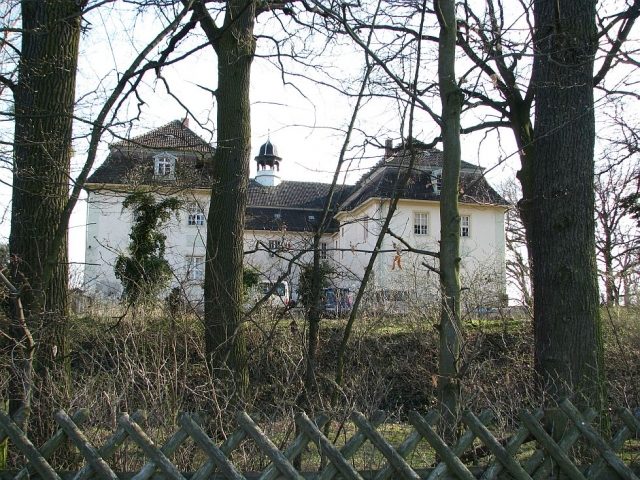
The foundation stone for the castle in the former Wartenburg manor was laid in 1663. In 1769, Baron von Hohenthal bought it. During the Wars of Liberation, the place became known for the Battle of Wartenburg on October 3, 1813, where an army corps of Prussian Field Marshal Blücher forced Napoleon's army to give up the crossing over the Elbe. This was the prerequisite for the later victory of the allied troops over Napoleon in the Battle of the Nations near Leipzig. Wartenburg Castle was the headquarters of the Allies for three days at the beginning of October 1813. Among others, Field Marshal Blücher, Generals Gneisenau and York, and Crown Prince Wilhelm of Prussia stayed here.
Count Peter von Hohenthal acquired the estate from his brother in 1920. In 1921, a wing of the originally square-shaped building was demolished. Towards the end of World War II, the count's family had to flee from the Red Army. In 1946, the castle was nationalized by the Soviet occupation forces. The president of the then province of Saxony ordered the establishment of a reformatory in the building. Initially, from January 1947, mainly war orphans and refugee children who had lost their parents were cared for here. At the same time, so-called "difficult-to-educate" children were admitted to the home from the beginning. A home school was also immediately established. At that time, 90 children lived in three groups in the home. They were cared for by four educators. Two permanent teachers and two itinerant teachers provided for the children's education.
In the mid-1950s, the institution was transformed into a "home for severely difficult-to-educate special needs students." Since then, there were only 60 children in three groups, six educators, and an independent home school. In 1952, the castle's columned hall served as a dormitory for 20 children. During GDR times, the children's home bore the name of the communist resistance fighter Walter Husemann (1909 - 1943).
After the fall of the Berlin Wall, the children's home in the castle was initially supported by the municipality of Wartenburg. In 1994, the Evangelical Youth and Welfare Organization took over the sponsorship of the institution. At the same time, two more buildings, the former rural outpatient clinic and the crèche, were added to the Schloss Wartenburg Children and Youth Welfare Association.
Currently, a total of 50 children and young people aged 6 to 18 are cared for in the castle and in the two other houses in the village. Some of them cannot or do not want to live with their families for various reasons, others show learning or behavioral disorders. In Wartenburg, they live in family-like groups. The children and young people living in the institution are firmly integrated into the village community.
The town of Wartenburg and the youth welfare institution find a literary-fictionalized equivalent in Antje Wagner's youth thriller Unland.
Take Mobile History with you
You are reading this text for free. Premium adds what matters on the road: descriptions read aloud, sites found through your camera, whole regions taken offline.
- Every description, including the ~17,700 Premium sites
- Audio guide: have descriptions read to you on location
- AR finder: see sites through your camera, with distance and bearing
- Unlimited saved sites
14 days free, then from €2.99 a month. Cancel anytime.
Source: Wikipedia · Licence: CC BY-SA 4.0
This description draws on the facts documented in the linked Wikipedia article; Wikipedia content is licensed under CC BY-SA 4.0. Wording and editing: Mobile History.
Location: 51.8136, 12.7792