To be privately owned
CastleWallenried
Wallenried Castle
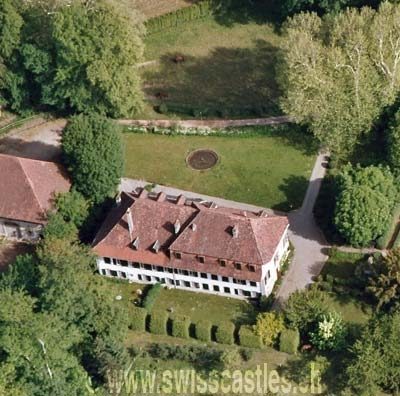
Most of the territory of Wallenried gradually came into the hands of the Castella family. This territory was formerly divided into several fiefdoms, which in the 16th and 17th centuries belonged to the following families: von Cléry von Watteville, von Praroman, von Lenzbourg, Erhard, Lanther, Kessler, von Fégely, von Gléresse and von Diesbach.
For the repayment of a debt of more than 5,000 livres, Captain Jean Ulrich von Lenzbourg was condemned in 1659 to hand over his estate of Wallenried to his creditor, Captain Charles Kessler (died in 1664). Kessler's daughter, who married Jean-Pierre von Castella (1643-1720), became the owner and wrote in her will of 1719 about the joys of this estate. She transferred this "with all that was added and bought for 5,000 livres" to her son, Francois-Joseph-Emmanuel, born in 1672, in the CC from 1699, Bailiff of Cheyres from 1724 to 1730, died in 1730. His wife Marie-Madeleine von Weck gave him a large number of children - sixteen in total. After his death in 1730, the estate was managed by his widow Marie-Madeleine. Legally, it passed to her son, Rudolph (1705-1793), the future Lieutenant-General in French service, and was inhabited by his brother Nicolas-Albert, Lord of Berlens from 1752.
On November 19, 1765, Rudolph von Castella was authorized by the small council of Fribourg to transform his estate of Wallenried into a substitution (an inalienable family property that could only be inherited from male predecessor to male descendant). This was in favor of his nephew, Nicolas-Antoine-Xavier, the eldest son of his brother Nicolas-Albert of the Berlens branch.
After Rudolph's death in 1793, Nicolas-Antoine-Xavier (1767-1830), Colonel and General in the service of France under Napoleon, became one of the most important "gentilshommes of agricultural science" of the Fribourg region. He lived in Paris, but had his lands managed. He married Anne-Marie von der Weid von Seedorf.
He enlarged his lands by one hundred poses (233 against 1813), modernized his methods, rebuilt his buildings and favored wheat cultivation. However, this interesting experiment was a failure, and in 1831 after the general's death, the area was handed over to a farmer.
With the death of Rudolph von Castella, the general's son, in 1890, the Berlens branch died out. The inheritance went to the Delley branch, in the person of Albert (1877-1953), then to his grandchildren.
The increasing difficulties regarding maintenance and restoration finally led to the sale of the castle in 1995 to the Hamoir Family Foundation. It is still the owner of the residence and the lands.
For the first time, the Wallenried manor house was mentioned in 1663, then as the property of Captain Charles Kessler. It was probably a rectangular building with two floors, oriented from north to south, corresponding to the first two axes of the current west wing. After Francois-Joseph-Emmanuel von Castella inherited this small castle in 1719, he probably had it enlarged by five axes, according to a perfectly symmetrical arrangement. He died in 1731 and probably could not complete the work, which now fell to his son and his widow. The coats of arms of the spouse and the date 1749 are included on the earthenware stove in one of the rooms. Before 1765, a wing about ten meters long was built on the northern half of the eastern facade of the new building.
After the fire of one of the barns in the area in 1814, the architect Charles von Castella (1737-1823), of the Montagny branch, suggested to the holder of the substitution, his cousin Nicolas-Antoine-Xavier, to precisely promote the yield of his territories in order to build adequate buildings there. The plans he submitted to him before 1819 (the time they fell out) have been partially preserved. The buildings erected at that time (except for the manor house barn) have disappeared.
The considerable enlargement of the manor house's area, the construction of the large Imperial Salon in the eastern wing in 1823-24, allowed for the accommodation of immense quantities of fabrics and materials from Charles Meynier and furniture brought back by General von Castella.
In the years 1909-10, the building was restored by the Bernese architect Henry Berchtold von Fischer (1861-1949) and again in 1983.
Take Mobile History with you
You are reading this text for free. Premium adds what matters on the road: descriptions read aloud, sites found through your camera, whole regions taken offline.
- Every description, including the ~17,700 Premium sites
- Audio guide: have descriptions read to you on location
- AR finder: see sites through your camera, with distance and bearing
- Unlimited saved sites
14 days free, then from €2.99 a month. Cancel anytime.
Source: Wikipedia · Licence: CC BY-SA 4.0
This description draws on the facts documented in the linked Wikipedia article; Wikipedia content is licensed under CC BY-SA 4.0. Wording and editing: Mobile History.
Location: 46.8747, 7.1161