Museum
CastleCreglingen - Waldmannshofen
Waldmannshofen Castle
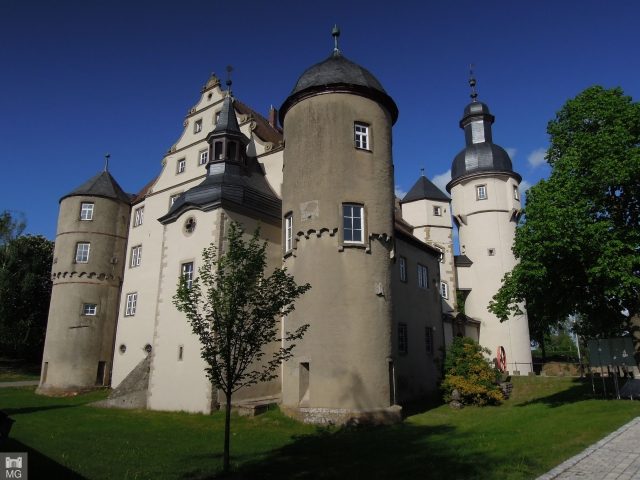
Waldmannshofen Castle is a former moated castle, built on the site of a late medieval castle on the northern edge of Waldmannshofen in the municipality of Creglingen in the Main-Tauber district in Baden-Württemberg.
As early as 1408, a complex in Waldmannshofen is mentioned in the division of property between Hans and Fritz Truchsess von Baldersheim. In 1421, Konrad von Rosenberg was the first representative of the Rosenberg family at the castle.
Destruction of the Water Castle in 1523
The end of the 15th century marked a time of upheaval. The loss of power of Emperor Charles IV and the election of Charles V immensely worsened the insecurity on the roads in the German Empire. Robber knights roamed the area, traveling merchants or envoys feared nocturnal attacks and could no longer feel safe. Although an eternal public peace had been decided at the Diet of Worms in 1495, this measure did not contribute to settling the unrest. Seven years earlier, in 1488, Franconian and Swabian imperial estates, led by Nuremberg, formed the so-called Swabian League. The aim of this alliance was to reduce attacks on traders and other travelers through cooperation. In 1489, the League was finally appointed as the imperial executive, i.e., the executive power.
In the middle of the 16th century, the robber knight Hans Thomas von Absberg abducted merchants from imperial cities in Franconia and Swabia on their trade journeys and demanded a high ransom for their release. To reduce the growing danger of being caught by troops of the Swabian League, he sought allies who would support him in his raids and hide his prisoners in their castles when danger arose. Kunz von Rosenberg also supported him in his feud, hoping to replenish his dwindling riches a little. In 1523, the League finally sent its troops to raze a total of 23 "robber nests" to the ground. The League's troops, consisting of 10,000 foot soldiers and 1,000 horsemen, carried 100 cannons and 30 arquebuses as armament, for which they had 900 hundredweight of gunpowder. On June 23, the troops finally reached Waldmannshofen Castle and blew it up to prevent the return of the Rosenbergs.
Woodcut by Hans Wandereisen
The castle complex is shown in Hans Wandereisen's woodcut as a massive structure, secured not only by a moat but also by an inner and an outer stone curtain wall, interspersed with watchtowers on both sides. Another wall with another gatehouse is placed in front of the area before the gatehouse. This advanced area is also partly filled with water, so that one has to cross two bridges to enter the castle. The outer gatehouse is extended by an additional half-timbered floor. The inner gatehouse bears the Rosenberg coat of arms above the archway. The entrance opposite the inner gatehouse leads into a first tall building; to its right is the main house with two gables, which is connected to a tower by a covered connecting passage. The tower widens towards the top. Another small building is visible in the background. Apart from the house and tower, the buildings and watchtowers within the first moat are made of half-timbering on the upper floors. Where the watchtowers are not yet covered by flames, their roofs taper to a point and are topped with a sphere. Almost all parts of the castle are depicted as burning, roofs are in flames, and flames also lick out of the window openings. The complex castle fills the woodcut as a motif; only a small building is located outside the walls in the front right of the picture. The army of the Swabian League is depicted in two separate parts. The cavalry, with a captain who also regularly appears in the other woodcuts, is located on the left in the foreground, while the infantry and two mounted knights are subtly indicated hidden behind the first curtain wall, which additionally shields the entrance area.
Reconstruction as a Renaissance Castle
Kunz von Rosenberg had the castle rebuilt as a moated castle between 1544 and 1548. After the extinction of the Rosenberg family, Brandenburg-Ansbach enfeoffed Field Marshal Count Melchior von Hatzfeldt with Waldmannshofen, who expanded the castle into a Renaissance castle with Baroque elements, as it is still preserved today. Although it is a castle, the layout as a fortress is still clearly recognizable. The most striking and unusual part is the detached Great Tower. It can be reached from the residential wing via a passage. Its function has not yet been researched. It could not have served as a keep, as it lacks embrasures, and for the customary use as a court tower at that time, it lacks the usual attributes (dungeons, interrogation rooms, or torture chambers).
The Hatzfeldt family remained the landlords in Waldmannshofen until 1886, i.e., for 249 years.
From the end of the 19th century, the castle was no longer inhabited and was left to decay.
Current Use
Since the 1950s, the castle has been owned by the municipality of Waldmannshofen and, since the territorial reform in Baden-Württemberg, by the city of Creglingen. It was restored from 1956 to 1970. Today, its rooms house a fire brigade museum.
Take Mobile History with you
You are reading this text for free. Premium adds what matters on the road: descriptions read aloud, sites found through your camera, whole regions taken offline.
- Every description, including the ~17,700 Premium sites
- Audio guide: have descriptions read to you on location
- AR finder: see sites through your camera, with distance and bearing
- Unlimited saved sites
14 days free, then from €2.99 a month. Cancel anytime.
Source: Wikipedia · Licence: CC BY-SA 4.0 · Image: Mobile Geschichte
This description draws on the facts documented in the linked Wikipedia article; Wikipedia content is licensed under CC BY-SA 4.0. Wording and editing: Mobile History.
Location: 49.5341, 10.0672