To be privately owned
CastleWolfsberg-Waldenstein
Waldenstein Castle
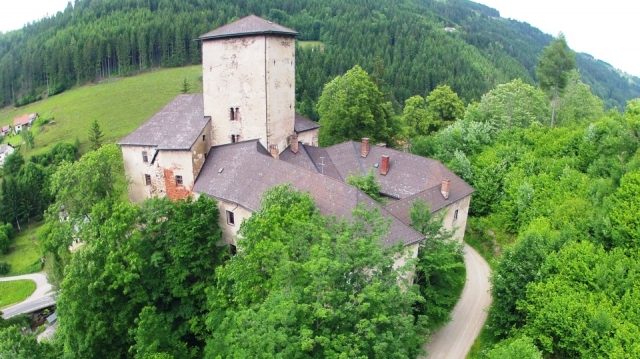
Waldenstein Castle is located between Bad St. Leonhard im Lavanttal and Wolfsberg in eastern Carinthia (Austria).
Construction of the Castle and Conversion into a Palace
Around 1150, it was built as a castle on behalf of the Diocese of Bamberg. From the 12th to the 17th century, the Lords Ungnad von Sonnegg were the feudal lords and owners of Waldenstein. They had the castle converted into a palace in the Gothic style in the 15th century. In the 16th century, Waldenstein was a center of the Reformation.
Waldenstein Castle and the Reformation Era
Hans von Ungnad invested most of his fortune in a printing press in Urach near Tübingen. There, the Protestant country pastor Primož Trubar, who came from the Ljubljana area and is considered the creator of the Slovenian written language, translated Luther's writings with the help of Georg Dalmatin to spread the controversial Reformation doctrine in his homeland of Slovenia. When the printing house in Urach was closed, a printing press and the old Glagolitic, Cyrillic, and Latin letters are said to have been brought to Waldenstein. However, nothing certain is known about the further whereabouts of the printing material. It was suspected that later, Napoleon's soldiers, who occupied parts of the Lavanttal in the early 19th century, carried the Ungnad printing press to Paris. Hans Ungnad, who enabled and ultimately financed the Reformation of the Slovenes, left his homeland Carinthia in 1557 and moved to Winternitz in Bohemia, where he died in 1564. In 1607, Simon Ungnad, the last male descendant of the noble family, died.
Further Owners
When Simon, the last Ungnad von Weißenwolff zu Waldenstein, died in 1607, his granddaughter Margarethe-Elisabeth, Landgravine of Hesse, inherited the dominion. The constant conflicts with the neighboring landowner, the Diocese of Bamberg, were too much for her. She sold Waldenstein to the Bishop of Bamberg in 1637, who in 1672 sold it to his vice-dom in Carinthia, Peter Philipp von Dernbach. From 1700 to 1754, the estate belonged to Count Rudolf Franz Erwein von Schönborn, who also restarted the local hammer mill. From his grandson Hugo Damian von Schönborn, the property passed to the Wolfsberg iron merchant Johann Michael Offner in 1803 by purchase. Counts Konrad and Friedrich von Westerholt owned the dominion only from 1842 to 1851.
Carinthian Homeland Song
In 1835, Josef Ritter von Rainer-Harbach from Wolfsberg set a poem by Johann Thaurer Ritter von Gallenstein to music at Waldenstein Castle. The song was officially declared the Carinthian Homeland Song in 1911.
Mining Center
In 1851, Count Hugo Henckel von Donnersmarck acquired the castle. He promoted the old mining in the Waldensteiner Graben. Even today, iron mica is still mined there, which is primarily used in the production of high-quality metal and anti-corrosion paints.
Take Mobile History with you
You are reading this text for free. Premium adds what matters on the road: descriptions read aloud, sites found through your camera, whole regions taken offline.
- Every description, including the ~17,700 Premium sites
- Audio guide: have descriptions read to you on location
- AR finder: see sites through your camera, with distance and bearing
- Unlimited saved sites
14 days free, then from €2.99 a month. Cancel anytime.
Source: Wikipedia · Licence: CC BY-SA 4.0 · Image: http://www.wehrbauten.at/ktn/kaernten.html
This description draws on the facts documented in the linked Wikipedia article; Wikipedia content is licensed under CC BY-SA 4.0. Wording and editing: Mobile History.
Location: 46.9275, 14.8869