To be privately owned
CastleReichenthal
Waldenfels Castle
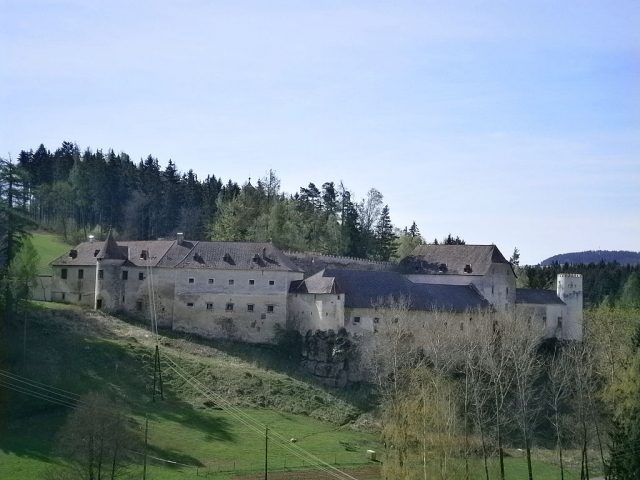
Waldenfels Castle is a castle complex 500 meters south of the village of Reichenthal in the Mühlviertel region of Upper Austria. The first castle was built in the 13th century, rebuilt several times, and has been owned by the Grundemann-Falkenberg family since 1636. Its current appearance dates from the 16th and 17th centuries.
It is presumed that the first castle was built around 1290 by the brothers Heinrich and Eberhard von Wallsee. The first documented mention is in 1300, Waldenfels as a refuge castle. Otwin Waldburger owned the castle in 1380 as a fief from Duke Albrecht III. In 1390, Hans Geiselberger sold the castle to the Duke, who pledged it to the Starhembergers in 1396. In 1415, Toman Geizesstetter is mentioned as administrator, and in 1421, Otto Brodmacher. In 1461, Hans von Plankenstein is named as the holder of the pledge lordship, followed by Reinbrecht von Polheim. In 1471, Waldenfels was besieged by Bohemian nobles and the Freistadt patrician Zinispan during border disputes, and destroyed by the Hussites in 1474. Afterwards, Waldenfels was rebuilt as a residential castle without a keep.
In 1537, Sebastian Meissauer is mentioned as administrator, and in 1579, Joachim Stängel. The latter bought the castle from Emperor Rudolf II in 1584, and the family remained in possession of the castle until 1636. In 1594, the castle served as a refuge for the surrounding population during the Turkish threat. In 1636, Count Konstantin Grundemann von Falkenberg bought the lordship, and the castle has been in the family's possession ever since. The Grundemann-Falkenbergs were elevated to the rank of baron in 1696 and count in 1716.
After the Second World War, the castle was occupied by around 700 Soviet soldiers; it took 12 years to repair the damage after the occupation. Count Ernst Grundemann-Falkenberg entered the Federal Council for the ÖVP in 1949 and the National Council in 1962, and was mayor of Reichenthal for 22 years. The current owner is Dominik Grundemann-Falkenberg.
Construction+
The castle is situated on a gentle slope. It is an extensive, irregular group of buildings composed of architectural elements from the Middle Ages, the Renaissance, and the Baroque period. The castle was given its current appearance at the beginning of the 17th century. A courtyard with a fountain from 1702 is formed by two-story wings from the 16th century, partly dissolved into arcaded walkways. This inner courtyard is partly bounded by the mighty, square tower with a Baroque onion dome and a crenellated wall. The residential buildings are two-story. Above the stone portal, consisting of a single-person opening and a large gate, the coat of arms of the Counts Grundemann is affixed.
The medieval keep was incorporated into the existing castle structure. The southwestern terrace, the so-called 'Tournament Courtyard' from the 17th century, is now a garden. It is surrounded by a wall dissolved into arches. In one wing, an artificial cave with stalactites and a female figure can be seen.
Take Mobile History with you
You are reading this text for free. Premium adds what matters on the road: descriptions read aloud, sites found through your camera, whole regions taken offline.
- Every description, including the ~17,700 Premium sites
- Audio guide: have descriptions read to you on location
- AR finder: see sites through your camera, with distance and bearing
- Unlimited saved sites
14 days free, then from €2.99 a month. Cancel anytime.
Source: Wikipedia · Licence: CC BY-SA 4.0 · Image: http://commons.wikimedia.org/wiki/File:Reichenthal_Waldenfels.jpg
This description draws on the facts documented in the linked Wikipedia article; Wikipedia content is licensed under CC BY-SA 4.0. Wording and editing: Mobile History.
Location: 48.5394, 14.3889