Cultural Events
CastleVöcklamarkt - Walchen
Walchen Castle
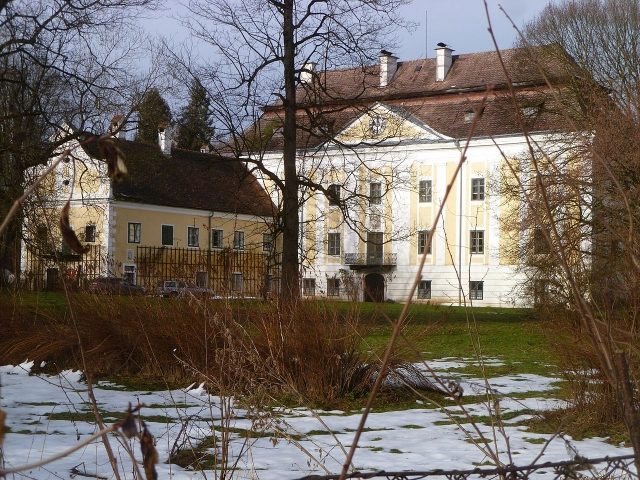
Walchen Castle is located in the Walchen district of the municipality of Vöcklamarkt in the Vöcklabruck district of Upper Austria (Walchen 1).
Hans Christoph Geymann (Geumann) acquired the Walchen lordship in 1583. In 1590, he had a new castle built in place of the former Walchen fortress. His son Ortolf occupied Kogl Castle on behalf of the Protestant estates during the noble revolt. However, after the invasion of the Bavarians, he had to flee to Prague to Frederick V, Elector Palatine, the so-called Winter King. Ortolf's stepbrothers, in turn, were partisans of the Emperor and were able to save Walchen for the family. In 1632, Franz Christoph Khevenhüller bought the Walchen lordship from Hans Paul Geymann's son. Already in 1638, he sold the property to Nikolaus von Gurland, the councilor and treasurer of Emperor Ferdinand II.
The Gurland family of counts died out within a short time in 1736 (possibly due to a plague or cholera epidemic). Count Leopold Christoph von Schallenberg, whose mother Dorothea Juliana was a Countess of Gurland, inherited the estate. She is said to have gone "mad" from grief over the loss of her family. According to legend, she still haunts the castle as a "white lady." Christoph von Schallenberg sold Walchen to Count Johann Gottlieb von Clam in 1766. In 1786, Walchen came into the possession of Baron Christoph von Aretin. His successor in 1802 was Josef Preuer. His wife Rosalie was succeeded in 1821 by Josef Klemens von Weichs. Under the Weichs-Glon family, Walchen developed into a kind of artists' colony in connection with Felix von Pausinger, who owned the nearby Kogl Castle, and Rudolf von Alt also belonged to it. In 1881, Georg von Aichinger acquired the property from the siblings Gabriele, Heinrich, Theresia, Friedrich, Maria, and Sophie Weichs-Glon. Successors were then Otto Steinbeis (1889), Felix Freiherr von Than-Dittner (1903), Georg Kaisinger (1914), Anton Gartner-Romansbruck (1916), Friedrich and Emma Waldeck, Otto and Ernst Mitteiswicz (1917), the Schaumburg-Lippe family; the last owner from this family was Princess Walpurgis zu Schaumburg-Lippe. Visitors to the Schaumburg-Lippes at Walchen included Friedrich Georg Jünger and Martin Heidegger.
In 1959, the castle and the associated estate were acquired by Mrs. Pauline Hanreich-Ludwig. She came from a Viennese imperial and royal court cabinetmaker family, and she acquired the castle to provide a worthy setting for her collection of antique furniture. Pauline's daughter, Eugenie Hanreich, collected a substantial collection of tools, toys, and objects from the children's worlds of the near and distant past during her folklore career, which form the basis of today's Children's World Museum in the castle's farm building. The current castle owners are Friedrun and Christoph Hanreich-Öttl, who are striving to revitalize the large castle. The Hanreich family also owns Feldegg Castle.
Measures for further contemporary use of the castle include exhibitions in the castle (e.g., "Goldhauben in Austria") and the marketing of agricultural products (2011: "Edible Landscapes"; 2012: sale of products from the castle's own production in the farm shop). The castle can also be used as a location for weddings or other events (concerts). A therapy program will also be set up in the castle in 2013.
Description+
The castle is a three-story building with a broken hip roof. A two-story wing is attached on the left side. A clock is located in the triangular gable above the entrance gate, and below it is the family crest of the Geymanns (?). The clock tower, which was formerly present and visible on a Vischer engraving from 1674, is no longer there. The wall surrounding the castle has also disappeared. The gate to the castle is a simple stone portal with a segmental arch and a protruding keystone. In 2001, the castle was awarded the Upper Austrian Craftsman's Prize by the Hochholzer company for the excellent restoration of the facade.
On the second floor are the library and other reception rooms, where a painted coffered ceiling (dowel wood ceiling) from the end of the 16th century was uncovered during the renovation in 1961. Further ceiling paintings show biblical scenes, hunting depictions, and the four seasons. The baroque stoves come from Losensteinleithen Castle. There are also two chapels in the castle. The baroque Catholic chapel forms the eastern end of a suite of rooms. Its flat ceiling features ceiling stucco from 1750/1770. In the gallery room there is a Rococo altar from the 18th century. A statue of Nepomuk dates from 1760/1770. The late Gothic stained glass windows are from the third quarter of the 15th century. The simple Protestant chapel was only discovered during the renovation of the castle in 1960/70, when the ground-floor rooms, which served as a coal cellar, were cleared out. It is likely to date from the time the castle was built. A wrought-iron grille, whose rhombuses match the painted coffered ceiling, is noteworthy. In the fresco decoration of the chapel, one can recognize, among other things, the baptism of Christ in the Jordan. It is likely to go back to the Geymanns, who adhered to the Protestant faith. Pictures of the interior of the castle and the artworks collected there can be found in the journal "money, das klubjournal, 2007, issue 2.
The castle includes a lime tree avenue, which was planted in 1822 by the Baron von Walchs. It is considered a natural monument.
In the park there are late Baroque stone figures depicting Saint Donatus and Saint Florian.
Take Mobile History with you
You are reading this text for free. Premium adds what matters on the road: descriptions read aloud, sites found through your camera, whole regions taken offline.
- Every description, including the ~17,700 Premium sites
- Audio guide: have descriptions read to you on location
- AR finder: see sites through your camera, with distance and bearing
- Unlimited saved sites
14 days free, then from €2.99 a month. Cancel anytime.
Source: Wikipedia · Licence: CC BY-SA 4.0 · Image: http://commons.wikimedia.org/wiki/File:Walchen_-_Schloss_Walchen_%28Gesamtansicht%29.jpg?uselang=de
This description draws on the facts documented in the linked Wikipedia article; Wikipedia content is licensed under CC BY-SA 4.0. Wording and editing: Mobile History.
Location: 47.9851, 13.4912