Vineyard
CastleRadebeul - Niederlößnitz
Wackerbarth Castle
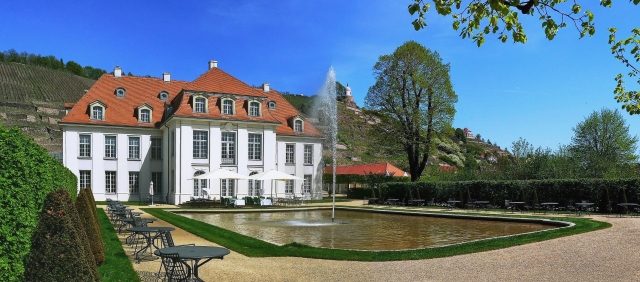
Wackerbarth Castle, also known as Wackerbarths Ruh', is a Baroque castle surrounded by vineyards in the Niederlößnitz district of Radebeul, on the road to Meißen, serving as the seat of the Saxon State Winery. The winery belongs to the Radebeuler Johannisberg single vineyard within the Lößnitz large vineyard area and is located in the protected historical vineyard landscape of Radebeul. The historic area of the castle forms an extension of the Lößnitz landscape protection area located above it. Wackerbarth Castle, as a Saxon cultural heritage site, is part of the Schlösserland Sachsen state cooperation.
Before the founding of Niederlößnitz in 1839, the estate was a manor directly subordinate to the Dresden office, situated on the Naundorf vineyard area.
Today, the state-owned winery, consisting of the historic complex and the modern new building of the wine and sparkling wine manufactory, is open to the public for visits. The in-house products are tasted and sold, and the associated glass production facility can be viewed. In the open areas around the buildings, sample vines of the cultivated grape varieties can also be observed in their seasonal growth. The estate's restaurant is housed in the eastern, listed economic building. The higher-lying Belvedere can also be used for weddings.
Baroque Noble and Country Seat
In 1727, Field Marshal and Imperial Count August Christoph von Wackerbarth acquired the Bischofsberge, located in the Naundorf area, as well as some green areas below these vineyard plots. On these, the cabinet minister of Augustus the Strong had Wackerbarths Ruh' Castle built as his retirement residence between 1727 and 1730 by the state architect Johann Christoph Knöffel, along with an octagonal Belvedere by Matthäus Daniel Pöppelmann and a French garden, simultaneously with two other houses, the Kurland Palace in Dresden and the new Palace in Zabeltitz, both also by Knöffel. From this time on, the estate was directly subordinate to the Dresden office until it became part of the newly formed rural municipality of Niederlößnitz in 1839.
After the death of the elder Wackerbarth (in distinction from his stepson, who was also a court minister) in 1734, the estate was inherited by his stepson, Cabinet Minister Count Joseph Anton Gabaleon von Wackerbarth-Salmour (the younger Wackerbarth). He stipulated in his will that upon his death, Wackerbarth Castle should be auctioned off for the benefit of Dresden widows and orphans. The subsequent owner was the Dresden banker and Baron Christian Friedrich von Gregory, who also owned Haus Sorgenfrei. Since 1799, the Jacobstein, together with the Fliegenwedel vineyard, has belonged to the Wackerbarth Castle ensemble, with which it is now listed as a monument ensemble under monument protection.
In 1808 or 1809, a great-grandnephew of the builder, the historian and art collector Raugraf August Josef Ludwig von Wackerbarth, acquired the estate, which he initially lost again in 1816 due to bankruptcy.
School, Sanatorium, Retirement Home, Residence, State Property, Reserve Hospital, Command Post, Post Office
In 1816, Wackerbarths Ruh' became the seat of the boys' boarding school, relocated from Tharandt, under the direction of Carl Lang and later his son-in-law Carl Vogel, father of the writer Elise Polko and the African explorer Eduard Vogel. From 1819 to 1823, Johann Peter Hundeiker, former ducal-Brunswick education councilor who had moved to Lößnitz, taught at Lang's boys' school. Renowned students of that time included the brothers Hermann and Heinrich Brockhaus.
After Lang's death in 1822, August Josef Ludwig von Wackerbarth bought the estate again in 1824. He had to auction it off again in 1846, after the estate had reached its greatest extent around 1840. From 1835, the castle was used by Friedrich Gustav Bräunlich (1800–1875) as a sanatorium for the mentally ill; in 1845, this was relocated to Neucoswig. The main building was partially redesigned in 1853.
The Saxon and Prussian statesman Albert von Carlowitz lived his last years at Wackerbarths Ruhe, where he died in 1874. Baron Adolf von Tümpling (1842–1920) had the castle building redesigned in the Italian Renaissance style in 1875 by the Leipzig master builder Friedrich Louis Winkler.
Among the owners of the estate was also the historian and court councilor Johann Georg Theodor Grässe, who died there in 1885, three years after the start of his retirement. Grässe's heirs continued to own the castle, first his widow and then a son, the Greek consul Hans Björn Grässe. In mid-1902, a forced auction (subhastation) took place. The subsequent owners were Ludwig Friedrich Matthis, Alexander Schuster, and after him, the Sparkasse of Oederan.
Between 1916 and 1923, the castle underwent another renovation by Georg Heinsius von Mayenburg, who re-Baroquized the building according to Knöffel's plans for the manufacturer Alfred Tiedemann, owner of the Coswig paint factory. When Tiedemann could no longer service his mortgages in 1926, the property came under forced administration. While Tiedemann became destitute and moved to the Coswig retirement home, the Dresden banking house Gebrüder Arnhold took over the estate. In 1931, Wackerbarths Ruh' went to the Saxon State Bank, and two years later to the Dresdner Bank.
In 1937, the castle became the Reich Leader School of the Reich Labor Service and from 1940, a reserve hospital.
On May 8, 1945, a conference on the food situation of the population took place at the castle between Soviet officers and a German delegation consisting, among others, of Hermann Matern, Rudolf Friedrichs, and Kurt Fischer, which is commemorated on a plaque on the castle fence. After the Commander-in-Chief of the 1st Ukrainian Front, Marshal of the Soviet Union Ivan Stepanovich Konev, had briefly quartered there, a post office of the Soviet army then moved in until 1950.
With the interim transfer to public ownership, the estate was handed over to "Volksbildung" (public education) in 1950, which turned it into a school with a boarding school for some of the Greek Markos children.
Winery Estate
The Volkseigene Gut Weinbau "Lößnitz" (People's Own Estate Viticulture "Lößnitz"), established in 1952, turned the estate back into a winery. Between 1974 and 1977, the castle and parts of the garden complex were renovated.
In July 1990, VEG Weinbau Radebeul was renamed Weinbau Radebeul GmbH, which came into the possession of the Free State of Saxony in 1992, thus becoming the Saxon State Winery again. In the same year, the first summer night ball took place there, to which the hosts, the Saxon State Winery and the Landesbühnen Sachsen, had invited Rüdiger Freiherr von Wackerbarth and his wife Adelheid as guests of honor.
Winery+
The modern winery dates back to the state winery founded in Radebeul in 1928. After World War II, the vintner school of the state winery in Oberlößnitz was affiliated with the newly established State Winery Radebeul-Lößnitz.
Volksweingut Lößnitz, Weinbau Radebeul
The City Winery Radebeul and the State Winery of Saxony both came under the legal responsibility of the Central Association of People's Own Estates (ZVVG) Southeast on October 1, 1949. This was subordinate to the Ministry of Agriculture and Forestry of Saxony. In addition, the city wineries of Dresden and Meißen, as well as some expropriated private wineries, were added. The merger of both wineries resulted in the Volkseigene Gut Weinbau "Lößnitz" (People's Own Estate Viticulture "Lößnitz"). The Paulsberg winery in the Zitzschewig district, which had belonged to the state property administration of the Saxon state government since 1940, was designated as the seat of the People's Winery. Besides Weinbau "Lößnitz," only the vintners' cooperative in Meißen remained as a production facility in the region.
In 1952, the People's Winery cultivated 39.1 hectares of agricultural land, of which 23.4 hectares were vineyards. Also in 1952, their first sparkling wine was produced using bottle fermentation (brand Sachsengold).
In 1954, it became the VEG(B) Volksweingut, which belonged to the Department of People's Own Estates of the Council of the Dresden District. From 1963, it then belonged as VEG(Z) Weinbau Radebeul to the VVB Saat- und Pflanzgut Quedlinburg.
The vineyard areas and the buildings of Haus Barnewitz, expropriated in 1952, also belonged to the People's Winery. From 1955, the People's Winery undertook its first major new plantings.
Due to the Radebeul City Council's plan from April 1958 to also produce sparkling wine using the large-tank high-pressure fermentation method in the future, the People's Estate received the Wackerbarths Ruhe property, where a new wine and sparkling wine cellar along with a bottling line was built between 1967 and 1969 next to the historic castle complex. The expansion plan was accompanied by a projected increase in turnover from 3 to 11 million Marks. The new, partially fully automated facility was intended to enable an annual production of 4.3 million bottles of sparkling wine, whose base wines, however, did not come from their own production but were brought in from elsewhere.
Subsequently, the People's Winery developed, also through the acquisition of further vineyards and through land consolidation, into the largest wine-growing operation in the Elbe Valley, with approximately 80 hectares. In 1974, it included six operating units, which cultivated 32.5 hectares in the Radebeul area, 10.5 hectares around Meißen (Meißen City Winery), 33.5 hectares in Seußlitz (near Nünchritz), and 3.5 hectares in Cossebaude. Cultivated varieties included Müller-Thurgau, Riesling, Pinot Blanc, Traminer, and Ruländer. According to "Werte unserer Heimat," a total of 136 hectares of vineyards belonged to the winery in 1970, with areas in Diesbar and the Spaargebirge added to the previous list. The vineyard areas in Diesbar-Seußlitz had been assigned to the city of Dresden as a Municipal Economic Enterprise (KWU) along with the local manor and castle even before the land reform. Later, the vineyards went to the People's Winery, which undertook new plantings on flat areas between Heinrichsburg and Goldkuppe in 1959 using the Lenz-Moser training system.
Between 1974 and 1977, Wackerbarth Castle and parts of the garden complex were renovated. From 1977 onwards, extensive preservation work was carried out on the dilapidated buildings of Hoflößnitz, which had suffered from aging and inappropriate use.
In April 1974, the People's Winery took over the nearby Bussard sparkling wine cellar, expropriated in 1972, which was used until 1978 for the artisanal production of sparkling wine by bottle fermentation. In 1978/1979, traditional bottle fermentation was discontinued, and the last remaining Bussard employees were transferred to mass sparkling wine production on the Wackerbarthsruhe site. The tank fermentation method practiced there for the mass production of cheap sparkling wine had priority over the classic bottle fermentation practiced with much manual labor at Bussard, which, although it delivered higher quality sparkling wines, was more cost-intensive. By 1981, sparkling wine output increased from 25,600 to 36,500 hectoliters. The protected brands were Schlossberg (named after the local mountain of Hoflößnitz) and Schloss Wackerbarth; in 1985, the sparkling wine brand Graf Wackerbarth was introduced.
Saxon State Winery Schloss Wackerbarth
In July 1990, the Volkseigene Gut was transformed into Weinbau Radebeul – Schloß Wackerbarth GmbH. Wackerbarth was taken over by the Free State of Saxony in April 1992, while the City Winery Radebeul, which had been incorporated into the People's Winery, was separated again as the municipal winery Hoflößnitz. Under the name Sächsisches Staatsweingut GmbH Schloss Wackerbarth, the winery belonged to the Saxon State Institute for Agriculture in the Pillnitz district of Dresden.
After an unsuccessful privatization attempt in 1998, the fiduciary management of the company passed to the Sächsische Aufbaubank. This transformed the company into a GmbH wholly owned by the Sächsische Aufbaubank in September 1999. From 2002, the historic building fabric was gradually and extensively reconstructed, and the castle was developed into an "experience winery." The urban planning concept envisaged separating the historic castle complex from the production site, but keeping the winery as a whole recognizable and accessible as a unit. The previously enclosed public road was reopened; a spacious entrance area, arranged under the roof of the modern production hall, is assigned to it. The new building block itself deliberately deviates from the symmetry of the Baroque complex; its construction and materials used show contemporary spirit and lightness.
The renovation of the castle complex followed a reconstruction from the years after 1920. In the Belvedere, wall paintings from the Semper era were reconstructed. The reconstruction of the terrace complexes and the Baroque garden facing the street with the revived fountains was carried out – as was the execution of all structural and urban planning details – with a high standard of quality.
The castle is now marketed as "Europe's first experience winery, dedicated to 800 years of Saxon viticultural tradition as well as contemporary enjoyment with all senses." Under this motto, there are multimedia tours with tastings and numerous event series. The winery is particularly known for its finely fruity, mineral Rieslings and Pinot Blancs, as well as for its expressive Traminer. The sparkling wines are produced using the classic bottle fermentation method. In addition to various brands, the tradition of the Bussard brand is continued as the second oldest German sparkling wine brand (based on the founding date of the closed Bussard sparkling wine cellar).
The German Wine Queen 2007/2008, Evelyn Schmidt, worked at Schloss Wackerbarth until the end of 2008, where she was responsible for planning and coordinating guided tours and wine tastings.
In 2012, the state winery cultivated 90 hectares of vineyards, located in the three Radebeul sites; this also includes the state vineyard Goldener Wagen directly north of Hoflößnitz. Further vineyard areas are located in the Seußlitzer Heinrichsburg wine region (large vineyard Schlossweinberg, Meißen area). The annual production is 500,000 bottles.
Building Culture+
The cultural monument ensemble, with the individual monuments of the castle building, Belvedere, the Jacobstein, remnants of garden sculpture, the enclosure with an attached commemorative plaque, and the vineyards including the Fliegenwedel vineyard, is today under monument protection as a monument ensemble (ensemble protection). The entire garden complex and vineyard landscape are considered a valuable work of landscape and garden design.
The following are provided with their own monument identification:
- Wackerbarthstraße 1: Ensemble Wackerbarths Ruhe with individual monument castle building
- Wackerbarthstraße 9001-I: Belvedere to the castle
- Wackerbarthstraße 9001-II and -III: Economic buildings to the castle
- Wackerbarthstraße 9001-IV: Park to the castle
- Wackerbarthstraße 9001-V: Jacobstein
Already in 1912, the municipality of Niederlößnitz issued a local decree to protect the property against parceling efforts (urban sprawl). The basis was the Saxon law against the disfigurement of town and country from 1909. At that time, the vineyard property Wackerbarths Ruhe was already included and published as a building and art monument in Gurlitt's Saxon fundamental inventory (1904) and Dehio's German short inventory (1905).
Even during GDR times, Wackerbarths Ruhe was on the district monument list as a monument of cultural history. The entry under monument areas (ensembles) and street sections also included the neighboring Traiteurhaus at Mittlere Bergstraße 4, which formerly represented the kitchen complex of the estate.
Descriptions
Economic Buildings
The two identically designed elongated economic buildings form the lateral boundary of the upper park area between the castle and the Belvedere. The buildings are single-story and have brick-covered hip roofs.
The building on the western side is the vinotheque. It closes off the property towards Mittlere Bergstraße. The entrance door faces the interior, where tables and chairs can be set up on the water-bound path surface during events.
The building on the eastern side is the guesthouse. It closes off the park towards the property with the diagonally built modern sparkling wine manufactory. An entrance door faces the interior. The actual entrance is from the side of the manufactory, where the guest tables are set up.
Remnants of Garden Sculpture
At the upper end of the central staircase from the castle building to the Belvedere, there are two sandstone sculptures from around 1730 on both sides, each on a pedestal. The figure on the left is a Bacchus with a dog, and on the right stands a Venus with a Cupid.
Jacobstein
The vineyard pavilion, which has belonged to the Wackerbarth estate since 1799, is perched on the edge of the slope amidst the vineyard landscape. It was built in 1742 by the owner of the eastern neighboring property Fliegenwedel, which at times also belonged to the Wackerbarth estate and whose in-house Fliegenwedel vineyard still belongs to it today.
Enclosure with Commemorative Plaque
On the south side of the property, on Meißen Street, an opening in the enclosure allows a view of the manor house. An archway in the enclosure with a lattice fence forms a former GDR memorial, which, as a monument of political history with the adjacent commemorative plaque, recalls the meeting of Soviet military personnel with German politicians on May 8, 1945. The commemorative plaque is still under monument protection today as part of the monument ensemble.
On the German side, Hermann Matern, Kurt Fischer, and Rudolf Friedrichs are commemorated; on the Soviet side, Anastas I. Mikoyan and Ivan S. Konev.
Enclosure with Eastern Gate System, next to it the Wackerbarth-Salmour Coat of Arms
On the outside left of the eastern gate system near the guesthouse, a coat of arms is affixed, depicting the union of the Wackerbarth and Salmour families. It is the coat of arms of Count Joseph Anton Gabaleon von Wackerbarth-Salmour (1685-1761), son of Katharina von Wackerbarth-Salmour (1670–1719) from her first marriage to Michele Conte Gabaleone di Salmour, who in 1707 married Count August Christoph von Wackerbarth (1662–1734) in her third marriage. He adopted his stepson and bequeathed Wackerbarth Castle (as well as Zabeltitz Castle and the Kurland Palace in Dresden) to him. The left half of the coat of arms, i.e., on the right in the image, shows the coat of arms of the Imperial Count Wackerbarth, the right side shows the coat of arms of the Counts of Salmour. It is a cast of the founder's coat of arms from the reliquary altar of the St. Valentin Chapel in the Church of San Filippo Neri in Chieri.
Awards
The renovated Wackerbarth Castle, including the new production hall, which was deliberately positioned without reference to the symmetry axes of the Baroque complex, received the Radebeul Building Owner Award in 2004 in the Commercial / Public Buildings category.
The Gottfried Semper Architecture Prize for Sustainable Building, awarded for the first time in 2007 by the Saxon Academy of Arts and the Saxon State Foundation for Nature and Environment, was presented to architect Erich Schneider-Wessling on October 19, 2007, at Wackerbarth Castle.
In 2012, the state winery cultivated 90 hectares of vineyards, located in the three Radebeul sites; this also includes the state vineyard Goldener Wagen directly north of Hoflößnitz. Further vineyard areas are located in the Seußlitzer Heinrichsburg wine region (large vineyard Schlossweinberg, Meißen area). The annual production is 500,000 bottles.
Take Mobile History with you
You are reading this text for free. Premium adds what matters on the road: descriptions read aloud, sites found through your camera, whole regions taken offline.
- Every description, including the ~17,700 Premium sites
- Audio guide: have descriptions read to you on location
- AR finder: see sites through your camera, with distance and bearing
- Unlimited saved sites
14 days free, then from €2.99 a month. Cancel anytime.
Source: Wikipedia · Licence: CC BY-SA 4.0 · Image: Thomas Eichler
This description draws on the facts documented in the linked Wikipedia article; Wikipedia content is licensed under CC BY-SA 4.0. Wording and editing: Mobile History.
Location: 51.1143, 13.6183