Cultural center
CastleWachau
Wachau Castle
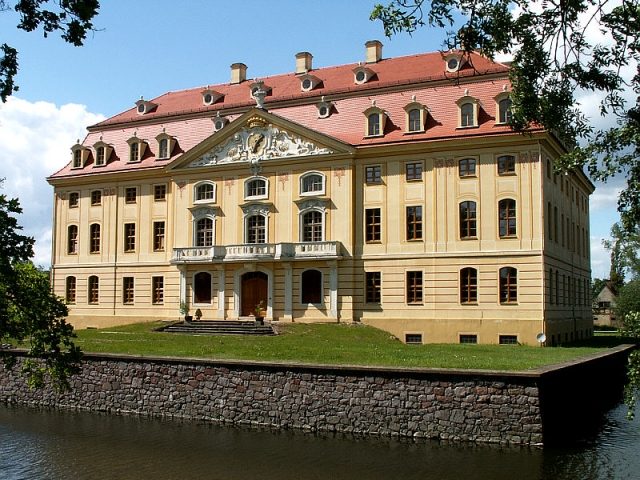
Wachau Castle near Radeberg stands proudly on a small artificial island. The red roof forms a fitting contrast to the bright yellow facade. Its exterior appears intact, but inside there is still a lot to do.
For over four centuries, the von Schönfeld family, who resided here from the 14th to the 18th century, determined the fate of the Wachau estate. The site of Wachau Castle, formerly surrounded by a moat, was probably also home to the manor house first mentioned in 1218, a fortified complex with a moated castle. Multiple changes - including the reshaping of the moat into a rectangular course - led to its current appearance. In the immediate vicinity of the fortified center, both the associated farmyard, later the estate, and the church were built.
In the 13th century, a family named von Wachau played a role, without a definite connection between them and this place being provable. In 1378, the von Schönfeld family first appeared as owners of the village, manor house, and Wachau outpost. But it was not until the marriage of Magdalena Sophie, Countess of Werthern, née Countess of Lynar, to Johann Siegfried Count von Schönfeld in 1715 that Wachau became crucially important. The Countess was 26 when her second husband died just three years later. She quickly took over the lordship of Wachau herself and had a magnificent new castle built, adorned with a count's crown, two monograms, and a black branch on a golden background as a coat of arms.
The castle, still surrounded by a wide moat today, was built by the Countess between 1730 and 1754 as a horseshoe-shaped complex with side wings extending to the rear. The two-and-a-half-story building is topped by a high mansard roof. The main entrance is on the garden side in a three-axis, richly structured central section with a strongly curved balcony and a wide, relief-decorated triangular gable. A two-flight access ramp with an axial grand staircase leads through a Baroque portal to the vestibule of the stairwell.
However, the estate did not remain in the possession of the count's family for long. Already in 1770, the Countess's son, Johann Georg von Schönfeld, died without a male heir. The castle passed to various owners until it was acquired in 1883 by the wealthy Leipzig merchant's son Gotthelf Kühne. Kühne had the interiors redesigned by architect Georg Weidenbach and established a collection of carpets, paintings, and furniture. The castle remained in the possession of his nephew until its expropriation and expulsion by the communists in 1945. Then, the municipality of Wachau housed small apartments, two sales outlets, a kindergarten, and a nursing station in the building. After the political change in the GDR, a private investor from Dresden acquired the castle. However, as he failed to implement his concept, the retransfer to the municipality of Wachau took place in 2008.
The interior of the castle surprises with its almost completely preserved furnishings of stucco and wall paintings. Particularly impressive is the ceiling painting in the ballroom, painted by C. Jolas, depicting Apollo riding Pegasus through the sky illuminated by sunlight. Mirrors and marble fireplaces complement the interior. Valuable wooden ceilings can be seen in other rooms.
The 4-hectare park adjoining the garden side is laid out in the English style. In the park, two female draped figures, two comedian figures at the ramp, and representations of the four seasons, as well as a life-size Saturn sculpture behind the castle, have been preserved.
The former manor house, with its 19th-century buildings, directly adjoins the castle park. At the gatehouse to the estate, there is an elaborate wrought-iron Baroque gate. On the exterior of the eastern farm building, two 16th-century coats of arms are walled in.
Take Mobile History with you
You are reading this text for free. Premium adds what matters on the road: descriptions read aloud, sites found through your camera, whole regions taken offline.
- Every description, including the ~17,700 Premium sites
- Audio guide: have descriptions read to you on location
- AR finder: see sites through your camera, with distance and bearing
- Unlimited saved sites
14 days free, then from €2.99 a month. Cancel anytime.
Source: Wikipedia · Licence: CC BY-SA 4.0 · Image: Ralf Zimmermann (Dresden)
This description draws on the facts documented in the linked Wikipedia article; Wikipedia content is licensed under CC BY-SA 4.0. Wording and editing: Mobile History.
Location: 51.1590, 13.9032