Museum
CastleOelsnitz/Vogtl. - Voigtsberg
Voigtsberg Castle
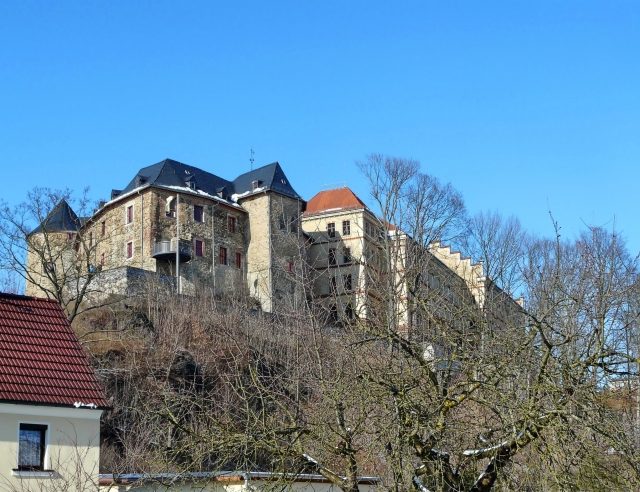
Voigtsberg Castle (formerly referred to as Voigtsberg Fortress) is a hilltop castle in the Voigtsberg district of the large district town of Oelsnitz/Vogtl.
The oldest part of the castle is the keep; originally 30 meters high, it now only rises 22 m into the sky. The tower, 9.7 m in diameter, has walls 3.3 m thick, but is currently not yet accessible again due to a vertical crack in the building fabric. The part of the building surrounding the keep houses the Knights' Hall and Princes' Hall, which is adjoined by the Gothic St. George's Chapel.
A faithful miniature model of the castle is located in the Klein-Vogtland miniature park in Adorf/Vogtl.
Middle Ages
It is presumed that the first parts of the castle were built around 1200. The verifiable old part of the castle was built between 1232 and 1249 by the Vögte von Strassberg and Eberhard de Voitesberk (also Eberhardus de Voitesberg). In addition to the keep, it consisted of a palas (today "Knights' Hall", the oldest part of the core castle), a comprehensive defensive wall, and a moat to secure the complex. Vogt Heinrich III expanded the castle after 1300 with round towers (West Tower, South Tower) and St. George's Chapel (around 1330). When the West Tower was added, one of the two existing latrine projections and a north-facing window had to be bricked up. One of the original latrine projections is still visible today to the right of the West Tower.
The rule of the Vögte Strassberg lasted until 1320. In 1327, the castle passed into the possession of the Vögte von Plauen. In 1356, it fell to the Margrave of Meissen from the House of Wettin. Around this time, the east wing was added to the castle, incorporating St. George's Chapel. In 1378, the castle became the seat of an electoral office. Until this time, the palas was freestanding, with access to the interior via a staircase or steps over the defensive wall.
Renaissance/Baroque
During the Wettin rule, the castle was expanded with five bastions and a zwinger on the attack side to accommodate advances in weapon technology (such as cannons). In 1505, the west wing was added, connecting to the north side of the palas and the west tower. In 1525, many nobles from the surrounding area fled to the castle for fear of peasant unrest in the Vogtland. In the war year 1632, it was completely plundered by the imperial troops of General Heinrich von Holk and subsequently set on fire during their repeated passage in 1633.
With the conversion of the medieval castle complex into a palace after 1633, much of the original building fabric was lost; for example, the west wing is characterized by many repairs and today contains hardly any building fabric from the 16th century. The exposed ceiling beams from 1637 are painted, and this painting has been preserved relatively completely to this day. From 1647, the mining office was located in the castle. The Princes' Hall on the upper floor (from 1774) originally consisted of two rooms; the court room in the back third and the "Great Hall" - the actual Princes' Hall was created by combining these two rooms.
Modern Era
The Voigtsberg office was located in the castle until 1855, after which the regional administration transferred to the district administration of Oelsnitz/Vogtl. The last official handed it over to the Zwickau penal institution. First a workhouse for men, the castle was converted into a "prison for women" in 1874. Structural changes from 1898 to 1900 significantly altered the castle and greatly affected its overall appearance. By removing the ceiling between the ground floor and the upper floor in 1898 - to set up a prison church - St. George's Chapel was only accessible via a gallery.
The gatehouse dates from this period. In 1924, the women's prison was dissolved, and the Voluntary Labor Service, glider pilots, and the Hitler Youth moved in. In 1937, the Oelsnitz local history enthusiasts and the hiking club set up a local history museum in the six rooms on the 1st floor of the core castle, but it had to be vacated in 1945, as the castle served as a refugee and transit camp until 1951. Afterwards, a youth work camp became the user of the complex, which established the nursery next to the castle. In 1961, the National People's Army took it over. In 1967, the complex then came into the possession of the city of Oelsnitz and has since housed the Carpet Museum again. In 1976, the castle became home to the district archive.
From 2001, extensive renovation and restoration of the castle ensemble began. More than 10 million euros have already been invested in the restoration, making it a jewel of the city of Oelsnitz today, but still little known far and wide. In 2010, the Carpet Museum was able to reopen. Today (as of 2012), only the keep remains, which is no longer accessible due to a crack from the roof to the base. Since 2011, the cellar has housed a small mineral cabinet. In the Princes' Hall hangs a painting of Archduchess Catherine of Austria, signed by Titian.
Take Mobile History with you
You are reading this text for free. Premium adds what matters on the road: descriptions read aloud, sites found through your camera, whole regions taken offline.
- Every description, including the ~17,700 Premium sites
- Audio guide: have descriptions read to you on location
- AR finder: see sites through your camera, with distance and bearing
- Unlimited saved sites
14 days free, then from €2.99 a month. Cancel anytime.
Source: Wikipedia · Licence: CC BY-SA 4.0 · Image: Thomas Eichler
This description draws on the facts documented in the linked Wikipedia article; Wikipedia content is licensed under CC BY-SA 4.0. Wording and editing: Mobile History.
Location: 50.4224, 12.1833