To be privately owned
CastleVölkershausen
Völkershausen Castle
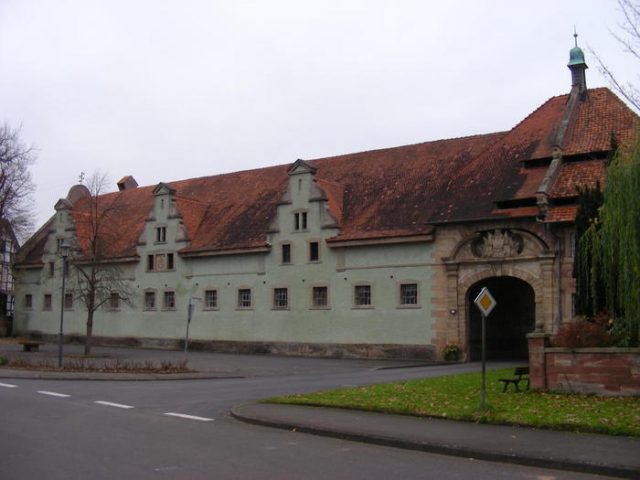
In the year 1729, Frederick I, King of Sweden, enfeoffed his brother Georg of Hesse with Völkershausen. Once again, a picture of an earlier time presented itself, even on an enlarged scale. The prince himself soon came to Völkershausen and was very interested in his new possession. If he was prevented from expanding it by the opposition of the Franconian knighthood, he was all the more intent on beautifying it. The castle was extended, the former court garden enlarged, provided with basins, fountains, avenues, labyrinths and the like. Sections of it were populated with pheasants and deer, the moat was stocked with goldfish, swans and other poultry enlivened the basins and individual parts of the park. A significant number of people from the court were always employed here and had good earnings. Even after the death of the prince in 1755, who was followed by Landgrave Karl of Hesse in 1784, this did not immediately cease. Hereditary Prince Friedrich, whose conversion to the Catholic confession had become known years earlier, in whose name the court was administered from then on, stayed there for a longer period. A house chapel was set up for him in the castle and several things indicated a longer stay. But the soon-to-follow Seven Years' War, although the court did not suffer so much from it, put an end to this and inflicted a deep wound on the inhabitants from that time on due to the absence of the court lordship from the place. The basins fell into disrepair, the fountains dried up, bosquets and avenues were cut down to make way for meager grass growth. A picture of the population itself. A population oppressed by feudal burdens, whose internal sources of income were insufficient and who lacked external ones, could from now on only look forward to all the more certain impoverishment, since even a court lord who was benevolent to the utmost limit had not been able to curb it. Once again, a diligence in trade favored by circumstances was to show itself and favorably shape the prospect of the future! But just as two centuries earlier, it was a destructive war that betrayed every hope, less tumultuous, but deeply intrusive, less immediately destructive, but after a sustained period, rolled a burden onto future generations that was impossible to bear for the present.
Friedrich Reichardt writes about the castle and grounds in his "Contributions to Local Chronicle"
The present castle was probably built in 1718 by the Landgraves of Hesse and served them as a summer residence. In its external appearance, it is simple and tasteless, and the greater part is a half-timbered building that has received a lime plaster. This simplicity is probably sufficient for a summer residence. All the more importance was placed on the park facilities. Whole avenues of lime trees, poplars, and chestnuts adorned the area, therefore called a labyrinth, because one could easily get lost. Only a particularly strong one above the castle and a row of chestnuts are still witnesses of a bygone era. The magnificent lime tree square with its approximately 60 stately trees lost its adornment in the war. All of them, some over 1 meter in diameter, fell victim to the axe. I would claim that a great valuable piece was lost to the property as a result. The entire park facilities must have given the summer residence a magnificent appearance. Ponds, waterfalls, and fountains further beautified the landscape. Two ponds already doomed to decay are still recognizable. An old woman, as it always is, once told me how she still remembered a stone-carved scissor grinder standing in the lime tree square, whose grinding stone was set in motion by flowing water. After the Peace of Vienna in 1815, our formerly Hessian region came to the Grand Duchy of Saxony-Weimar-Eisenach. The castle became state property, in 1848 it was used as a cholera hospital and for a time, also as a sisters' recreation home. In 1910, Dr. Greff acquired it as property.
Dr. Greff paid 15,000 marks for the building and property. In an outbuilding (Wandelhalle), Dr. Greff kept numerous plaster casts (arms, busts, bodies) of people from various cultures. Before the Second World War (1939), the Günter family then acquired the property.
In the 1960s, 3 classrooms and a after-school care room were set up in the castle. During this time (1964), the kindergarten and nursery were also moved into the castle. The Wandelhalle was expanded. An open-air stage was built next to the castle. An extensive renovation of the facilities in the castle took place in 1989. The rockfall also hit this building; it was demolished in 1989.
Take Mobile History with you
You are reading this text for free. Premium adds what matters on the road: descriptions read aloud, sites found through your camera, whole regions taken offline.
- Every description, including the ~17,700 Premium sites
- Audio guide: have descriptions read to you on location
- AR finder: see sites through your camera, with distance and bearing
- Unlimited saved sites
14 days free, then from €2.99 a month. Cancel anytime.
Source: Wikipedia · Licence: CC BY-SA 4.0
This description draws on the facts documented in the linked Wikipedia article; Wikipedia content is licensed under CC BY-SA 4.0. Wording and editing: Mobile History.
Location: 51.1610, 10.1628