College
CastleVarenholz
Varenholz Castle
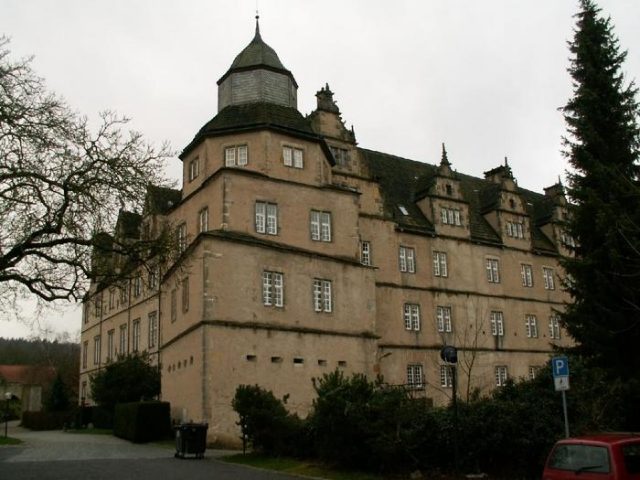
Varenholz Castle is a Weser Renaissance style castle in the municipality of Kalletal in the district of Lippe. The castle now houses a private boarding school.
The castle is located in the village of Varenholz in the municipality of Kalletal, south of the Weser river. Originally, the castle was directly on the Weser, but the course of the river has since shifted northwards. A four-arched bridge made of quarry stone, bearing the year 1753, still bears witness to the former course of the river.
The Evangelical-Reformed Church of Varenholz is located on the outer ring wall of the castle grounds. The church building consists of a cross-shaped hall with a flat-roofed nave from 1500, the vaulted north wing from the 14th century, and the south wing with a portal from 1839.
To the south is the domain, which originally belonged to the castle.
A castle was first mentioned in 1188, at that time in the possession of the Lords of Vornholte. In 1323, Simon I zur Lippe acquired the castle from the Lords of Varenholz, thus extending his dominion in the north to the Weser.
The building history of the current castle complex dates back to 1540. Between 1591 and 1600, Count Simon VI zur Lippe had the castle expanded into one of the most important buildings of the Weser Renaissance.
Under the National Socialists, the castle served as a training center for the League of German Girls (BDM). From 1945 to 1949, UFA Universum Filmgesellschaft was housed in the buildings. Subsequently, Elisabeth Engels established a boarding school in the premises.
Today, the castle is owned by the Lippe Regional Association and houses Schloss Varenholz GmbH, a boarding school society for child and youth welfare.
Legend of the "White Lady"+
According to legend, a White Lady, a benevolent spirit, is said to have appeared to pregnant women in Varenholz on clear full moon nights. Records show that a lady-in-waiting named Katharina Gerstein lived in the castle at that time. The lady-in-waiting is said to have had ten children and been beautiful. When her husband had to go into exile for political reasons, she disappeared without a trace and was never seen again. Later, she appeared as a ghost. She was also sometimes described as a harbinger of impending misfortune.
Organ of the Castle Church+
The organ of the castle church was built in 1748 by the organ builder Christian Klausing (Herford) as a unique instrument with 9 stops and an attached pedal. The instrument was expanded in 1840 with an independent pedal division. The instrument now has 14 stops on one manual and pedal. The casing, the windchest, and seven stops of the historic organ are preserved.
Take Mobile History with you
You are reading this text for free. Premium adds what matters on the road: descriptions read aloud, sites found through your camera, whole regions taken offline.
- Every description, including the ~17,700 Premium sites
- Audio guide: have descriptions read to you on location
- AR finder: see sites through your camera, with distance and bearing
- Unlimited saved sites
14 days free, then from €2.99 a month. Cancel anytime.
Source: Wikipedia · Licence: CC BY-SA 4.0
This description draws on the facts documented in the linked Wikipedia article; Wikipedia content is licensed under CC BY-SA 4.0. Wording and editing: Mobile History.
Location: 52.1717, 8.9862