School
CastleUsingen
Usingen Castle
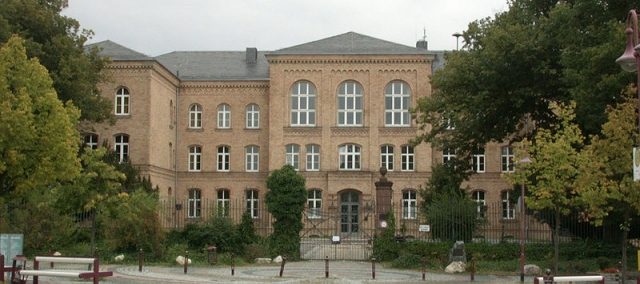
Usingen Castle is a building in Usingen that is now used as a school.
Until the 19th century, Usingen Castle was located in the center of Usingen's inner city. Its exact origins are not clearly established, but the first defensive structure on this site is documented as a castle house built in the 14th century under Johann I of Nassau-Weilburg. Prince Walrad (Nassau-Usingen) had a new castle built on the site of the old one between 1660 and 1663. From 1733 to 1738, architect Friedrich Joachim Stengel (1694–1787) converted it into a Baroque residence on behalf of Princess Charlotte Amalie, the widow of Prince Wilhelm Heinrich I. On January 5, 1873, a major fire destroyed the castle. Only the "Krumme Bau" (Crooked Building), an outbuilding of the castle, remained, where teaching continued. In its place, a Prussian brick building was erected according to plans by architect Gustav Knoblauch, which has been used as a teacher training college and today as a grammar school (Christian-Wirth-Schule) since its opening in 1879. The new building was controversial in Berlin. A relocation of the teacher training college from remote Usingen was discussed in the capital. However, after strong protests from the city, the new building was approved. Contrary to the original plans, the Krumme Bau, which was originally built in 1730 by master builder Jost Bager as a coach house, confectionery, and bakery, was demolished down to the cellar in 1877. The Usingen Castle Garden directly borders the school; the castle square separates the lower town in the south from the upper town in the north.
Use as a School+
The Christian-Wirth-Schule (CWS), housed in the castle, is named after the Prussian state director and member of parliament Friedrich Christian Wirth, who earned merit through his commitment to establishing Usingen as the district town of the Usingen district.
In addition to the actual castle building, further annexes have been built in the former castle garden. The school is a grammar school with special musical promotion and has approximately 1,400 students. Every two years, at the end of November, the Winter Festival takes place, to which former students and teachers are invited.
As early as 1851, the castle was used as a school. At that time, a teacher training institution for Protestant seminarians was established as a precursor to today's Christian-Wirth-Schule. During the First World War, the castle was used as a military hospital. In 1922, after a dispute about the school type, the first "Aufbauklasse" (preparatory class) was established. Since 1950, the school has offered classes from the 7th grade onwards. In 1960, the "Förderstufe" (orientation stage) was introduced. In the 1970s, students and teachers long resisted the plans of Minister of Culture Ludwig von Friedeburg to compulsorily establish a comprehensive school. In 1976, the CWS was merged with Hauptschule and Realschule into an additive comprehensive school. However, the individual school types remained intact and were only organizationally combined. According to the SPD state government, this was intended to be a preliminary stage for the formation of an integrated comprehensive school. With the state election in Hesse in 1987, however, the CDU prevailed and was able to enforce its demand for school freedom (i.e., the freedom of choice between comprehensive school (here the ARS in Neu-Anspach) and a differentiated school system (here the CWS / KLS in Usingen). With the school year 1988/89, the grammar school section became an independent school again.
Expansion+
The CWS has been extensively expanded in several stages. After student numbers rose massively in the 1970s, additional classrooms were housed in pavilions in the school garden in the mid-1980s. With the abolition of the "Förderstufe" in Hesse, additional 5th and 6th grades were introduced. The associated space requirements made extension buildings unavoidable. Thus, the toilet building in the schoolyard was demolished and a new building was erected, which was connected to the old central building by a bridge. The former science classrooms were newly accessed by the addition of a staircase. A new building with classrooms was built in place of the pavilions. Sports facilities were also massively expanded. While sports lessons used to take place in the former princely stables (disrespectfully but accurately called "Bruchbude" by the students), a new gymnasium was built at the end of the 1980s, and 15 years later, a second modern sports hall was built below the Taunusbad.
In March 2010, the new canteen with a small auditorium was opened.
Take Mobile History with you
You are reading this text for free. Premium adds what matters on the road: descriptions read aloud, sites found through your camera, whole regions taken offline.
- Every description, including the ~17,700 Premium sites
- Audio guide: have descriptions read to you on location
- AR finder: see sites through your camera, with distance and bearing
- Unlimited saved sites
14 days free, then from €2.99 a month. Cancel anytime.
Source: Wikipedia · Licence: CC BY-SA 4.0
This description draws on the facts documented in the linked Wikipedia article; Wikipedia content is licensed under CC BY-SA 4.0. Wording and editing: Mobile History.
Location: 50.3341, 8.5381