To be privately owned
CastleKraichtal-Unteröwisheim
Unteröwisheim Castle
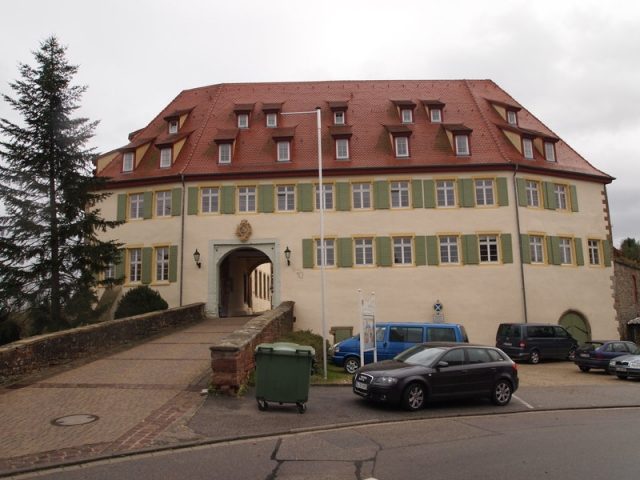
Impressively, the originally fortified complex rises on the gentle southern slope of the Kraich valley, surrounded by a moat. To this day, both its founding date and its founder have remained a mystery.
In 1249, a chapel in the castle courtyard - St. James' Chapel - is mentioned in documents; unfortunately, it was demolished after the construction of the current Protestant church in Unteröwisheim (mid-19th century). While the site was owned by the Count of Eberstein in the 13th century, it passed to Maulbronn Monastery in 1346 via the Margraves of Baden. Operated as a monastic farm, the complex now served as the economic center of the growing village. The large cellar systems under the castle can certainly be attributed to this period. Due to the Reformation, the complex was again converted into a ducal-Württemberg castle. Additional buildings were constructed - recognizable by their Renaissance attire - on the south side.
Significantly damaged in 1689, Friedrich August - Duke of Württemberg - had the complex renovated from 1709 onwards, reusing the cellars and outer walls. The impressive building inscription in the gate entrance bears witness to his work. Again affected by warlike events and operated as a domain administration, the complex was acquired by the municipality in 1847 for teacher housing and as a school. In 1908, the new school was built on the east side of the castle. Many Unteröwisheim residents attended school here.
Last used by associations and as apartments, the roof truss and upper floor of the main building above the gate entrance completely burned down in 1989.
The city administration succeeded not only in securing the preserved building stock but also in enabling the revitalization of the community's original founding site in 1991 through the transfer of ownership to the CVJM Landesverband Baden e.V. Using all preserved building components, the main building has now been rebuilt; half-timbering from the 16th century, hidden under plaster, now adorns its courtyard facade. Marked by a new tower floor, a gate passage from the 13th century belonging to the original complex is on its north side. Here, even ashlar blocks are still preserved.
Take Mobile History with you
You are reading this text for free. Premium adds what matters on the road: descriptions read aloud, sites found through your camera, whole regions taken offline.
- Every description, including the ~17,700 Premium sites
- Audio guide: have descriptions read to you on location
- AR finder: see sites through your camera, with distance and bearing
- Unlimited saved sites
14 days free, then from €2.99 a month. Cancel anytime.
Source: Wikipedia · Licence: CC BY-SA 4.0 · Image: http://www.wehrbauten.de/thread.php?threadid=1785
This description draws on the facts documented in the linked Wikipedia article; Wikipedia content is licensed under CC BY-SA 4.0. Wording and editing: Mobile History.
Location: 49.1426, 8.6724