To be privately owned
CastleAbtsgmünd - Untergröningen
Untergröningen Castle
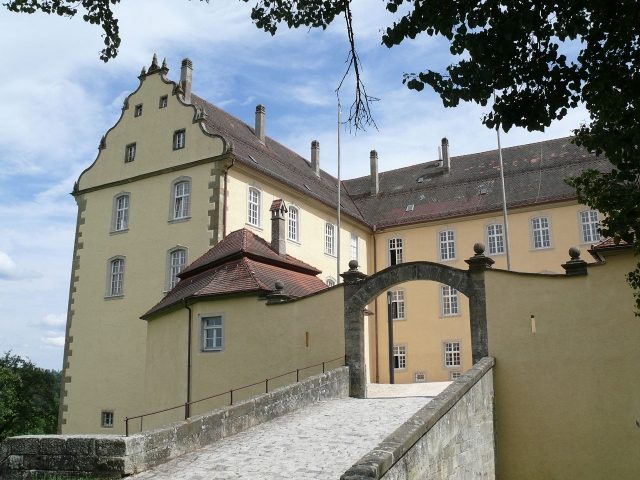
The baroque castle of Untergröningen is located on a mountain spur of the Frickenhofer Höhe and today belongs to the municipality of Abtsgmünd. The castle is currently used, among other things, as an exhibition space by the art association KISS.
A predecessor castle was first mentioned in a document on November 7, 1351. Ulrich VI. von Rechberg sold the city of Sindelfingen for 5000 pounds Heller. In payment for this, debts were waived by Counts Eberhard II. and Ulrich IV. von Württemberg, and the castle of Gröningen was ceded by his brother Johann II. von Rechberg. After the death of Knight Wilhelm III. von Rechberg in 1413, the castle came into the possession of the Lords of Yberg, who already in 1436 sold it to Schenk Conrad von Limpurg and his brothers for 5250 Rhenish gold guilders. In the 15th century, the castle had several owners simultaneously. The Schenken von Limpurg finally succeeded in securing dominion over the castle. Around 1564, Schenk Christoph von Limpurg converted a medieval residential building in the south of the complex into a gate and bailiff's house, thus expanding the castle into a palace. This is still attested today by the inscription on a coat of arms plaque on the side where the former entrance once was, before the west side was opened:
- „We, Christoph, Lord of Limpurg, Hereditary Cupbearer of the Holy Roman Empire, semperfrei, completed this construction in the year 1564. Maria, Lady of Limpurg, born Countess of Wied, Runkel and Isenburg, his lawful spouse.“
The building couple was therefore Christoph Schenk von Limpurg-Gaildorf (* July 12, 1531; † September 3, 1574) and his first wife Maria von Wied-Runkel († March 15, 1563). The conversion into a palace as a hunting and summer residence began in 1603 with the new construction of the north and east wings. In 1690, the estate came into the possession of the Limpurg-Speckfeld-Sontheim line, which died out as early as 1713 due to a lack of male descendants. An inheritance dispute developed as early as 1690, which only ended in 1774, as ten female descendants were available as heiresses. By an out-of-court decision by lot, the Limpurg-Sontheim-Gröningen line became the owner of the castle. Thus, Princess Marie Friederike Sophie Charlotte von Hohenlohe-Waldenburg-Bartenstein (* February 18, 1714; † May 1, 1777) inherited the dominion of Gröningen.
From 1775, extensive alterations were made to the castle complex, creating its present appearance. Among other things, the drawbridge was demolished and replaced by a solid structure. The previously Protestant castle church was converted into a Catholic one, for which a new church was built in the village as a replacement. In 1804, Prince Ludwig Aloys exchanged the manorial claim with the Imperial Vice-Chancellor Franz Gundaccar von Colloredo-Mansfeld.
Through the mediatization, which was enshrined in the Confederation of the Rhine Act in 1806, the property came under the influence of the Kingdom of Württemberg. This was finally confirmed by the sale on January 2, 1827, of the castle and lands for 141,000 guilders from Prince Rudolf von Colloredo-Mansfeld to the Württemberg crown. Official residences and a Catholic school were established in the castle.
The use of the castle changed several times in the 19th century. In 1852, a soup kitchen for feeding the poor and a box-making workshop were established. In 1862, a private Realschule (secondary school) was set up in the south wing. At the beginning of the 20th century, the castle was used as a parish office for both denominations, and at times also as a kindergarten and elementary school. After the Second World War, rental apartments were located in the castle building.
At the end of 1980, the castle was in a structurally poor condition. Only the ceilings were temporarily secured. In 1996, the employment initiative Schloss Untergröningen was founded, after which a comprehensive renovation of the buildings was carried out. Today, in addition to the art association, the castle houses the Catholic parish and the local history association Untergröningen.
Art in the Castle+
In the summer of 2001, the art association KISS (Kunst im Schloss - Art in the Castle) was able to open its first art and culture summer. The permanent exhibition of the Temporary Museum of Contemporary Art is dedicated to the theme of plastic bags.
Take Mobile History with you
You are reading this text for free. Premium adds what matters on the road: descriptions read aloud, sites found through your camera, whole regions taken offline.
- Every description, including the ~17,700 Premium sites
- Audio guide: have descriptions read to you on location
- AR finder: see sites through your camera, with distance and bearing
- Unlimited saved sites
14 days free, then from €2.99 a month. Cancel anytime.
Source: Wikipedia · Licence: CC BY-SA 4.0 · Image: http://de.wikipedia.org/wiki/Datei:Schloss_Untergr%C3%B6ningen_-_Auffahrt_und_Nordfl%C3%BCgel_von_Westen.jpg
This description draws on the facts documented in the linked Wikipedia article; Wikipedia content is licensed under CC BY-SA 4.0. Wording and editing: Mobile History.
Location: 48.9164, 9.8909