Nursing home
CastleUlenburg
Ulenburg Castle
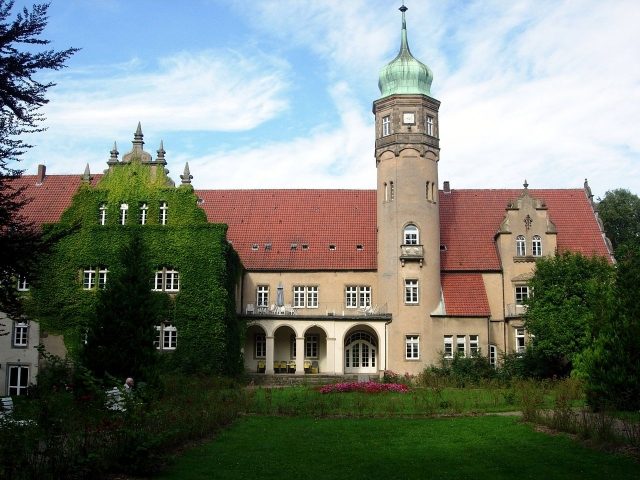
Ulenburg is the smallest district of the city of Löhne, located in the northeast of North Rhine-Westphalia. Until its founding in 1969, the place formed its own municipality. The local moated castle Ulenburg gave it its name.
The district stretches as a narrow strip of land from the northwest of the city area on both sides of the Mühlenbach stream to its confluence with the Werre river in the northern center of Löhne. Adjacent districts are Mennighüffen to the north and northeast, Gohfeld and Löhne-Bahnhof to the southeast, and Obernbeck to the southwest. To the west, Kirchlengern-Häver adjoins.
Ulenburg has only just under 500 inhabitants, whose dwellings are not concentrated in a settlement core but are rather spread out. Therefore, the place is hardly perceived as independent but mostly as part of Mennighüffen, and in its southern parts also Obernbeck. Also, regarding church parishes, schools, clubs, etc., Ulenburg has no institutions of its own, but mostly falls within the catchment area of Mennighüffen.
Ulenburg Castle, Haus Beck, Schockemühle Estate+
The former municipality of Ulenburg goes back to two estate districts around the former knightly estates of Ulenburg, Beck (pronounced: Beek), and Schockemühle. The Schockemühle estate no longer exists, Haus Beck is privately owned and the site of an agricultural enterprise. Ulenburg Castle is a moated castle in the Weser Renaissance style, for which the oriel in the southeast part of the upper floor and the south gable are particularly characteristic.
Until 2008, the castle belonged to the Diakonische Stiftung Wittekindshof, which operated a facility for the care of people with intellectual disabilities there. Since then, the Ulenburg site of Wittekindshof consists of three residential houses near the castle.
Originally, a Meierhof (called Ulenhof) is said to have stood in place of the castle, which since the late Middle Ages was owned by a branch of the von Quernheim family; a second family branch resided at Haus Beck.
In 1469, Bernhard VII zur Lippe conquered the estate, and the Quernheims were from then on vassals of the Counts zur Lippe. The Bishop of Minden was not satisfied with this situation. He did not want to grant Ulenburg any special privileges, as he was of the opinion that Ulenburg, as a former Meierhof, had to comply with the general land law of the Amt Hausberge and thus could not exercise sovereign rights.
Hilmar von Quernheim expanded the estate into a moated castle between 1568 and 1570. After his death in 1581, the Bishop decided to forcibly seize Ulenburg. Only 12 years later, after many lawsuits and negotiations, the Counts zur Lippe regained possession. However, the unrest continued.
In 1613, Philipp Eberhard von Wrede acquired the castle. Almost a hundred years later, in 1711, Ulenburg was sold to the von Ledebur family. In 1745, the two estates Ulenburg and Beck were united under the new owner Werner Heinrich Christoph von Wulfen, canon of Magdeburg. After his death, the heirs could not keep the estates and went bankrupt.
The new owner was the Imperial Baron von Münster, who acquired the estates of Ulenburg, Beck, and Schockemühle in 1786. He found no happiness at Ulenburg; just one year later, his wife Louise Friederike Wilhelmine died of smallpox. An obelisk, which Baron von Münster had erected at Beck in memory of his wife, stands not far from the castle.
In 1791, von Münster sold the estates to Franz Christian von Borries zu Eckendorf. From 1846, the Russian Prince Handjery was the owner of Ulenburg, but he sold the property again to the von Borries family in 1865. Finally, in 1927, the Wittekindshof sanatorium and nursing home acquired the castle.
On January 1, 1929, the estate districts of Ulenburg and Beck were merged and formed the municipality of Ulenburg. As a result of the municipal reorganization, the municipality of Ulenburg was incorporated into the newly founded city of Löhne on January 1, 1969.
Take Mobile History with you
You are reading this text for free. Premium adds what matters on the road: descriptions read aloud, sites found through your camera, whole regions taken offline.
- Every description, including the ~17,700 Premium sites
- Audio guide: have descriptions read to you on location
- AR finder: see sites through your camera, with distance and bearing
- Unlimited saved sites
14 days free, then from €2.99 a month. Cancel anytime.
Source: Wikipedia · Licence: CC BY-SA 4.0
This description draws on the facts documented in the linked Wikipedia article; Wikipedia content is licensed under CC BY-SA 4.0. Wording and editing: Mobile History.
Location: 52.2252, 8.6861