Hotel
CastleZweibrücken
Tschifflik Castle
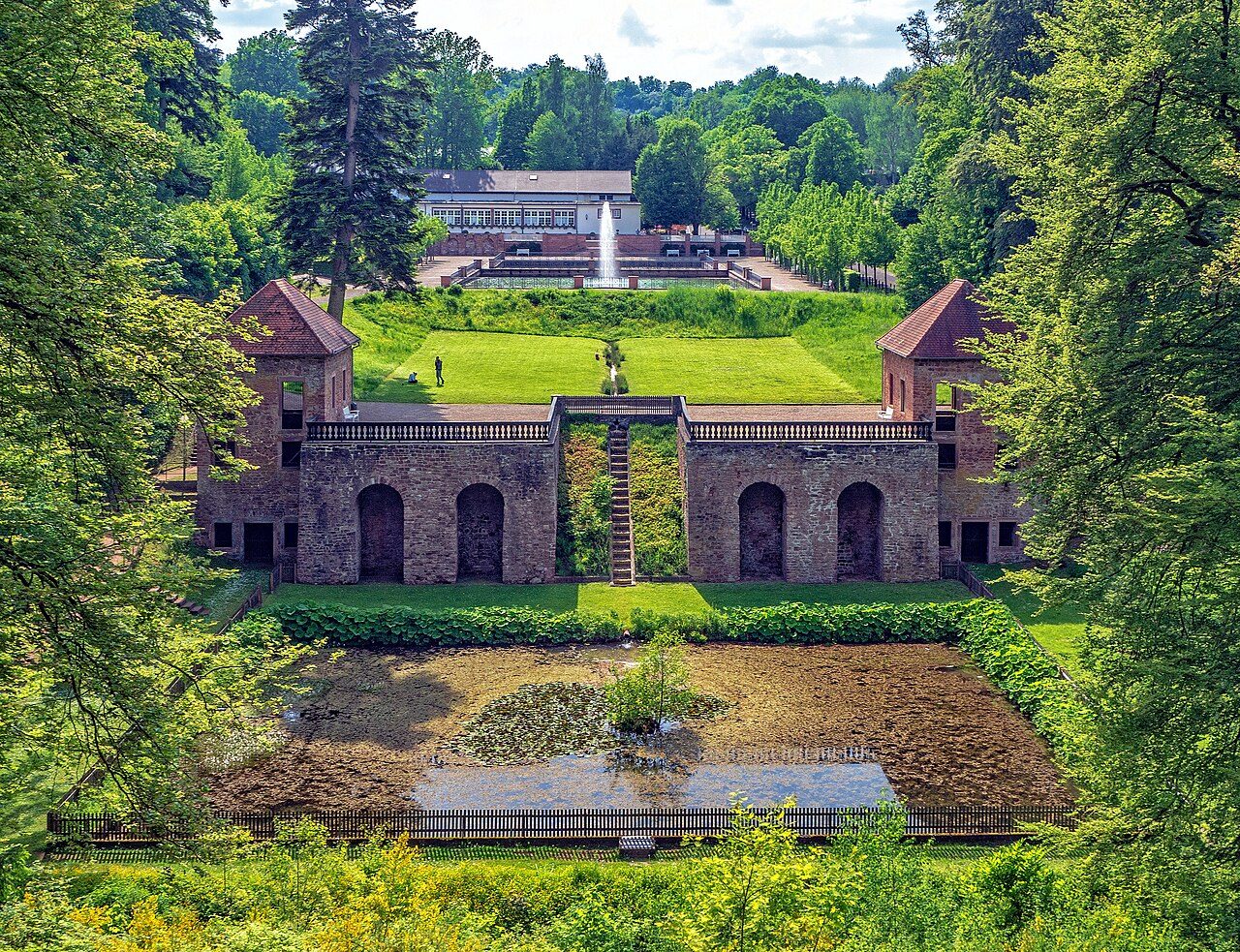
The pleasure palace Tschifflik (from Turkish Çiftlik, "farm") near Zweibrücken was built in 1715 and 1716 by Stanislaus I Leszczyński, the exiled King of Poland and Grand Duke of Lithuania (1704–1709 and 1733–1736) as a summer residence. According to his ideas, the complex was planned and structurally realized by the Swedish master builder Jonas Erikson Sundahl. Tschifflik is considered a typical example of Baroque garden architecture.
The complex was built during Stanislaus' first exile, which he spent in Pfalz-Zweibrücken from 1714 to 1718. The choice of the Turkish name Tschifflik probably goes back to Stanislaus' previous stay in Bender. The complex, occupied by the royal family in 1716, was sealed off from the outside world by a 4 km long and 2.50 m high surrounding wall and included, in addition to the main house, two residential houses, a terrace system with apartments, two utility houses and an extensive garden area with an open-air stage and varied water features. Stanislaus and Sundahl oriented themselves in the planning to the given terrain east of the city, characterized by clearings, and used the natural structure to generate the flow of the water features exclusively physically-mechanically. However, the plans, especially those for the garden, could not be completely realized during Stanislaus' stay.
Duke Gustav Samuel Leopold had the summer residence, not completely realized by Stanislaus, completed by the architect Sundahl in 1728. In the following interregnum after his death, the complex partly fell into disrepair and was only revived during the time of Duke Christian IV. Christian commissioned the garden architect Johann Ludwig Petri with a contemporary renewal and expansion of Tschifflik. Petri oriented himself, among other things, to English garden art. From 1757 to 1769, a pheasantry was established in the garden. Under the term pheasantry, the area is better known to locals today than under its original name Tschifflik.
After the French Revolution, the site was allocated to the Zweibrücken State Stud for use. The original complex fell victim to practical requirements and decayed. In 1887, the city of Zweibrücken acquired the terrain.
Present+
In the 1930s, the area was revitalized by the construction of an excursion restaurant; today, a hotel stands there. In the 1970s, a wild rose garden was created, which is connected to the Zweibrücken Rose Garden via the "Rosenweg" (Rose Path). Also at this time, the ruin of a previously unknown tower castle, whose origin is dated to the early 12th century, was uncovered at the northern end of the area.
The listed historic pheasant garden, which gave its name to today's local recreation area "Fasanerie", was largely renewed from 2006 to May 2008 as part of the newly created theme path "Gardens and Landscape" by the city of Zweibrücken with EU funding. The Baroque origin was combined with modern usage possibilities in the sense of a local recreation area during the renovation. Tschifflik is one of the sights of the Baroque Road SaarPfalz.
Take Mobile History with you
You are reading this text for free. Premium adds what matters on the road: descriptions read aloud, sites found through your camera, whole regions taken offline.
- Every description, including the ~17,700 Premium sites
- Audio guide: have descriptions read to you on location
- AR finder: see sites through your camera, with distance and bearing
- Unlimited saved sites
14 days free, then from €2.99 a month. Cancel anytime.
Location: 49.2448, 7.3942