To be privately owned
CastleBad Rappenau-Treschklingen
Treschklingen Castle
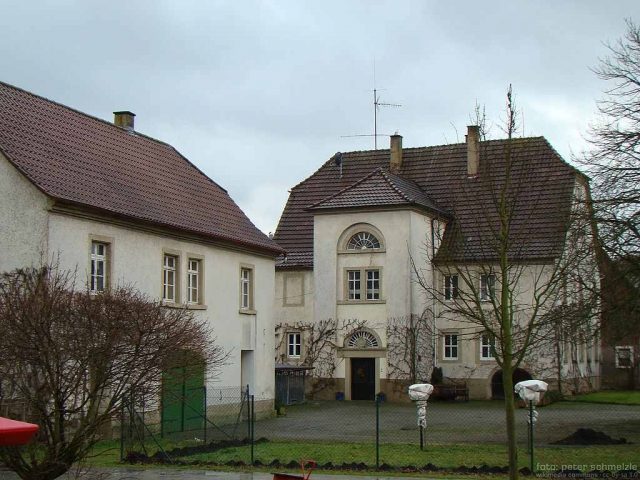
The castle in Treschklingen, a district of Bad Rappenau in the Heilbronn district in northern Baden-Württemberg, was built in 1802 as an official residence on the site of an older manor house. For a time, the Barons of Gemmingen resided on the castle estate; for many years, it was managed by stewards. From 1896 to 1952, it was leased to the sugar factory in Waghäusel, or rather, Südzucker.
Predecessor Buildings
In Treschklingen, there were already two manor houses in the late Middle Ages. In 1470, an old and a new castle are mentioned. Feudal descriptions until 1780 always named two manor houses as part of the fiefdom. In 1588, Reinhard von Gemmingen (1532–1598) had a "completely new stone dwelling" erected in place of the old castle. This stone manor house was destroyed in 1693 during the War of the Palatine Succession by French troops; the ruin remained until 1744, after which the remains of the building were removed.
After the farm buildings of the Treschklingen estate were demolished in 1990 and building land was developed here, in 1993, remains of a ashlar wall and an oak beam grating came to light in the area of the current building Im Gutshof 13, which are considered to be remnants of the "stone dwelling" built by Reinhard in 1588. According to the findings, the "stone dwelling" must have been a moated castle. There are no reliable findings regarding the location of the second castle.
In modern times, the Barons of Gemmingen rarely resided in Treschklingen, but usually had the estate managed by stewards; a representative manor house on site was therefore not necessary. In 1785, Christoph Klenk was named as a steward.
The Castle of 1802
Sigmund von Gemmingen (1724–1806) built the present castle as an official residence in 1802. He was succeeded by Sigmund Johann Nepomuk von Gemmingen (1777–1843), who managed the estates in Treschklingen himself from 1803 to 1813, occupied the official residence as his home, and had a new official residence built northeast of the building in 1806.
The castle is a two-story plastered building. In 1832, a staircase with two round-arched windows in classical style was added to the rear. In the 19th century, the castle occupied the southwest corner of the almost right-angled building complex of the Treschklingen estate. Along the present street Im Gutshof and between the castle and the Treschklingen church stood large farm buildings, and there were also several residential houses for employees.
In 1824, the estate comprised a total of 259 acres of arable land, 37 acres of meadows, and a few vineyards. In the late 19th century, the steward's estate comprised a total of 402 acres of agricultural land.
Sigmund Reinhard von Gemmingen (1819–1883) had already promoted the cultivation of sugar beets from 1851 and negotiated with the sugar factory in Waghäusel and the landowners and farmers of the surrounding villages about the delivery of 100,000 hundredweights of sugar beets annually, which was intended to induce the sugar factory to build a drying house in the vicinity of Rappenau. The sugar factory built ten drying houses in other locations, used until the 1870s, whose supply from Treschklingen was not profitable, so that the large-scale sugar beet plans initially fell through. However, numerous farmers had been encouraged to cultivate beets by the lord of the manor.
In the summer of 1868, the steward's buildings of the estate were destroyed by arson and subsequently rebuilt.
Sigmund Reinhard von Gemmingen died in 1883 without male heirs, so his Treschklingen property fell to his brother Adolph von Gemmingen (1822–1902). He lived in Fränkisch-Crumbach, which is why he leased the castle estate again, from 1877 to 1889 to Jacob Schmutz. Numerous inhabitants of Treschklingen were employed as day laborers on the estate or hired themselves out as harvest helpers during harvest time.
The Waghäusel sugar factory had initially obtained beets from a multitude of small farmers; from 1862, it began to lease larger farm estates. In 1896, the sugar factory (later Südzucker) finally also leased the Treschklingen estate with an area of 166 hectares, on 40 to 50 hectares of which it cultivated sugar beets.
After the lease agreement with Südzucker expired in 1952, Gustav Freiherr von Gemmingen-Hornberg (1925–2005) managed the estate. From 1954 to 1970, he was mayor of Treschklingen and from 1967 to 1969 a member of the German Bundestag; around 1970, he worked for five years as a development worker in Africa. During this time, his second wife, Gudrun née Heinzelmann, managed the estate, where she also operated a master weaving workshop until 1986. Later, Gustav von Gemmingen leased the agriculture again for health reasons, sold parts of the castle estate, and donated smaller parts to the municipality of Treschklingen for the construction of the schoolhouse, the creation of a sports field, and for the cemetery expansion.
In 1990, the farm buildings of the castle estate were demolished. The northwestern area of the former estate was built over with residential houses from 1993. Apart from the actual castle building, an outbuilding, and the surrounding garden, nothing remains of the estate complex. The tomb chapel of the Barons of Gemmingen, built in 1839, stands in the Treschklingen cemetery near the castle.
Take Mobile History with you
You are reading this text for free. Premium adds what matters on the road: descriptions read aloud, sites found through your camera, whole regions taken offline.
- Every description, including the ~17,700 Premium sites
- Audio guide: have descriptions read to you on location
- AR finder: see sites through your camera, with distance and bearing
- Unlimited saved sites
14 days free, then from €2.99 a month. Cancel anytime.
Source: Wikipedia · Licence: CC BY-SA 4.0 · Image: https://commons.wikimedia.org/wiki/File:Treschklingen-schloss2.jpg
This description draws on the facts documented in the linked Wikipedia article; Wikipedia content is licensed under CC BY-SA 4.0. Wording and editing: Mobile History.
Location: 49.2233, 9.0580