Golf club
CastleFreigericht
Trages Castle (Freigericht)
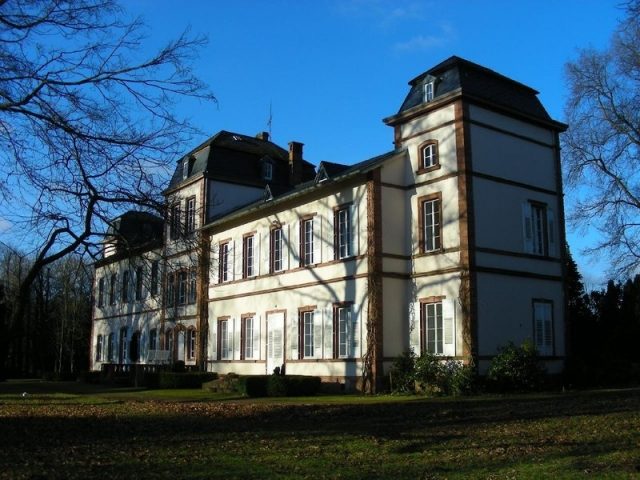
Southwest of Somborn, on the border with Bavaria, lies the Trages estate. It probably owes its name to the clearing of this area by a Drago, who in the 9th century had pushed a so-called "Beyfang" into the forest from Somborn through cultivation.
In the 14th century, 2 farms are mentioned: Vorder and Hinter Drages. In 1358, the land of Peter von Dragus was devastated by the Ronneburgers. In 1374, according to a document, Arnulf von Drages, his wife, and 5 sons handed over their farm "Zum Trages" to Lord Ulrich von Hanau and received the farm back as a hereditary fief. As a tribute, they only had to pay a "Shrovetide chicken" and had the duty to offer a ceremonial drink to traveling lords.
During the Thirty Years' War, Trages was completely destroyed and its inhabitants expelled. According to a feudal letter from 1639, Hanau granted the "Höfe zum Trages" as a fief to Dietrich von Erkenbrecht. From his descendants, the Hanau Chancellor von Cranz bought the estates of Trages and Hüttelngesäß at the beginning of the 18th century (1727). He and his son built the main part of the current buildings of the former farmyard and the park with its now old and stately trees, as well as a garden house, the foundation of the current castle building. In 1751, the childless Johann Sebastian von Cranz bequeathed Trages and Hüttelngesäß to his sister's son, the Nassau-Usingen Privy Councillor Christian Carl Ludwig von Savigny.
Of his 12 children, only Friedrich Carl von Savigny, born on February 21, 1779, outlived his parents and siblings, and at 16 years old, he was alone and without relatives, the sole offspring of the von Savigny family.
But as unusual as his youthful fate was, so was the rest of his life. At the age of 16, he began his legal studies at the University of Marburg and later in Jena and Göttingen, received his doctorate in law in 1800, and at 24, already a professor, began his teaching career in Marburg. In addition, he conducted intensive legal research. In 1803, his first significant work, "The Law of Possession," was published. About it, the legal scholar Brun wrote: "Through this epoch-making work, Savigny rose to the classics of the nation and became the actual founder of the historical school of law, its leader, its head."
Already in his student and early teaching years, Savigny had gathered a large circle of friends and students around him, who, like him, achieved great importance in the science and poetry of their time. His student friends were the poets Clemens Brentano and Achim von Arnim, the brothers Jakob and Wilhelm Grimm, the poetesses Bettina Brentano, later the wife of Achim von Arnim, and their friend Caroline von Günderode. Together with Savigny - he married Brentano's sister, Guida, in 1804 - they were often "at Trages," whose idyllic location and surroundings found ample nourishment and inspiration for their romantic feelings, their love of nature, their enthusiasm for homeland sentiment, folk songs, and fairy tales.
Clemens Brentano wrote his famous fairy tale "Gockel, Hinkel und Gackeleia" here. In the Brentano room, the walls painted in 1809 with romantic depictions and satirical verses still bear witness to their activities. The Günderode cottage next to the old manor house still stands, and life at Trages is described in many letters from this circle of poets. Friedrich Carl von Savigny's scientific activities took him far afield: in 1804/05 for legal research to Paris, from 1808-10 as a professor to Landshut. In 1810, he was appointed to the newly founded Humboldt University in Berlin, where he became rector in 1812, succeeding the philosopher Fichte. In Berlin, he published his great life's works "History of Roman Law" and "System of Roman Law," two foundations of our current law and international private law. Under Friedrich Wilhelm IV, he became President of the State Council and in 1847 Prime Minister. However, he always returned to Trages, whose fortunes he managed with his great thoroughness even from afar.
He now rests in the family crypt in the chapel in Trages, which was built in 1870 by his son Carl Friedrich von Savigny, as was the main part of the castle as it stands today. Carl Friedrich von Savigny was a schoolmate and then a student friend of Bismarck, with whom he was connected by common political activity, until Savigny, along with other leading politicians, founded the Centre Party in December 1870.
Under his successor, the Reichstag member Carl von Savigny, Trages was developed into a modern agricultural and forestry enterprise. In addition, the architectural and written testimonies of the history of this "Hof Trages" were preserved and cared for and today attract numerous interested visitors. The always close relationship with Somborn, to which Trages also administratively and communally belongs since the dissolution of the independent estate districts in 1929, allows it to joyfully participate in the anniversary of the old "Sonnenborn."
Take Mobile History with you
You are reading this text for free. Premium adds what matters on the road: descriptions read aloud, sites found through your camera, whole regions taken offline.
- Every description, including the ~17,700 Premium sites
- Audio guide: have descriptions read to you on location
- AR finder: see sites through your camera, with distance and bearing
- Unlimited saved sites
14 days free, then from €2.99 a month. Cancel anytime.
Source: Wikipedia · Licence: CC BY-SA 4.0
This description draws on the facts documented in the linked Wikipedia article; Wikipedia content is licensed under CC BY-SA 4.0. Wording and editing: Mobile History.
Location: 50.1225, 9.0909