Apartments
Local government
CastleTollet
Tollet Castle
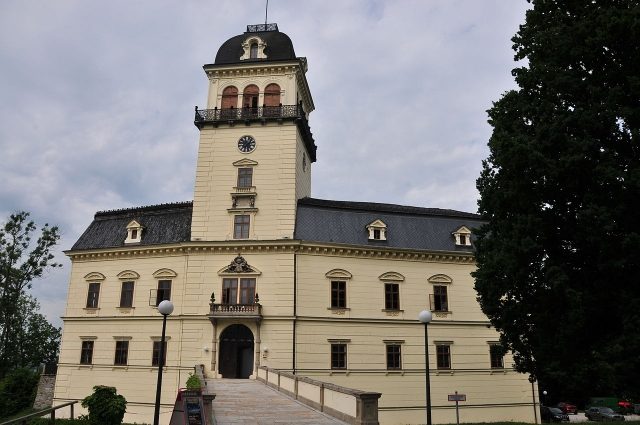
Tollet Castle is a Renaissance castle in the municipality of Tollet, located two kilometers northwest of Grieskirchen.
Tollet was a fief from Ort bei Gmunden to the Tolleters. The first fortification on a hill above the Trattnachtal was built by Ortlof von Tollet in 1170. The Tolleters were a ministerial family of the Styrian Ottokars. Ortlof von Tollet became the namesake of the first seat and later also of the entire settlement. After the extinction of the Tolleters, the castle reverted to the Lordship of Ort in 1273. The complex was expanded when it came into the possession of the Lerbühler family in 1331, who, like the first owner, presumably belonged to the knightly class and received Tollet as a fief from Ort am Traunsee and also owned Parz. As early as 1330, the castle was to be further expanded with the permission of the sovereign, Duke Friedrich the Fair, but this did not happen, as the more favorably located Trattenegg Castle was preferred at the same time. After the Lerbühler family, the next owners came from the Jörger family, as Dietmut von Lerbühler had married Helmhart IV. Jörger in the 14th century.
The Jörger family was a noble family residing in the area. Originally, they came from St. Georgen near Tollet, where their first castles stood. Tollet came into other hands twice as a dowry, but always reverted to the Jörger family through inheritance. Over time, they rose to high offices in the state and acquired large estates. Probably the most famous representative of the Tollet line of the Jörger family was Wolfgang Jörger IV, who, as a personal friend of Emperor Maximilian I, became captain of the Enns in 1513. His wife Dorothea and his children had converted to Protestantism early on. This was because Wolfgang Jörger's sons studied in Germany and met Luther personally there. After her husband's death, Dorothea was in correspondence with Martin Luther, who also sent her the first Lutheran preacher of Upper Austria, Michael Stifel, to Tollet; among other things, he prophesied the end of the world for October 19, 1533, which, like so many others, he was wrong about. The Protestant faith was so important to the Jörger family that they sought to defend it by all means, even during the Counter-Reformation. Adherence to Luther's teachings would ultimately lead to the downfall of the family.
Hans V. Jörger von Tollet had the castle rebuilt in the Renaissance style between 1601 and 1611. His name can also be found in the stucco of the ballroom on the first floor. However, he was a representative of the Protestant estates and openly opposed Emperor Ferdinand's plans for re-Catholicization; he even refused to pay homage to the Catholic Majesty. He was therefore accused of high treason. Although he was able to save his life through a petition, he lost almost all of his possessions, including his ancestral castle Tollet. Tollet then went around 1625 at a bargain price to an enemy of the Protestants, the Bavarian governor of Upper Austria, Adam Graf von Herberstorff, who had gained questionable fame through the Frankenburg Dice Game. Herberstorff's widow sold the lordship in 1637 to Wenzel Reichhard von Sprinzenstein; the castle remained in the possession of this family until 1771, when Franz II. von Sprinzenstein sold the castle for 150,000 fl to Philibert Graf Fieger von Hirschberg. In 1738, the chapel was consecrated as a Marian chapel by the Bishop of Passau.
The Fieger von Hirschberg family kept Tollet until 1809. After further changes of ownership (Bocella, Stremayr), the castle came into the possession of Count Anton Revertera y Salandra in 1845.
Under the Reverteras, measures were taken to renovate the complex. A road bend was created instead of the extremely steep incline below the castle, and the castle was re-plastered externally. In 1869, a stable building in the English style was built next to the tavern above the filled-in moat. The other outbuildings were demolished. Under Friedrich Revertera, a roof with steep and flat surfaces was added instead of the steep gable roof, and the tower was raised and somewhat reshaped. On the whole, however, the character of the building has been preserved since the Renaissance. The courtyard gallery's railings date from 1607 and comprise 48 fields with 46 different motifs.
Present Day+
According to its location, Tollet Castle can still be recognized as a castle, although at that time it was not a castle in the modern sense, but probably a fortified wooden structure with palisades and moats. Nothing remains of the fortified castle, as it was demolished and converted into a palace in 1607. The castle tower still rests on the foundations of the predecessor castle, and the front wall sections of the square complex probably also contain remnants of the original ring wall. Four residential wings are grouped around a square inner courtyard to form a closed unit. In the inner courtyard there is a well with a stylized wrought-iron well basket. A gallery runs around the first floor, which can be reached via an external staircase, also equipped with a wrought-iron railing. The ground-floor rooms, which today house the municipal administration of Tollet, are entirely original from the 17th century. Of the original furnishings, a stucco ceiling from 1609 has been preserved in the former dining room, whose inscription and coat of arms refer to Hans Jörger. On the upper floor there are two more stucco ceilings from the second half of the 17th century. The Revertera-Salandra coat of arms, held by two lions, can also be found on the tower.
The complex includes a large park that stretches down the hill. In front of the castle are the outbuildings, including quite remarkable horse stables. At the beginning of the 18th century, the castle tower was rebuilt; the dial of the tower clock is a replica of the country house tower clock in Linz. The two- to three-story Renaissance building was completely redesigned in the taste of the time towards the end of the 19th century.
During the Second World War, Tollet Castle was confiscated by the German government. It first housed a school for female labor leaders and later a military hospital. After the war, it temporarily served as a transit camp for refugees and as barracks for an American tank unit. The Revertera-Salandra family leased the castle from 1947 until about 1976 to the Upper Austrian Chamber of Agriculture, which established an agricultural educational center here. The castle threatened to fall into disrepair in the 1980s (parts of the roof had already collapsed). In 2002, Tollet Castle was acquired by AREV Immobilien and renovation began, which was completed in 2009.
In the renovated rooms of the museum in Tollet Castle, the District Local History Association has put together a presentation on the noble family of Jörger von Tollet to contribute to the Upper Austrian State Exhibition "Renaissance and Reformation". In 2010, the exhibition "Standpoints - The Jörger von Tollet and their Time" took place here.
Today, eight apartments are housed on the first floor. On the ground floor are the municipal office of Tollet and the District Local History Association. The castle is now owned by the municipality of Tollet, the apartment owners, and the Revertera-Salandra family.
Take Mobile History with you
You are reading this text for free. Premium adds what matters on the road: descriptions read aloud, sites found through your camera, whole regions taken offline.
- Every description, including the ~17,700 Premium sites
- Audio guide: have descriptions read to you on location
- AR finder: see sites through your camera, with distance and bearing
- Unlimited saved sites
14 days free, then from €2.99 a month. Cancel anytime.
Source: Wikipedia · Licence: CC BY-SA 4.0 · Image: http://commons.wikimedia.org/wiki/File:Schloss_Tollet.jpg?uselang=de
This description draws on the facts documented in the linked Wikipedia article; Wikipedia content is licensed under CC BY-SA 4.0. Wording and editing: Mobile History.
Location: 48.2448, 13.7983