University
CastleGera-Tinz
Tinz Castle
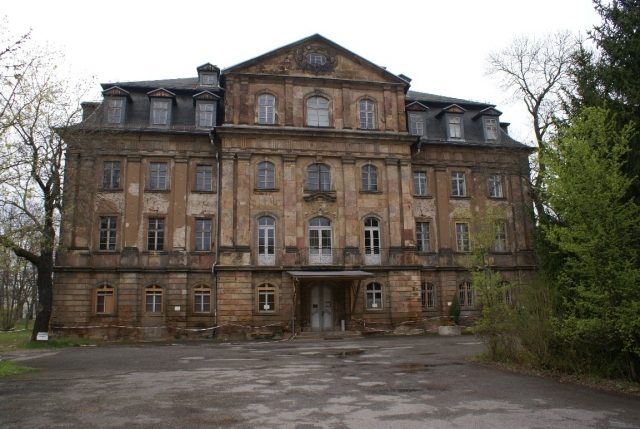
Tinz Castle is a Baroque castle built between 1745 and 1748 in the Tinz district of Gera.
Already in the Middle Ages, a moated castle stood on the same site. Excavations revealed minor traces of the medieval castle, which is believed to have been mainly located under the present castle building.
The castle was built according to plans by Gerardo Hofmann. Construction began in 1745 under Heinrich XXV Reuss-Gera and was completed in 1748, with the completion of the spacious park, under his son Heinrich XXX. Subsequently, it served the Reuss ruling house as a summer residence and widow's seat. The castle was originally surrounded by a geometrically laid out moat spanned by bridges, which was filled in 1975.
From 1827, the castle stood empty and was repeatedly used for military purposes. During the Franco-Prussian War in 1870, it served as accommodation for soldiers. During the First World War, from September 8, 1914, 204 French prisoners of war were temporarily housed in the castle, and from December 1914, it was used as a military hospital and convalescent home for German soldiers. In 1918, the castle was expropriated from the Reuss princely house by the Workers' and Soldiers' Council.
On March 8, 1920, a socialist residential adult education center was established in the castle on the initiative of USPD, MSPD, KPD, and with the participation of the Free Trade Unions. In five-month courses, politically engaged young socialists were to be offered systematic education with a socialist worldview and cultural understanding. Subjects taught included economics, social studies, history of the working class, labor law, trade unionism, art, and literature. Many well-known representatives of workers' education taught on site, including Alfred Braunthal, Ernst Fraenkel, Georg Engelbert Graf, Karl Korsch, Anna Siemsen, and Otto Suhr. After the National Socialists came to power, the residential adult education center was closed in March 1933. By then, approximately 1,350 women and men had participated in the courses offered.
After 1933, it served the National Socialists as a labor service camp, and during the Second World War, as a military hospital.
On January 15, 1947, the castle was transferred to the district executive committee of the SED, which subsequently used it for courses at the Workers' University, later the District Party School.
Between January 15, 1996, and April 2010, the castle served as the provisional seat of the Gera Regional Court until it moved to the new Justice Center in the city center. In July 2013, the renovation of the castle began, and the former castle park is also to be redesigned. By summer 2015, new seminar rooms, offices, and a library are to be created and subsequently used by the Gera University of Cooperative Education.
Take Mobile History with you
You are reading this text for free. Premium adds what matters on the road: descriptions read aloud, sites found through your camera, whole regions taken offline.
- Every description, including the ~17,700 Premium sites
- Audio guide: have descriptions read to you on location
- AR finder: see sites through your camera, with distance and bearing
- Unlimited saved sites
14 days free, then from €2.99 a month. Cancel anytime.
Source: Wikipedia · Licence: CC BY-SA 4.0 · Image: Roland Neubert, Halle (Saale)
This description draws on the facts documented in the linked Wikipedia article; Wikipedia content is licensed under CC BY-SA 4.0. Wording and editing: Mobile History.
Location: 50.9041, 12.0695