To be privately owned
CastleSt. Florian-Tillysburg
Tillysburg Castle
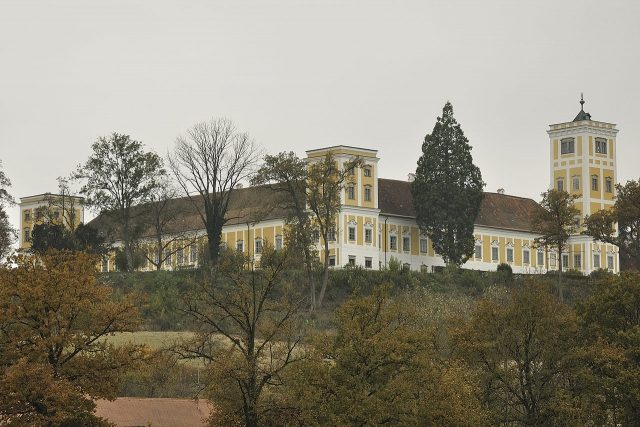
Tillysburg Castle is located in the village of Tillysburg, part of the municipality of St. Florian in the Linz-Land district, about 2.5 km west of Volkersdorf.
The predecessor building of Tillysburg Castle was the ancestral castle of the Lords of Gleink, also known as the Volkersdorfer. The Lords of Gleink ("Glunich") had built the Benedictine monastery of Gleink on their ancestral seat of the same name around 1120 and then built Volkenstorf Castle. After 1151, they named themselves Volkersdorfer (Volkenstorf) after this castle. The Volkersdorfer were one of the oldest noble families in Upper Austria (so-called Apostle family). Subsequently, the family split into three lines, one of which was settled in Volkenstorf, one in Kreuzen (1282-1489), and one in Neuhofen (1223-1312). The Volkersdorfer held the regional court between Traun and Enns as a fief from the sovereign.
In 1256, Ortlof von Volkenstorf stabbed Wittiko, the scribe of Enns and a Rosenberg, in the refectory of St. Florian Abbey. As a result, King Ottokar declared him to have forfeited his fiefs, and the castle was razed. However, his son Heinrich Volkensdorf managed to regain possession of the fief. In 1282, he issued a reversal to the regent Duke Albrecht I, in which he promised not to "burden" anyone, neither clergy nor laity, from his new Volkenstorf Castle ("castrum meum Volchnsdorf, quod destructum fuerat"). The castle was rebuilt again after a fire in 1558.
In 1616, this lineage died out in the male line with Wolf Wilhelm von Volkersstorff. In his will, he established a fideicommissum from the lordships of Volkensdorf, Weissenberg, Stein, and Reichersdorf. Wolf Wilhelm was governor of Upper Austria from 1610 until his death, but also a Protestant. After his death, his possessions went to his wife Katharina, who, as a Protestant, first had to emigrate to Regensburg and then to Nuremberg. From her, Count Werner t'Serklaes von Tilly, a nephew of the general Johann t'Serclaes von Tilly, bought the property in 1629/1630. He had the former Volkenstorf Castle demolished and, using the demolition material, built the new Tillysburg Castle between 1633 and 1645. In 1720, the castle was redesigned by Johann Michael Prunner. The Tillys of Tillysburg died out with Ferdinand Lorenz in 1724. His sister, the married Countess Montfort, became the heiress. In 1730, she sold Tillysburg, along with the lordships of Volkertorff and Stein, to the poorly managing Baron Johann Josef Clemens Anton von Weichs. From the bankruptcy estate, Ludovika von Weichs acquired the lordships of Tillysburg and Stein in 1755. In 1764, she sold the castle and land to St. Florian Abbey. During the Napoleonic Wars (1809), the castle served as a field hospital.
In 1841, Count Karl O'Hagerty acquired the castle and the estate (but without the regional court); his wife was Countess Sternberg-Manderscheid. O'Hagerty had previously been master of the horse at the French court; based on this background, he set up stables for about 40 horses and began horse breeding, which, among other things, supplied the Enns barracks with cavalry horses. The stable was reconstructed in its 1849 furnishings during the last renovation. Anton Bruckner gave piano lessons to the count's children and probably also lessons in other subjects during his time as a school teacher in St. Florian (1845-1855). The count's daughter Ida O'Hagerty married Count Franz von Eltz in 1883. In 1897, Count August and Margarete von Eltz followed; this family managed the castle and the associated agriculture for more than 100 years. The building suffered greatly from looting and the billeting of refugees during the Second World War.
Since 1989, Tillysburg Castle has been owned by Georg Spiegelfeld-Schneeburg, who oversaw the renovation and revitalization of the castle.
Tillysburg Castle Today+
The castle is a four-winged building with square corner towers around a rectangular inner courtyard. It is a building typical of the transition between Renaissance and Baroque. The left corner tower, facing the park, extends far beyond the ridge of the roof, while the other three only protrude one story above the roof. They have flat roofs. This is because the former towers were partially dismantled and stripped of their onion domes at the end of the 19th century. This unusual current design has led to the popular designation of the castle as "the inverted bedstead." The inner courtyard is completely enclosed by the four wings, which are equipped on the ground floor with arcades featuring 36 imposing granite columns. The east wing has a Baroque staircase, which was installed in the second half of the 18th century and is an exact replica of Jakob Prandtauer's staircase in St. Florian Abbey. The courtyard facades have rich stucco decoration. From the north and south, the courtyard is accessible through Baroque gatehouses with pedestrian gates. On the north facade of the courtyard, there is a painted sundial, framed by the coats of arms of the owner families.
The interior rooms are equipped with rich stucco ceilings with figural bas-reliefs from 1736, and the doors with inlays. In the west wing of the castle, there is a Baroque chapel with a barrel vault from the time of its construction; the high altar dates from around 1635.
In the garden areas in front of the castle entrance, there are stone figures representing the four seasons.
South of the castle is the former, recently renovated courthouse. In its completely preserved dungeon cells, mainly Protestants had to await their trial or expulsion from the country. In the court clerk's room, multi-layered graffiti is preserved, the layers of which come from different periods of origin (17th to 19th century) and are historically unique in their kind. This building is privately owned and cannot be visited.
Since 1973, the Golfclub Linz St. Florian has been located in the area of the former castle garden, operating an 18-hole course there.
The castle is privately owned; parts of it are rented out to various users. Through cultural events (concerts, literary evenings, seminars, exhibitions, special festivals), parts of the castle are publicly accessible for events. A guided tour of the large north tower is possible by prior arrangement. Otherwise, the castle can only be viewed from the outside.
Take Mobile History with you
You are reading this text for free. Premium adds what matters on the road: descriptions read aloud, sites found through your camera, whole regions taken offline.
- Every description, including the ~17,700 Premium sites
- Audio guide: have descriptions read to you on location
- AR finder: see sites through your camera, with distance and bearing
- Unlimited saved sites
14 days free, then from €2.99 a month. Cancel anytime.
Source: Wikipedia · Licence: CC BY-SA 4.0 · Image: http://commons.wikimedia.org/wiki/File:Schlossanlage_Tillysburg.JPG
This description draws on the facts documented in the linked Wikipedia article; Wikipedia content is licensed under CC BY-SA 4.0. Wording and editing: Mobile History.
Location: 48.1992, 14.4226