To be privately owned
CastleDeutschfeistritz
Thinnfeld Castle
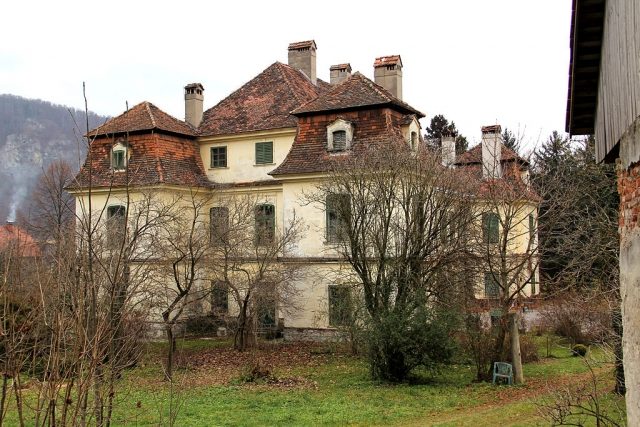
Thinnfeld Castle is located in the municipality of Deutschfeistritz in the district of Graz-Umgebung in Styria.
Between 1761 and 1764, Ferdinand Joseph von Thinnfeld had the castle built on what was then the edge of the village of Deutschfeistritz, at the foot of the Kirchberg hill. The plans were provided by the renowned Graz architect Josef Hueber, with the builder Thinnfeld himself incorporating his own ideas. The wealthy Thinnfeld family owned several ironworks in Deutschfeistritz, Waldstein, and Übelbach. In 1731, Anton Balthasar and Josef Ferdinand were ennobled, and Ferdinand Joseph von Thinnfeld bore the noble predicate "Edler Herr von Thinnfeld" from 1767 onwards.
Ferdinand Joseph's grandson, Ferdinand Freiherr von Thinnfeld, born in 1793, served as Minister for Agriculture and Mining under the young Emperor Franz Joseph I and was also involved in drafting the constitution in 1849, as well as founding the Imperial Geological Institute. Due to high family debts, the castle was auctioned off in 1871, but a daughter of the minister managed to acquire the family seat with the help of her husband, a Viennese dentist.
After the Second World War, the castle began to decay due to neglect but was restored in the 1970s. Thinnfeld Castle is one of the most beautiful Rococo castles in Styria and is currently owned by the Steinklauber family.
Architecture and Design+
The two-story building has a rectangular floor plan and is surrounded by a park. Four corner pavilions are attached to the main block, while the garden front is slightly recessed. The main wing has a high, hipped gable roof, while the corner pavilions have mansard roofs. Above the entrance gate is the coat of arms of the Thinnfeld family. The facade is structured by a continuous cornice between the two floors. A stucco-decorated ornamental window is set into the gable of the three-axis central risalit.
The entrance hall has flat vaulted ceilings and a wrought-iron railing in the staircase. Significant artists of Styrian Rococo contributed to the interior design of the castle. Heinrich Formentini created the stucco ceilings in 1764. The ceiling paintings and wall hangings are by Joseph Adam von Mölck. In the three-axis, centrally located garden hall, the depictions of Bacchus, Ceres, Venus, and Vulcan are by him. In the adjoining room, Apollo and Daphne are depicted in a fresco. Another room shows biblical scenes painted in 1766, with Jacob and Rebekah at the well depicted on the ceiling. The furnishings also include Rococo-style tiled stoves and several portraits of the former lords of the castle. The house chapel is located in one of the garden-side corner pavilions and is dedicated to the Holy Trinity. The crucifixion group, consisting of a white-painted wooden crucifix and two adoring angels, was carved in 1768 by the South Tyrolean sculptor Veit Königer.
Take Mobile History with you
You are reading this text for free. Premium adds what matters on the road: descriptions read aloud, sites found through your camera, whole regions taken offline.
- Every description, including the ~17,700 Premium sites
- Audio guide: have descriptions read to you on location
- AR finder: see sites through your camera, with distance and bearing
- Unlimited saved sites
14 days free, then from €2.99 a month. Cancel anytime.
Source: Wikipedia · Licence: CC BY-SA 4.0 · Image: http://commons.wikimedia.org/wiki/File:Schloss_Thinnfeld_IMG_0153.jpg
This description draws on the facts documented in the linked Wikipedia article; Wikipedia content is licensed under CC BY-SA 4.0. Wording and editing: Mobile History.
Location: 47.2012, 15.3384