To be privately owned
CastleSurpierre
Surpierre Castle
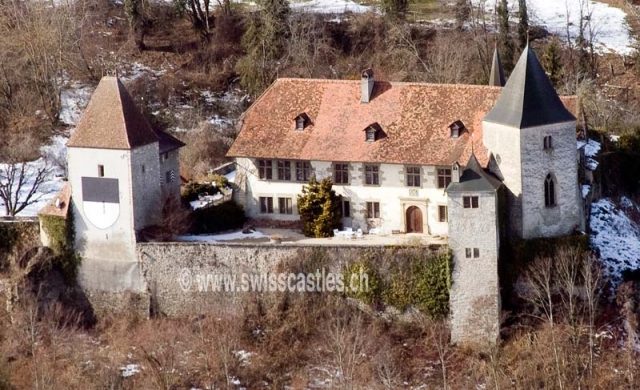
On a molasse rock dominating the central part of the Broye Valley, almost halfway between Moudon and Payerne, stands Surpierre Castle. The seigniorial domain to which it formerly belonged alone sparks interest. This area largely corresponds to an enclave that the State of Fribourg possessed on Vaudois soil, comprising six communes. The territory is almost quadrilateral. Each of its borders is approximately 3.7 kilometers, and those to the east and west, as well as to the south and north, are almost parallel. On the other hand, the borders leading towards the Broye Valley can easily be integrated into the Roman topographical network established from Avenches.
This seems to confirm that the territory thus delimited has existed for a long time. Knowing that the high plateau extending between Broye and Lake Neuchâtel was populated very early on, it is not possible to say in which era the seigniorial center was formed. From traditions, we know that Surpierre was a pressure point of the Burgundian Kingdom in the 6th century, and thus it seems obvious that such a location, dominating an important communication route, must have entailed the establishment of a post. However, documents only briefly mention a defensive work shortly before the middle of the 12th century, a work that then belonged to the noble "Surpetra," but which must have been built earlier. To this day, it is not possible to clarify whether it was located at the site of the future castle or in its vicinity.
In history, Surpierre only appears in the 13th century. After the Lords of Cossonay acquired the lordship of this name, they made it a cornerstone of their territory, which at that time stretched fragmented from Mont-sur-Rolle to Grandcour, near Estavayer. These lords probably had the castle rebuilt at the end of the 13th century. The current castle includes only a few elements from its predecessor, such as the quadrilateral tower, probably a residential tower, erected on the edge of the high plateau, which dominated the Broye Valley. Even today, it contains a chapel with primary pointed arch style, as well as the foundations of the watchtower, located a little further back, which overlooked the moat and the castle's access. It is well conceivable that the available terrain, given the topographical conditions of the site, was still occupied by some small craft businesses and some communes. To better protect their inhabitants and the surrounding farmers, the Lords of Cossonay founded a small fortified town within the defensive work. It was mentioned for the first time in 1344 and was one of the last foundations of this kind. Other families undoubtedly lived at the foot of the rocky hill down in the Broye Valley at the place where the village of Villeneuve is located today. Was it also a medieval town foundation? In the absence of precise historical information, this question remains open. A small ecclesiastical area extended a little above the castle, where the church still stands today.
From the end of the 14th century and throughout the 15th century, there were several owners of Surpierre Castle. Finally, it fell to Prince Jacques of Savoy, Count of Romont. Under him, it was involved in the Burgundian Wars in 1475. It was burned at the same time as the village and rebuilt after the peace. The small village, on the other hand, was abandoned. Although some 18th-century remains can still be found today, all traces of this agglomeration have disappeared.
After the conquest of Vaud by the Bernese in 1536, Fribourg extended its territories to Surpierre but had to leave Bern the artery running along the Broye. The castle, which thus stood in the resulting enclave, became the center of a small bailiwick. After a new fire, the Fribourgers decided in 1544 to rebuild the work to better adapt it to its new functions. Tastefully furnished and made more comfortable, the central building became the residence of the bailiffs. At the same time, several annexes were built, and a little later, a magnificent gate was erected next to the medieval watchtower. A drawbridge crossed the moat.
One can recognize a certain kinship between this work and the gates of the three Fribourg bailiwick centers of Romont, Rue, and Attalens, which gates were also erected towards the end of the 16th century or at the beginning of the 17th century. Carefully maintained and adorned with a charming garden, Surpierre Castle transformed into a magnificent manor house over the years.
In 1848, the Surpierre bailiwick was assigned to the new Broye district, and the castle was sold. In 1850, it was acquired by Victor-Henri Leenhart-Imer, a merchant from Marseille.
Max Bürki bought it in 1951 from the later owner family Delpech.
Take Mobile History with you
You are reading this text for free. Premium adds what matters on the road: descriptions read aloud, sites found through your camera, whole regions taken offline.
- Every description, including the ~17,700 Premium sites
- Audio guide: have descriptions read to you on location
- AR finder: see sites through your camera, with distance and bearing
- Unlimited saved sites
14 days free, then from €2.99 a month. Cancel anytime.
Source: Wikipedia · Licence: CC BY-SA 4.0
This description draws on the facts documented in the linked Wikipedia article; Wikipedia content is licensed under CC BY-SA 4.0. Wording and editing: Mobile History.
Location: 46.7451, 6.8637