To be privately owned
CastleVienna (Wien)
Süßenbrunn Castle
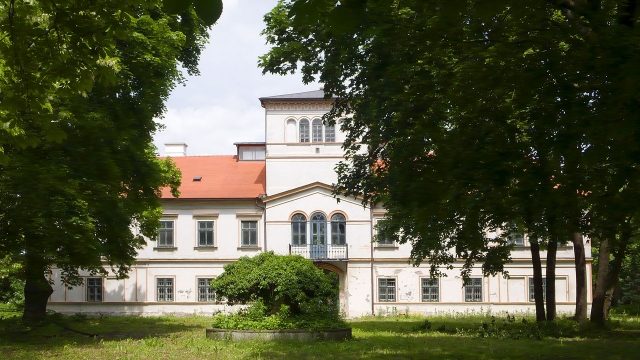
Süßenbrunn Castle is located in the Süßenbrunn district in the 22nd Viennese district of Donaustadt at Süßenbrunner Hauptstraße 9. The castle is first documented in 1320 as a fortified house, together with the dominion of Prun(n), taken over by Dietrich von Pillichsdorf. After wars with the Turks, the fortified house was devastated around 1529.
In the last quarter of the 16th century, the place was re-settled by Urban Sueß (Siess) and a castle was built, with the place name Sueßen Brunn (Siessenprunn) being newly composed from the family name and the old dominion name. Around 1600, the castle was owned by the Barons of Landau, from 1622 by the Losenstein, from 1660 by the Auersperg, from 1667 by the Grundemann, from 1802 by Baron von Walterskirchen, from 1813 by Count Kokorzowa, from 1816 by Baron von Bartenstein, in the 19th century by the Dubsky von Trebomyslice, around 1900 by the Bösch family, and since 1926 by the Theresianische Akademie. In 2008, the castle was acquired by the Ludwig Reiter Schuhmanufaktur, which renovated the building and moved there in March 2011.
Castle Building+
The castle building consists of a two-story U-shaped complex under hip roofs. It features a central main tower and a rear courtyard of honor. It was built at the end of the 16th century. In the mid-19th century, the facade was renewed in early historicist style, and some of the interior rooms were redesigned. There are pointed caps and barrel vaults or cross vaults from the construction period and stucco ceilings from the 17th century.
Outbuildings+
The administration building is located to the north of the complex and was originally built in the mid-18th century, then extended and raised in early historicist style in the mid-19th century. The one to two-story farm wing from the early 20th century has an 18th-century core and a small building (Stöckl) from the second half of the 17th century. Next to it is a dovecote from the 20th century with neo-Gothic turrets and an iron weather vane and flag, dated 1905 and named after its builder Bösch.
Granary+
The baroque granary from the second third of the 17th century stands in the center of a large courtyard. It has a mighty volute gable with a tower-like projection of a former bell tower and open wooden beam ceilings over wooden supports inside.
Well+
South of the castle stands a well with a water nymph by the sculptor and painter Viktor Tilgner, dating from around 1880.
Take Mobile History with you
You are reading this text for free. Premium adds what matters on the road: descriptions read aloud, sites found through your camera, whole regions taken offline.
- Every description, including the ~17,700 Premium sites
- Audio guide: have descriptions read to you on location
- AR finder: see sites through your camera, with distance and bearing
- Unlimited saved sites
14 days free, then from €2.99 a month. Cancel anytime.
Source: Wikipedia · Licence: CC BY-SA 4.0 · Image: http://commons.wikimedia.org/wiki/File:Schloss_S%C3%BC%C3%9Fenbrunn_01_.jpg
This description draws on the facts documented in the linked Wikipedia article; Wikipedia content is licensed under CC BY-SA 4.0. Wording and editing: Mobile History.
Location: 48.2788, 16.4944