To be privately owned
CastleBrackenheim-Stockheim
Stocksberg Castle
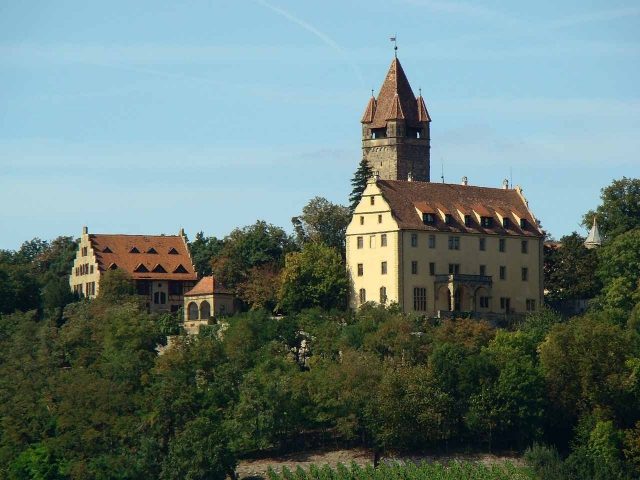
Stocksberg Castle is a castle in Stockheim, a district of Brackenheim in the Heilbronn district in northern Baden-Württemberg.
Stocksberg Castle is located on the eponymous Stocksberg, a southeastern spur of the Heuchelberg, northeast above the village of Stockheim. The core area of the complex lies on an almost square plateau, which is separated from the rest of Stocksberg to the west by a moat bent at an approximately right angle. The two-winged main building and the 30-meter-high tower are located on the approximately 29 × 30 meter plateau; to the west of it, along the opposite side of the moat, are some farm buildings, and further west, a park-like garden.
The Lords of Stocksberg are considered to be the builders of a first castle on the Stocksberg above Stockheim. They presumably descended from the Lords of Stockheim, who had previously resided in the village, and were first mentioned with Ulrich von Stockersberg in 1220. The early history of the castle's ownership is unknown. Count Eberhard the Illustrious ceded his rights to Stocksberg Castle to the Teutonic Order on December 6, 1307. The Order had already received the estates of the Lords of Stockheim in 1295 and thus, through further acquisitions, owned both the castle and the village. In 1334, Stockheim was elevated to a commandery, but was already united in 1375 with the rising commandery of Horneck, which also acquired Kirchhausen and parts of the Heuchlingen district from 1404.
How the early castle on the Stocksberg might have looked can only be reconstructed from structural findings. The palas was probably located at the site of the current main building, and the castle tower dates back to the former keep, which was located at the angle of the bent moat. The current narrow north wing of the complex could have been built on an old shield wall between the tower and the palas. A bailey was located at the site of the current farm buildings west of the moat.
During the German Peasants' War, on the night of Easter Monday, April 17, 1525, Stocksberg was the target of rebellious peasants under their leader Hans Wunderer from Pfaffenhofen. Except for the bailiff and another citizen, all Stockheim residents joined the peasant mob, who plundered and set fire to the castle. After this act, the rebellious groups were called the Stocksberg mob. A few days later, this mob united with the Bottwartal mob under Matern Feuerbacher to form the "Helle Christliche Haufen" (Bright Christian Mob) and moved on via Bietigheim, Vaihingen, Stuttgart, Schorndorf, Göppingen, and Urach. After the defeat at Böblingen on May 12, 1525, the Helle Christliche Haufen united with the Heilbronn mob on May 19, 1525, but with the impending failure of the uprising, the peasants returned to their home villages. On August 12, 1525, Deutschmeister Dietrich von Cleen was in Stockheim for a punitive judgment. His successor Walther von Cronberg had Horneck and Heuchlingen rebuilt by 1530. However, Stocksberg Castle was not completed until 1574 under Heinrich von Bobenhausen. The master builder could have been Thomas Knoll († 1573) from Weinsberg, who also built the Teutonic Order Castle Kirchhausen, which is very similar in details, for the Teutonic Order. Through this reconstruction, the complex essentially acquired its present form as a two-winged structure.
During the Thirty Years' War, in December 1631, Swedish troops under Marshal Gustav Karlsson Horn advanced from Mergentheim to Heilbronn. On Christmas Eve, Swedish cavalry plundered Stocksberg Castle. In 1634, the Teutonic Order regained control.
During the War of the Palatine Succession, troop movements repeatedly occurred in the area of Stockheim. In June 1693, the village and castle were plundered by the French. In October of the same year, troops of the Bavarian General Serini set up their camp on the Stocksberg.
During the Second Coalition War, in 1799, the French General Michel Ney occupied Stocksberg Castle with his 7,000-strong troops and engaged in a battle on the Heuchelberg with the Austrian cavalry, who had entrenched themselves in Güglingen.
In November 1805, Württemberg occupied the former imperial knightly residences and their offices, including Neipperg and Stockheim. While the village became an independent municipality within the Kingdom of Württemberg, Stocksberg Castle initially became a state domain under an official. In 1832, it came into the possession of the widow of the court saddler Fröhlich, whose children initiated extensive renovation measures on the complex. In 1843, Alfred von Neipperg acquired the castle; his brother and heir Erwin von Neipperg sold it to the municipality in 1873. The municipality parceled out the associated castle estate and sold the parcels at favorable conditions to the residents of the village. The castle itself came into the possession of the sparkling wine manufacturer Eduard Gießler in 1890, to whom the current interior design of the main wing is attributed.
During World War II, Stocksberg Castle was occupied by the Reich Labor Service; later, the city of Heilbronn established a retirement home there as an alternative accommodation for the Heilbronn Katharinenstift. From 1954, the property was divided. A farmer acquired the farm buildings, and the castle building was sold to a manufacturer in 1969. The stone archway in the vineyards marks the former end of the municipal hollow path leading up to the castle.
Take Mobile History with you
You are reading this text for free. Premium adds what matters on the road: descriptions read aloud, sites found through your camera, whole regions taken offline.
- Every description, including the ~17,700 Premium sites
- Audio guide: have descriptions read to you on location
- AR finder: see sites through your camera, with distance and bearing
- Unlimited saved sites
14 days free, then from €2.99 a month. Cancel anytime.
Source: Wikipedia · Licence: CC BY-SA 4.0 · Image: https://commons.wikimedia.org/wiki/File:Stockheim-Schloss-2009-2.jpg
This description draws on the facts documented in the linked Wikipedia article; Wikipedia content is licensed under CC BY-SA 4.0. Wording and editing: Mobile History.
Location: 49.0882, 9.0090