Musical school
CastleBad Salzuflen - Schötmar
Stietencron Castle
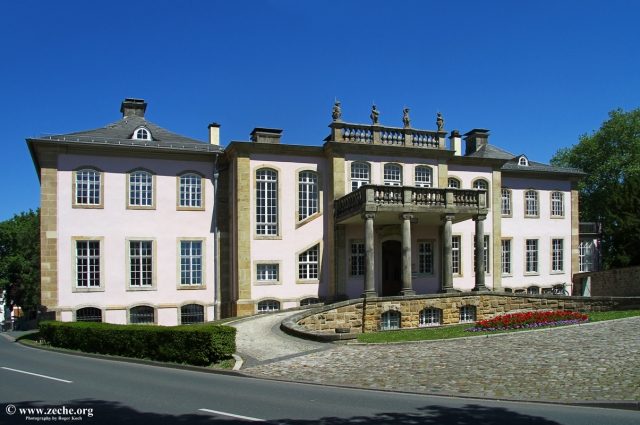
Stietencron Castle is located on Schlossstraße in Schötmar, a district of Bad Salzuflen. It served as the seat of the Schötmar manor. Currently, the Bad Salzuflen Music School is housed in the premises.
The Schötmar manor was founded in 1664 by Colonel Simon Moritz von Donop (1613–1676) from Wöbbel. In the early 1660s, he acquired the Schötmar parish inn (today "Korf") with all its privileges, and subsequently further lands and buildings. In 1664, Simon Moritz von Donop succeeded in obtaining the status of a manor for his estate. In 1729, the castle was built by the Swedish and Hessian state minister August Moritz Abel Plato von Donop. It served as the manor house of the Schötmar estate.
Between 1788 and 1831, the castle and manor changed hands several times. In 1831, Johann von Stietencron the elder bought the castle with the approximately 138-hectare estate and made it the seat of the von Stietencron family. His son Johann von Stietencron, known as Iwan, inherited the house in 1835. He was a fellow student of Bismarck, president of the Lippe knighthood, and a member of the Lippe state parliament. In 1949, the town of Schötmar took over the park and the castle as an addition. Since 1983, the Bad Salzuflen Music School has been located in Stietencron Castle. Weddings are performed in the Rococo Hall of the castle.
Construction Measures+
Built between 1729 and 1732 in the Late Baroque and Rococo style, the first minor alterations followed as early as 1758/59. From 1909, it was extended with the new entrance hall and staircase on the entrance side. In 1913, Margarete von Stietencron, who inherited the castle from her husband Iwan (II) von Stietencron, had extensive alterations carried out. The building was modernized in the neoclassical style, and the main entrance was moved from the north side to the south side. In addition, the entrance was provided with a ramp. In 2009 and 2010, the castle underwent extensive renovation. In this context, all windows were refurbished, a new slate roof was installed, and the facade was plastered and given a new coat of paint.
Castle Park+
Schötmar Castle Park, or Stietencron Park, has developed into a public park since the 18th century.
18th Century
A site plan from 1775 shows a regularly designed flower and pleasure garden north of the castle. Contemporary written sources also mention several avenues as well as a kitchen garden and an orchard. The mighty old trees, in particular a Norway maple and a sweet chestnut, probably date from this period. Both trees have a considerable trunk circumference of 4.50 m each.
19th Century
In 1867, after disputes with the Protestant church community of Schötmar, Johann von Stietencron had a private family chapel with a mausoleum built in the park. Probably at the same time, the oak avenue leading to the mausoleum was planted. Together with his wife Catharina, known as Cathinka, he expanded the park almost to its present size. Likewise, their son Iwan Friedrich showed a particular fondness for the park and, like his parents, had rare trees planted. Numerous rare deciduous trees and conifers, often planted more than 100 years ago, have since shaped the appearance of the landscape park. Iwan Friedrich also made the castle park available to the citizens of Schötmar for occasional festivities. After Cathinka's death in 1910, she outlived her husband by 37 years, she bequeathed a larger sum of money to the castle gardener as an expression of her high appreciation for his services.
20th Century
The structural changes to the castle also led to further redesign measures in the park. Until 1913, the main access to the manor house was from the north via a straight path lined with a lime tree avenue. The path and the avenue, as well as a brick outdoor seating area with an ice cellar underneath, are no longer present today. A large water basin, originally intended to be used as an outdoor swimming pool, has also not been preserved. In 1933, the then lord of the castle had a brine spring drilled near the mausoleum close to the park wall to direct the spring water directly into the basin. Today, this spot in the park wall is marked with an oval opening.
Upon acquiring the castle grounds in 1949 for the price of 240,000 DM (approximately 297,955 Euros in today's prices), the city committed to maintaining the park as a public facility and preserving the mausoleum with the small cemetery of the von Stietencron family in a dignified condition. The castle building had to be taken over as an "addition." The city planned to transform the castle park into a "people's park" for the rest and relaxation of its citizens. In the spring of 1950, the redesign of the complex began. An intensively designed area was created south of the castle. A species-rich perennial garden and a heath garden with numerous bog plants were laid out as a botanical show garden. Directly at the castle, the themed gardens are complemented by a rose garden, whose geometric beds are bordered by regularly trimmed boxwood hedges.
Current State and Use
The structure created from 1950 still defines the park's appearance today. A new decorative main entrance to the park was created on the northwest side. In the northern park area, the now overgrown tree population was thinned out, generous new lawns were laid, and the border areas were planted with woody plants and perennials. The southwestern part of the park in the area of the mausoleum now has more the character of a small grove. In the early 1960s, the mausoleum in the castle park was converted into a memorial for the victims of both world wars. Only four inscription plaques from a memorial erected in the castle park in 1922 were reused in the design of the mausoleum hall. The once stately pleasure garden has now become an inner-city park, which is also used for public events and concerts. In some areas, the intensity of use for such events conflicts with the preservation of the park's substance.
Take Mobile History with you
You are reading this text for free. Premium adds what matters on the road: descriptions read aloud, sites found through your camera, whole regions taken offline.
- Every description, including the ~17,700 Premium sites
- Audio guide: have descriptions read to you on location
- AR finder: see sites through your camera, with distance and bearing
- Unlimited saved sites
14 days free, then from €2.99 a month. Cancel anytime.
Location: 52.0699, 8.7596