The Castle can be visited
Museum
CastleSteinau
Steinau Castle
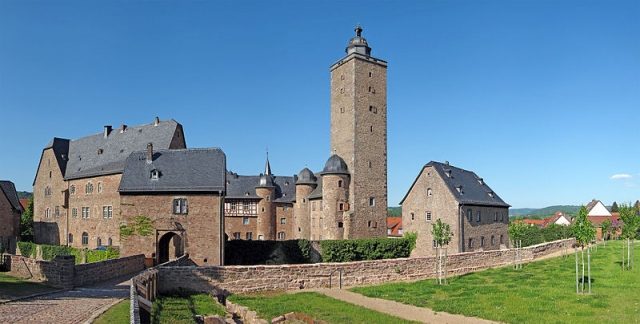
Steinau Castle in Steinau an der Straße, Hesse, was a secondary residence of the Lords and Counts of Hanau. It is the earliest, largest, and best-preserved early Renaissance castle complex in Hesse.
The complex originated from a medieval castle, but nothing is known about its appearance. It may have been founded by the Fulda Abbey. At the time of written records at the end of the 13th century, the castle was initially in the allodial possession of the Counts of Rieneck. With the marriage between Ulrich I of Hanau and Elisabeth of Rieneck, the town and castle passed to the Lords of Hanau as a dowry. In later times, the castle, like the castles in Schwarzenfels and Windecken, was used as a dower house for Hanau countesses.
Parts of the curtain wall and the keep, a mighty tower with a square footprint and now a Baroque dome, which dominates the complex, are still preserved from the medieval complex. In the medieval defense system of the city of Steinau, it protected the most vulnerable side to the south, while the north of the city was protected by the then impassable Kinzig floodplain.
Steinau Castle is a pentagonal complex, which was probably based on early Italian Renaissance fortresses. The design is attributed to Count Reinhard zu Solms, guardian of Count Philipp III of Hanau-Münzenberg. A master builder from Steinau named Asmus was probably in charge of the execution.
Both the always dry moat with its high enceinte walls and the core complex are pentagonal, although the southern half-wing, demolished in the 19th century, is missing. Until then, the castle consisted of a closed, pentagonal ring of buildings. At four of the five corners of the enceinte are bastion-like utility buildings projecting into the moat with integrated stair towers; at the fifth corner is the field gate. At the two gatehouses there and in the middle of the north side, the moat was spanned towards the town and outwards with drawbridges. In the pentagonal courtyard there are four stair towers that provide vertical access to the buildings.
The complex was built in several construction phases, predominantly in the 16th century. The last expansion was a connecting building between the castle and the previously freestanding north gate to the town in the early 17th century.
Buildings+
The west wing, the hall building, was built around 1525 to 1528 under the reign of Count Philipp II of Hanau-Münzenberg. Typical of its exterior decor are the late Gothic ogee arches of the windows – a modern form around 1525, but otherwise only found in Saxony and Thuringia. On the northern gable side of the hall building is a three-story bay window. On the ground floor was the two-aisled court room with a net vault on five columns. On the first floor were the "state rooms" for high-ranking guests. The former banquet hall on the second floor has the remains of a stucco ceiling.
Due to the early death of Count Philipp II, construction was interrupted until 1542. Under the guardianship and later under the reign of Count Philipp III of Hanau-Münzenberg, work was continued swiftly. South of the hall building, the kitchen building with a magnificent bay window was erected by 1546. The spacious kitchen on the ground floor is equipped with a huge fireplace. The count's apartment was located in the rooms above the kitchen. The north and east wings were built from 1551 to 1553. The stair tower at the keep was added in 1571.
In front of the castle, the stables from 1557/58 (today: Die Holzköppe Puppet Theater) and the cattle yard with buildings from the 16th and 18th centuries are preserved.
The complex, with the Castle Museum and the Brothers Grimm Memorial, has been part of the administration of the State Palaces and Gardens of Hesse since 1957.
Take Mobile History with you
You are reading this text for free. Premium adds what matters on the road: descriptions read aloud, sites found through your camera, whole regions taken offline.
- Every description, including the ~17,700 Premium sites
- Audio guide: have descriptions read to you on location
- AR finder: see sites through your camera, with distance and bearing
- Unlimited saved sites
14 days free, then from €2.99 a month. Cancel anytime.
Source: Wikipedia · Licence: CC BY-SA 4.0
This description draws on the facts documented in the linked Wikipedia article; Wikipedia content is licensed under CC BY-SA 4.0. Wording and editing: Mobile History.
Location: 50.3119, 9.4611