Kolleg St. Sebastian
CastleStegen
Stegen Castle
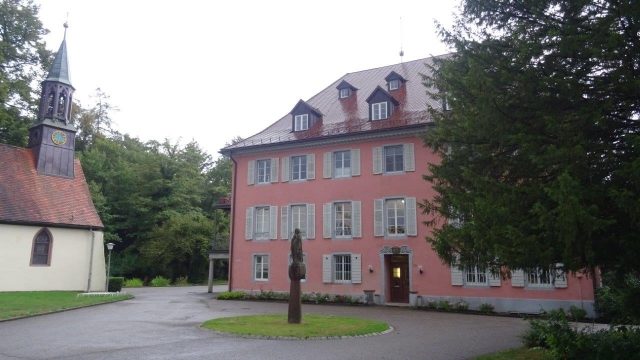
Stegen-Weiler Castle was a manor house from at least the High Middle Ages until the emancipation of the peasants, located in present-day Stegen on the northern edge of the Dreisam Valley, a few hundred meters south of the Eschbach, a tributary of the Dreisam. Today, Kolleg St. Sebastian stands on the site. The main building, dating from the Baroque period, is now referred to as the castle in the narrower sense.
Around the year 1000, Einsiedeln Abbey owned land on the northern edge of the Dreisam Valley, from Ebnet in the west, past Eschbach, to the Ibenbach, a tributary of the Wagensteigbach, in the east, i.e., in the area of present-day Stegen. Presumably as bailiffs of Einsiedeln Abbey, the Lords of Weiler gained influence here. They later became ministeriales of the Dukes of Zähringen and are mentioned in 1112 and 1113 in the Rotulus Sanpetrinus, where Reginhard de Wilare, Reinhard von Weiler, witnessed donations by Duke Berthold III to St. Peter's Abbey in the Black Forest, and Wido de Wilare witnessed a consecration of the monastery. The Lords of Falkenstein emerged from the Weiler family in the 12th century, but individuals named von Weiler continued to be mentioned, for example, as councilors of the city of Freiburg im Breisgau, most recently Hans Ulrich Meyer von Wyler, who became mayor of Freiburg in 1464 and died without male offspring in 1480. His daughter married Hans von Reischach († around 1524).
Around this time, the Stegen area belonged to Further Austria, and Archduke Siegmund enfeoffed Hans von Reischach with the lordship of Weiler. At the beginning of the 16th century, the Reischachs built a fortified castle on the site of the Meierhof. The castle chapel, dedicated to Saint Sebastian, also dates from this period at the latest; a window sill in the chapel bore – no longer visible today – the year 1504. Services were provided by priests from the parish of St. Gallus (Kirchzarten) and St. Peter's Abbey, and from 1786, after Eschbach was ecclesiastically separated from St. Gallus, by priests from the local parish of St. Jakobus. During the Reischach era, the name Stegen first appeared, probably from the footbridges (Stegen) over the Rotbach and Wagensteigbach, the converging headwaters of the Dreisam: "On Tuesday after St. Gall's Day in the fifteen hundred and tenth year according to custom and tradition, a court was held ... at Yben and Stegen with timely and well-considered advice, and also with the knowledge and will of the noble and strict Lord von Reyschach."
When Eucharius von Reischach died in 1596 without a male heir, Emperor Rudolf II enfeoffed Weiler to the archducal secretary Dr. Justinian Moser († 1633), who thereafter called himself Justinian Moser von Weiler. For a good hundred years, Weiler remained with the Moser zu Weiler family. The castle, destroyed in the Thirty Years' War, was rebuilt by Maria Clara Anna Moserin zu Weyler († 1657) and her children over the preserved mighty cellars.
Having reverted to the crown again, Weiler, "with rights, revenues, buildings, forest, fields, meadows, etc.," passed in 1702 to Johann Friedrich von Kageneck (1633–1705), who also owned property in Munzingen and built and resided in the castle there. The Counts of Kageneck played "a leading role in
In 1928, after the death of his brother and his sister-in-law Catharina Wilhelmine née von Linden (1863–1926), Ernst Maximilian Philipp leased the property to the Freiburg training house of the Priests of the Sacred Heart, founded in 1927. During World War II, soldiers were quartered there, later children from the Ruhr area and bomb victims, not least victims of the air raid on Freiburg on November 27, 1944, were accommodated. After the war, a gymnasium was established, which initially led students only to the Mittlere Reife (intermediate secondary school certificate), and from 1966 to the Abitur (university entrance qualification), and since 1966 has been named "Kolleg St. Sebastian" after the patron of the chapel. Gradually, the Priests of the Sacred Heart purchased the property from the Kagenecks. Among other alterations and extensions, a new Sacred Heart parish church was built on the site from 1959 to 1961 for the parish curacy (since 1970 a parish) of Stegen, which had been separated from St. Jakobus (Eschbach) in 1958. The chapel was renovated in 1970, 1982–1983, and most recently in 1997–2000. In 1999, the Priests of the Sacred Heart handed over their school to the School Foundation of the Archdiocese of Freiburg, to which they granted free use of the grounds and buildings.
Secular Buildings+
From the period up to the Kagenecks, the extensive, partly park-like, partly walled grounds include the main building, the castle in the narrower sense, the chapel to its southeast, and further east the Brothers' House, built by the Kagenecks and so named since its use by the Priests of the Sacred Heart. Furthermore, north outside the wall, beyond the main street of Stegen, is the Aunts' House, also built by the Kagenecks. The castle today houses the accounting office for Catholic parishes of the Archdiocese of Freiburg as well as private apartments, and the Aunts' House also contains private apartments. Heinrich Maximilian Edmund Philipp Franz Xaver Maria von Kageneck (1886–1957), with whom the Stegen line died out, lived in the Aunts' House for some time. Above the entrances to the castle and the Aunts' House is the Kageneck coat of arms, a silver bend sinister on a red shield.
Castle Chapel – Building+
It is the oldest, essentially medieval building of the complex. Ecclesiastically, it belongs to the Roman Catholic parish of Herz Jesu (Sacred Heart) of the Northern Dreisam Valley pastoral unit. From west to east, it consists of the nave with two pointed-arch windows in each side wall, the recessed, straight-closing choir with one pointed-arch window in each side wall, and a sacristy added in 1982–1983. A roof turret, shown in late medieval pictures approximately in the middle of the nave, now stands over the west end. In the west facade, flanked by diagonally set buttresses, opens the pointed-arch portal, above it a round window, and finally the tall roof turret with a clock and bell tower. On the south wall, next to a neo-Gothic personification of Fides (Faith), lean the heavily worn gravestones of Maria Clara Anna Moser and Christian Moser, who died in 1702. Above them is a sandstone tablet with the inscription: "In memory of the Moser family buried here, as well as all families of the Weiler estate in Stegen, who maintained and adorned this castle chapel over 700 years. Stegen 1982 The Priests of the Sacred Heart."
The single-nave room has a travertine floor from 1970 and, since the 1893–1894 renovation, a brown wooden coffered ceiling with an embedded round painting of Saint Sebastian by Joseph Schultis, presumably the same painter who worked in the Freiburg Loreto Chapel in 1902. Sebastian, holding two arrows and a palm branch in his left hand, protects Stegen-Weiler Castle with his right hand holding his cloak. Behind the triumphal arch, the choir opens with a cross-rib vault on corbels, whose capitals seem to be modeled after those of the wall arcades of the portal vestibule of Freiburg Minster and, like the keystone with the Kageneck coat of arms, may have been created during their renovations.
The stained-glass windows in the side walls were created by Lorenz Helmle (1783–1849) from Breitnau, who, with his brother Andreas (1784–1839), also designed several windows in Freiburg Minster. Alfred Erhart, art teacher at Kolleg St. Sebastian from 1972, wrote: "He and his brother Andreas were among the first in the age of Romanticism to rediscover the art of stained glass, forgotten since the 16th century. In terms of content, the windows provide a concise summary of the castle lord's family history, as befits a noble chapel. Certain technical imperfections, combined with the greatest care in detail, give the windows a special charm." The Stegen windows are missing from Daniel Parello's catalog raisonné of the Helmles' work.
The window in the back left of the nave, like all of them crowned with the Kageneck coat of arms, reports on the renovation: "The restoration and new constructions of this Weyler began in 1841, were completed in 1843, under Count Philipp v. Kageneck, and under the direction of the manorial steward Matthias Heizler von Stegen." Lorenz Helmle signed the window at the bottom right. The opposite window lists the family of Philipp Joseph von Kageneck. The windows at the front of the nave show kneeling knights in armor, on the left Arbogast von Kageneck, who fell in 1499 in the Battle of Dornach, on the right Stephan von Kageneck, who fell in 1396 in the Battle of Sempach, both battles in the conflict between the Swiss Confederacy and the Habsburgs.
The western round window contains a Lamb of God by Benedikt Schaufelberger (1929–2011), also an art teacher at Kolleg St. Sebastian.
At the front right in the nave, a cross on the floor marks the crypt where Maria Franz Xaver Philipp von Kageneck and his wife Catharina Wilhelmine rest. Inscribed on a stone tablet on the wall above, beneath the coats of arms and the mottos "IN VALORE VIRTUS" – "GOTT WALTET" (God Reigns), is: "HERE REST IN GOD FRANZ XAVER IMPERIAL COUNT VON KAGENECK ROYAL BAVARIAN ORDER KNIGHT OF ST GEORGE BORN IN FREIBURG 19 JULY 1860 DIED IN WEYLER 30 MAY 1895 AND HIS WIFE WILHELMINE IMPERIAL COUNTESS VON KAGENECK NÉE COUNTESS VON LINDEN BORN IN NUREMBERG 21 JUNE 1863 DIED IN BADEN 25 MARCH 1926 † R.I.P."
Castle Chapel – Movable Furnishings+
The only original medieval piece of movable furnishings belonging to the chapel is an altarpiece from the first half of the 16th century. It hangs at the front left of the nave and shows Saint Sebastian, clad only in a loincloth and pierced by five arrows, tied to a tree trunk. At his feet, henchmen in Landsknecht attire are busy, while from the right, heavily cropped, a scepter-bearer rides in on a white horse. From above, an angel hovers with a red martyr's crown. To the sides, however, the painter has placed three Dreisam Valley locations, each marked with their names: Kirchzarten on the right, Wiesneck Castle to the upper left (east of Stegen), and Weiler Castle in its medieval aspect to the lower left.
The altars are 19th-century compositions. "As described, the two brothers Franz Xaver and Philipp Ernst von Kageneck ... in 1894, with great taste, purchased sculptures and panel paintings of various provenances and qualities, but all from around 1500, from the art trade in Munich, and had them assembled, supplemented by neo-Gothic additions such as tracery and pinnacles, into the impressive whole of the three shrine altars that we still have before us today."
The left side altar shows in the shrine as sculptures Sebastian once again, next to him Saint Bishop Wolfgang of Regensburg with bishop's staff and a model of a church. On the front sides of the painted wings, to the left are Saint Catherine of Alexandria with sword and wheel and Saint Odilia with two eyes on a book; to the right are Saint Barbara of Nicomedia with her tower and Saint Mary Magdalene with her anointing vessel. The reverse sides are also painted. On the predella, angels hold Veronica's Veil.
In the shrine of the right side altar, two winged putti crown an almost fully sculpted Madonna. The wings show in reliefs on the left a saint with an oil lamp, on the right Saint Afra of Augsburg on a burning pyre. The predella with the tabernacle and two angels is a 19th-century addition. If the saint with the oil lamp refers to Lucy of Syracuse, this would be unique in German art. "The meaning of the lamp as an attribute of Saint Lucy cannot be doubted. It is a speaking attribute, a pictorial representation of her name (Lucia = Lux)."
In the shrine of the main altar stands "the expressive carved image of the Crucified, whose loincloth swings dynamically in various directions." The painted wings show, from left to right, Saints George, defeating the dragon, Pope Urban I with tiara and grapes, Christopher, carrying the infant Jesus, and Anthony the Great with a book and a small bell on his staff. The predella contains an Agony in the Garden group.
Take Mobile History with you
You are reading this text for free. Premium adds what matters on the road: descriptions read aloud, sites found through your camera, whole regions taken offline.
- Every description, including the ~17,700 Premium sites
- Audio guide: have descriptions read to you on location
- AR finder: see sites through your camera, with distance and bearing
- Unlimited saved sites
14 days free, then from €2.99 a month. Cancel anytime.
Source: Wikipedia · Licence: CC BY-SA 4.0 · Image: Jörg Heldt
This description draws on the facts documented in the linked Wikipedia article; Wikipedia content is licensed under CC BY-SA 4.0. Wording and editing: Mobile History.
Location: 47.9837, 7.9614