Tax Office
CastleStarnberg
Starnberg Castle
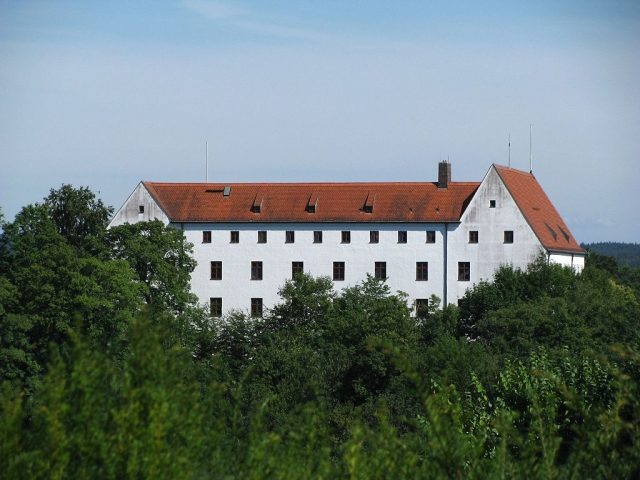
Starnberg Castle originated in the early modern period through the conversion of the high medieval castle complex of Starnberg (Starnberg district) in Upper Bavaria. The four-winged building with steep gables is prominently situated on an elongated moraine ridge above the town and Lake Starnberg. The complex now serves as an administrative building for the Starnberg tax office. The freely accessible castle garden has been redesigned in Baroque style since 1979.
The founding of the castle is attributed to the Counts of Andechs-Merania and dated to the 11th century. As a defensive structure, however, the castle is certainly older due to its strategic location. Starnberg Castle is first mentioned in a document in 1244 as "Starnberch Castrum". The high medieval fortress may have been built as a counter-castle to the nearby Karlsburg of the Wittelsbachs, which has survived as a castle mound a few kilometers north above the Mühltal near Leutstetten.
The Counts of Andechs garrisoned Starnberg Castle with burgmannen and ministerials. As early as 1208, a Wernher Miles de Starnberk appears in a document.
After the death of the last Andechser (1248), the Wittelsbachs took over the castle. It is not known whether the Dukes of Bavaria took the servants of the Andechs counts into their retinue or replaced them with their own loyal servants. The Dukes then integrated the lordship of Starnberg into their administrative and judicial organization. Initially, Starnberg was assigned to the court of Pähl or Weilheim. In 1346, independent judges for Starnberg first appear in the sources. Heinrich der Küchenmeister is documented as the first administrator (Pfleger) of the Starnberg court in 1365.
The later Duke Ernst bequeathed the castle to his future wife Elisabeth Visconti as a morning gift in 1395. The princess had brought a dowry of 75,000 guilders from Milan to her husband.
In 1541, under Duke Wilhelm IV, the medieval castle was demolished and a new residential and defensive building in Renaissance style was constructed. Under Duke Albrecht IV, the conversion into a pleasure palace and summer residence began. In 1643, the Swedes stormed the castle and partially destroyed it. Under Elector Ferdinand Maria, the castle was an important summer residence; from 1663 onwards, the magnificent ship Bucentaurus, built by Santurini after the Venetian model, also sailed on Lake Starnberg.
In 1734, a large part of the now Baroque castle was destroyed by fire, and the remaining buildings slowly fell into disrepair. From 1803, the castle was used as an administrative building for the Rentamt (revenue office) and the Forstamt (forestry office). From 1969 to 1972, the castle was completely gutted and rebuilt. In 2001, the historic columned hall was converted into the new service center of the tax office.
Take Mobile History with you
You are reading this text for free. Premium adds what matters on the road: descriptions read aloud, sites found through your camera, whole regions taken offline.
- Every description, including the ~17,700 Premium sites
- Audio guide: have descriptions read to you on location
- AR finder: see sites through your camera, with distance and bearing
- Unlimited saved sites
14 days free, then from €2.99 a month. Cancel anytime.
Source: Wikipedia · Licence: CC BY-SA 4.0
This description draws on the facts documented in the linked Wikipedia article; Wikipedia content is licensed under CC BY-SA 4.0. Wording and editing: Mobile History.
Location: 47.9992, 11.3397