To be privately owned
CastleSt. Martin-Diesseits
St. Martin Castle
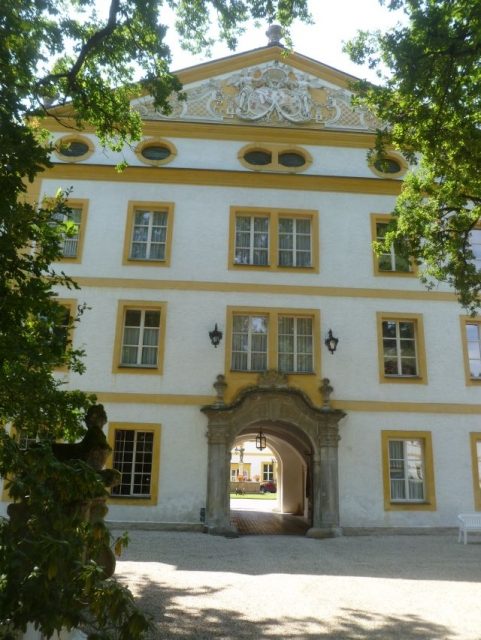
Sankt Martin Castle in Innkreis, also known as Arco-Zinneberg Castle, is located in the Diesseits district of the municipality of Sankt Martin, Ried im Innkreis district, Upper Austria. The current Baroque castle is the fifth castle or palace built on this site. The castle was also known as Altschwendt.
The first documented mention dates back to 1150, when the estate was owned by the Schwenter (Schwendter) family. The last of this family was Hans der Schwenter († 1417). In 1430, Ortolf von Trennbach acquired the estate, which was then still built of wood and surrounded by a pond. The later Passau bishop Urban von Trennbach († 1598) was born here from the Trennbacher family and also spent his youth here. In 1584, the Trennbach family died out, and Bishop Urban first entrusted Christoph Pienzauer with the administration of the property (until 1606).
Through the second marriage of Maria Stocker, née von Trennbach (married in her first marriage to Hans Stocker von Utzenaich), to Veit von Tattenbach (Tattenbeck) von Hausbach (1575), the property passed to the latter family. In 1584, Veit von Tattenbach bought Einburg Castle, the Hofmark Raab, and in 1588 he had acquired the already dilapidated Murau noble seat. He and his son were shipwrecked and drowned in 1593 on a pilgrimage to the Holy Land. After compensation of the Trennbacher heirs, the castle passed to the Tattenbach-Rheinstein family. The owner became Hans Ardolf (Johann Adolf) von Tattenbach-Rheinstein († 1647). He was a hated lord by his subjects. During the Upper Austrian Peasant Uprising in 1626, his "servants" set fire to the castle. After a reconstruction, it was again consumed by flames in the same year. The old castle was no longer rebuilt, but the next construction was a stone building and brought with it a significant enlargement. Johann Adolf, however, was very economically successful; he acquired Zell an der Pram Castle in 1617, the dominion of Obereitzing in 1638, and Sigharting Castle in 1639.
Johann Adolf was succeeded by his nephew Count Gottfried Wilhelm von Tattenbach-Rheinstein († 1687), who, unlike his predecessor, was very popular with his subjects. He was married to Maria Barbara, Countess of Kurtz and Valley († 1703). The Tattenbachs had been elevated to the rank of Baron in 1620 and to Imperial Count in 1637. The next heir was Ferdinand Josef Imperial Count von Tattenbach. He was shot dead on October 3, 1712, in a forest near Hart bei Sankt Peter by hired assassins. The rumor that his own son von Tattenbach had him killed to get the inheritance earlier is not substantiated. The property then passed to Max Franz († 1762). He, too, was able to significantly enlarge the property. In 1723, a fire broke out again in the castle. The reconstruction completed in 1726 led to its present appearance. The Baroque castle chapel dates from 1726 and is dedicated to St. Florian.
Max Franz's only son was Joseph Ferdinand von Tattenbach († 1802). Since he remained childless despite two marriages, the property passed to Heinrich Christian Joseph Ignaz from the so-called Wolf line of the Tattenbachs. He also died heirless († 1821), but bequeathed his property to his cousin Count Maximilian von Arco-Valley († 1875). Twelve children were born from his marriage to the Italian Countess Anna Mareschaldi. Noteworthy is the marriage in 1865 of Countess Maria Arco-Valley to Sir Acton, a member of the English House of Commons, in the castle chapel of St. Martin. After the end of World War II, the Spanish Riding School was housed here. Further owners were Maximilian Count von Arco-Valley and Ferdinand Count Arco-Valley († 1968). He was succeeded by Ulrich Philipp von Arco-Zinneberg, an adopted son of the previous owner living in Bavaria. In 1970, an interior restoration of the rooms and several oil paintings in the castle took place. In 1971, Gordon Getty, son of the "oil tycoon" Jean Paul Getty, rented the castle.
Sankt Martin Castle today+
The castle stands in the middle of a very well-maintained park, which is surrounded on three sides by a wall and is not publicly accessible. The enclosure on the fourth side consists of the Antiesen river. To the right of the castle entrance is an equally well-maintained farm building, behind which are a riding stable and the rider's tavern. The pond that formerly surrounded the castle was drained in 1854.
The castle itself is a mighty square building with a smooth facade. The three floors are structured by ocher-colored string courses, and the corners are emphasized by plaster quoins in the same color. The color is also used for the window frames. When Aurolzmünster Castle was sold by the Arco-Valley family, the furnishings of that castle were moved to the ancestral castle of Sankt Martin; in some cases, built-in columns and balconies were also taken along.
One enters the castle courtyard through a simple gate. Here one finds a sculpture fountain with a mandolin-playing youth in the middle of a garden. The rooms on the first floor are richly decorated with stucco; the fields are colorfully designed with allegorical representations.
Take Mobile History with you
You are reading this text for free. Premium adds what matters on the road: descriptions read aloud, sites found through your camera, whole regions taken offline.
- Every description, including the ~17,700 Premium sites
- Audio guide: have descriptions read to you on location
- AR finder: see sites through your camera, with distance and bearing
- Unlimited saved sites
14 days free, then from €2.99 a month. Cancel anytime.
Source: Wikipedia · Licence: CC BY-SA 4.0 · Image: http://commons.wikimedia.org/wiki/File:St._Martin_im_Innkreis_%28Schloss%29.jpg
This description draws on the facts documented in the linked Wikipedia article; Wikipedia content is licensed under CC BY-SA 4.0. Wording and editing: Mobile History.
Location: 48.2953, 13.4382